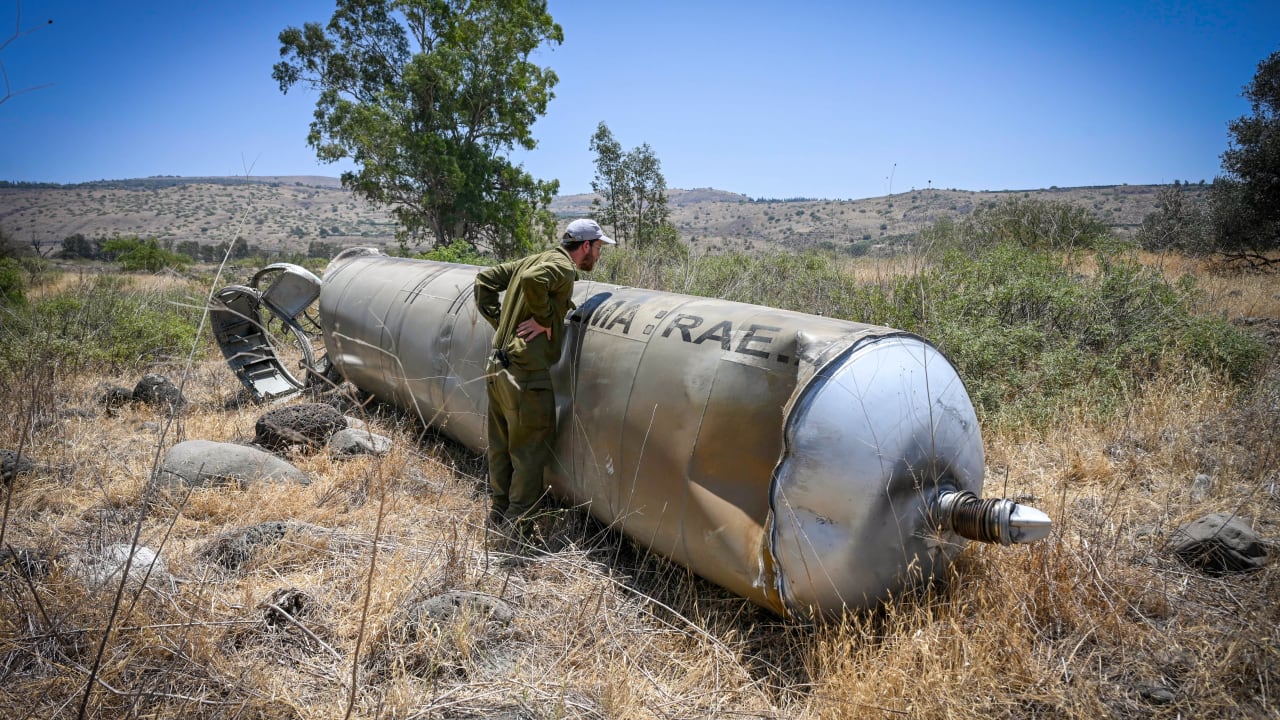
Technicians from the Israel Defense Forces (IDF) say they recovered dozens of unexploded canisters on Thursday after one of the missiles Iran fired toward central Israel carried a cluster bomb warhead, and have opened an inquiry into whether Tehran’s arsenal might also include true MIRV (multiple independently-targetable reentry vehicle) capability.
Cluster bombs vs. MIRVs
A cluster bomb is a containered warhead that, upon reaching its target area, opens in mid-air and scatters dozens or hundreds of smaller explosives, known as “bomblets,” over a wide zone. Those bomblets are unguided and designed to increase the chance of hitting troops, vehicles or soft targets across an area roughly the size of several football fields.
By contrast, a MIRV-equipped missile carries several precision warheads, each with its own guidance system. After the missile’s main rockets burn out, an onboard “bus” maneuvers in space, releasing each reentry vehicle on a separate trajectory aimed at distinct targets. In effect, one missile becomes multiple cross-country threats.
Why MIRVs change the game
MIRVs first appeared on US Minuteman III intercontinental ballistic missiles in the early 1970s and were quickly adopted by the Soviet Union. They revolutionized nuclear strategy by forcing defenders to launch an interceptor for each incoming warhead, making missile defense both costly and technically daunting. A single MIRVed missile carrying, say, five warheads compels an adversary to fire five interceptors or risk one warhead slipping through.
Who actually fields MIRVs?
Today, confirmed MIRV systems remain in the hands of the world’s most advanced nuclear powers:
- United States, Russia, China, France and the United Kingdom all deploy MIRVs on land- or submarine-based strategic missiles.
- India has tested a multi-warhead configuration on its Agni-V and is moving toward deployment.
- Pakistan and North Korea claim MIRV tests, but independent analysts say the evidence for true independently-targetable warheads is inconclusive.
No other states are known to field operational MIRVs, making the technology a hallmark of a mature nuclear deterrent.
Iran’s MIRV-related claims
Iran has periodically touted MIRV capability for some of its medium-range missiles. The two most cited examples are:
Khorramshahr-4 “Kheibar”: A liquid-fueled missile with a 2,000-kilometer range and a payload capacity up to 1,500 kilograms. Iranian state media have claimed it can strike “up to 80 targets” by dispensing multiple warheads.
Fajr-3: An earlier project that Iran’s leaders said could hit several targets simultaneously, though details remain scarce.
To date, however, no public footage or flight-test data shows an Iranian missile releasing more than one reentry vehicle. US and Israeli intelligence assessments report no evidence of an operational Iranian MIRV system. Many defense experts believe Iran’s descriptions refer instead to cluster-munition effects or simple submunition dispensers rather than true independently guided warheads.