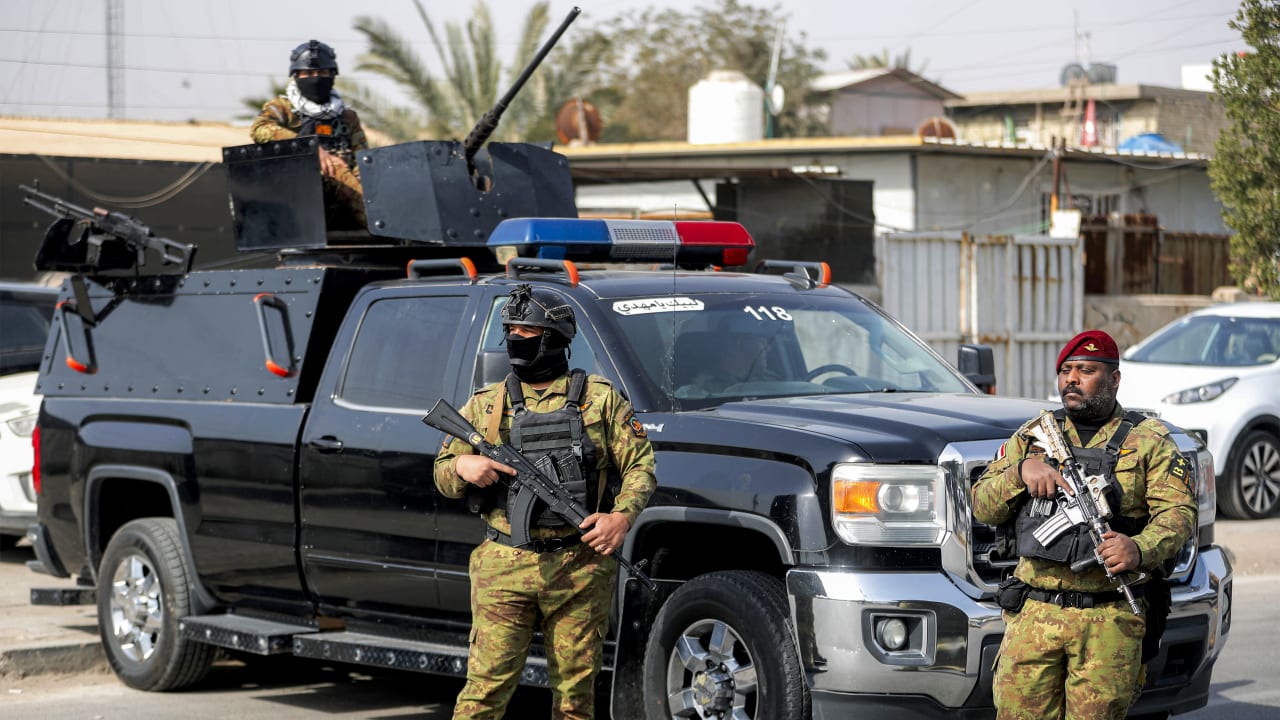
Iraq suffered its worst night of the Iran conflict on Monday evening. Iran has made Iraq a frontline of its war since the US and Israel began strikes on Iran on February 28.
It initially began operationalizing militias in Iraq to attack Kurdish opposition groups in the Kurdistan region and also to target US forces and facilities.
Now the militias and Iran have escalated, attacking a key hotel in Baghdad and carrying out dozens of attacks across Iraq.
The Iranian-backed militias in Iraq have become increasingly powerful over the last decade. They used the war on ISIS to gain legitimacy in Iraq as part of the state-backed paramilitary force known as the Popular Mobilization Forces (PMF), and they operate there in a similar way to Hezbollah in Lebanon. However, the militias in Iraq enjoy more state backing, more similar to the Islamic Revolutionary Guard Corps in Iran.
Several Iranian-backed militias in Iraq have been sanctioned by the US Department of the Treasury and other US authorities due to their links to Iran’s IRGC and its external operations arm, the Quds Force.

Iran proxies turn Iraq into key battleground
Among the most prominent sanctioned groups are Kataib Hezbollah, Harakat Hezbollah al-Nujaba, Asaib Ahl al-Haq, and Kataib Sayyid al-Shuhada. These militias have been involved in attacking US forces in Iraq, targeting diplomatic facilities, and supporting Iran’s regional proxy network.
Other factions tied to the same ecosystem include Harakat Ansar Allah al-Awfiya, Kataib al-Imam Ali, and groups such as Ashab al-Kahf.
US sanctions have targeted the organizations and individual leaders, citing involvement in attacks on coalition forces, human rights abuses, and destabilizing activities in Iraq and Syria.
The designations are part of a broader effort by Washington to counter Iran’s influence in Iraq while pressuring militias that operate both inside and outside Iraqi state structures.
The militias have also been hit with increasingly intense airstrikes over the last few weeks, which began alongside the US and Israeli war with Iran. The militias accuse the US and Israel of the strikes, but it is not clear who is carrying out the attacks.
The initial strikes targeted a key base of Kataib Hezbollah near Baghdad, called Jurf al-Sakhr, as well as PMF units in the Nineveh plains and near Qaim on the Syrian border.
Now the strikes have also escalated alongside the militia escalation and have started targeting militia leaders.
It appears the militias may be prepared to destroy Iraq in order to help Iran survive the war. This is a typical tactic of Iranian-backed groups. In Syria, it was called, by one author, “Assad, or we burn the country.” As such, the militias in Iraq may be entering the ‘Assad or we burn the country’ phase of the conflict, meaning that they are throwing caution to the winds and increasing their attacks.
For instance, Rudaw, a Kurdish media network, noted that “Iraq’s Popular Mobilization Forces said on Monday that one of its positions at a checkpoint on the Iraq-Syria border in western Anbar province was hit by an Israeli strike, killing six fighters and injuring four others.”
In another report, Rudaw said that “four people were reportedly killed in a strike on a house in Baghdad’s high-end Jadriya neighborhood, known to be a nerve center for Iraqi armed groups aligned with the Iran-led ‘Axis of Resistance,’ with two of those killed believed to be Iranian advisors.”
Iraq’s Prime Minister Mohammed Shia’ al-Sudani claimed on Tuesday that he would order an investigation into “terrorist attacks” targeting the United States embassy. In the past he has not reined in the militias.
Kataib Hezbollah said on Monday that its spokesperson, Abu Ali al-Askari, was killed in a strike.
In the Kurdistan Region, the local authorities believe more than 300 attacks have been carried out by the militias. This may be an undercount, as the real number now seems to be higher, and in all of Iraq it is probably closer to 500.