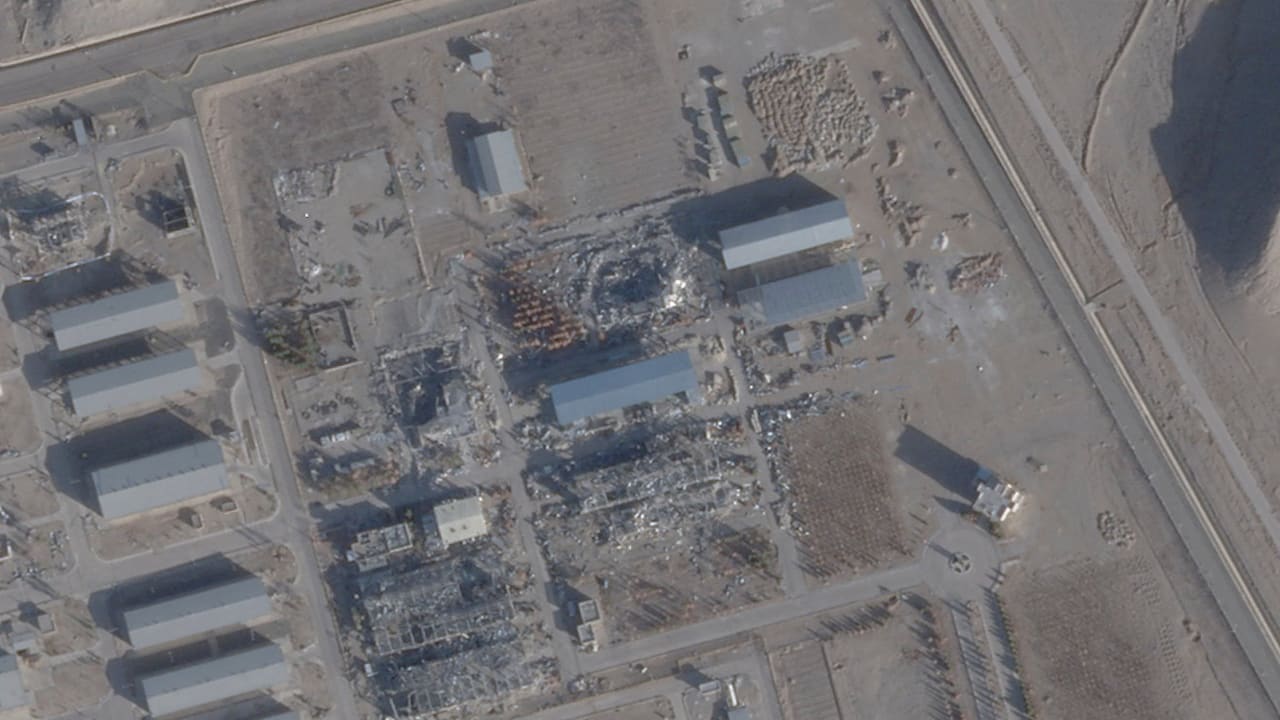
Iran seems to have repaired some ballistic missile facilities damaged in strikes last year, according to satellite images, with only limited fixes to major nuclear sites, The New York Times reported on Friday.
The regime’s reconstruction provides insight into Iran’s priorities as talks of diplomatic appeasement conclude in Oman for the time being.
According to the report, if the US were to attack, Iran would likely retaliate with ballistic missiles towards Israel and US assets in the Middle East.
The Times reported construction work at more than half of the two dozen locations struck by the US or Israel during the 12-day war in June of last year. The analysis was corroborated by experts who closely track Iranian nuclear and missile programs,” said the report.
Some repairs occurred soon after the strikes, suggesting that the regime is making missile production a short-term priority, with Iran picking up the pace to recover from the June attacks over the last few months.

According to The Times, Western and Israeli officials have found few signs that Iran is making significant progress towards enriching nuclear fuel and building a nuclear warhead.
Iran is in a weakened position
In recent high-stakes negotiations between the US and Iran in Oman, Iran rejected US calls to halt uranium enrichment. It said, however, that it was willing to discuss the “level and purity” of enrichment or a regional consortium, according to a regional diplomat briefed by Tehran.
Iran arrived to the table in a weakened position, with protests earlier this year having posed the greatest challenge the remine has seen in its half-century of power, leaving its economy weakened and its currency at an all-time low.
Iran’s leaders showed little readiness to compromise on the core issue of uranium enrichment, threatening to trigger another war in the event of a US attack, according to the Wall Street Journal. However, both sides showed willingness to continue working towards a diplomatic solution.
Initial reports in June following US strikes on Iran claimed that airstrikes in Fordow, Natanz, and Isfahan did not destroy core components of Iran’s nuclear program, and that they had only set back Iran’s nuclear program by a few months.
Experts say that these three main facilities remain inoperative, despite some visible work, according to The Times’s report.
US attacks were a ‘successful mission’
The White House denied the assessment, with White House Press Secretary Caroline Leavitt saying it was “flat-out wrong” and US Defense Secretary Pete Hegseth claiming that “our massive bombs hit exactly the right spot at each target and worked perfectly.”
“Anyone who says the bombs were not devastating is just trying to undermine the president and the successful mission,” he stated.
Additionally, the White House’s National Security Strategy published in November last year claimed that the strikes had “significantly degraded Iran’s nuclear program.”
Iran has erected roofs at two of the facilities, according to the report, which could indicate that the regime is trying to recover assets without being observed from above.
Natanz, identified by the Institute for Science and International Security (ISIS) as the pilot fuel enrichment plant, has been covered with a white roofing structure, according to satellite images.
The institute is a nonprofit organization that aims to inform the public science and policy issues affecting interntional security, according to its website.
Less than a mile from Isfahan, barriers have been installed at one of the entrances to a nearby complex, indicating the possibility of a secret enrichment facility. At a new underground site close to Natanz, tunnel entrances have also been reinforced.
The report shows another important development at the Parchin military complex, where “Iran has tested high explosives that can be used as triggers for nuclear warheads.”
Images show a 150-foot-long chamber that has been recently built at the factory. The site was not attacked in June, according to The Times, but was targeted by Israel in 2024. It has since been fortified with anti-aircraft artillery, according to the ISIS.
The organization stated that “although the new facility’s intended purpose could not be determined from the imagery, the new construction indicates its strategic significance.”