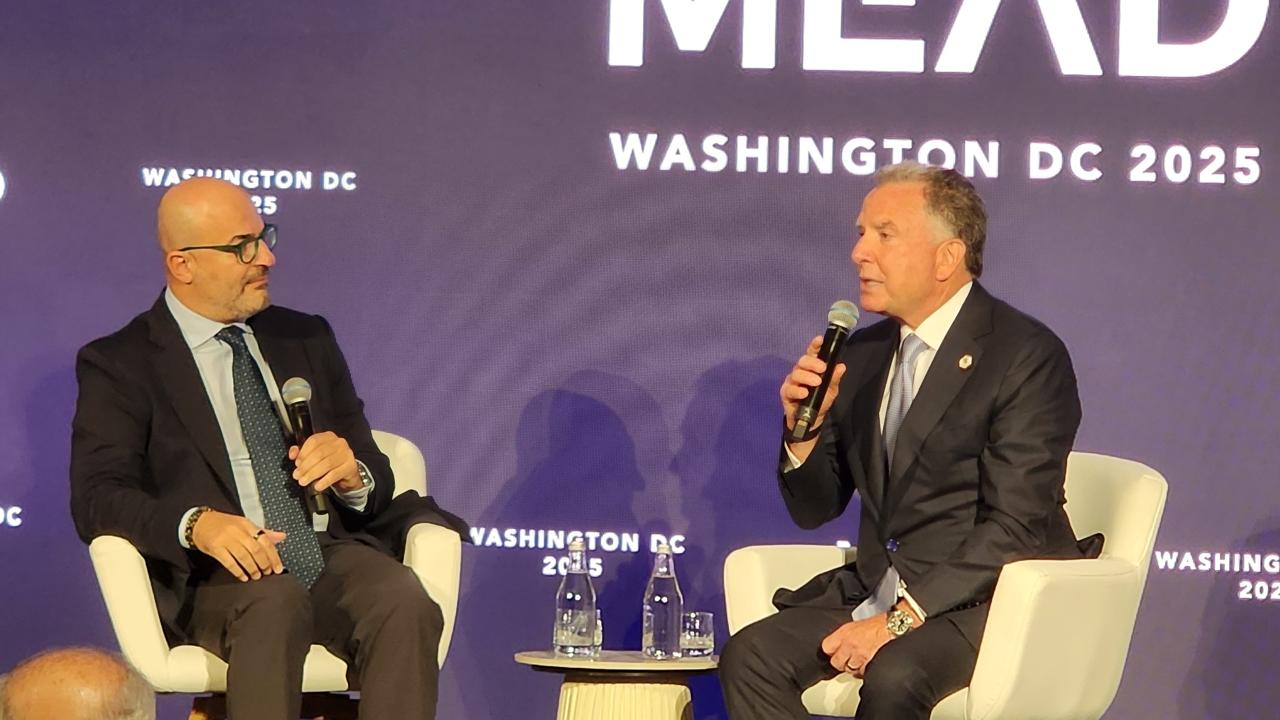
"Every single person who's still alive in the Iranian regime right now is alive for a purpose and by choice."
That was how Emirati senior journalist and TV commentator Nadim Koteich framed the moment, speaking as the region absorbed the full weight of the US-Israel strike on Iran and Tehran's response across the Middle East.
Midway through the interview, an emergency alert sounded in the UAE warning of a missile threat. There was a brief pause, then the conversation resumed. The interruption only deepened the atmosphere surrounding his central claim: in Tehran, survival has become part of the message.
Koteich's view held consistent across topics—from the Gulf to Lebanon to Washington. Iran's behavior, he argued, is widening the circle of targets while rapidly compressing the space for states that have tried to stay out of the fight.
"Hezbollah wants to interfere, but they cannot," he said. "They are simply a defeated militia."

'Try not to poke Iran in the eye'
Koteich opened by describing how much of the region has approached Iran for years.
"We downplayed attacks," he said. "We pushed the media to take a more or less harsh take on Iran for years… it fluctuates, goes up and down, but the majority of the approach is try not to, you know, poke Iran in the eye, because we know that it can hurt, and we don't want to be hurt."
He argued that posture has shaped policy, media tone, and regional instincts — especially among Gulf states that built their prosperity around stability and predictability.
Then he turned to what he sees as the fundamental problem with that approach right now: Iran's recent targeting choices, he argued, have stripped caution of its value.
'What did Kuwait do?' 'Why would you hit Oman?'
Koteich acknowledged that Tehran frames some attacks as punishment for normalization with Israel and the Abraham Accords — the 2020 agreements that formalized ties between Israel and several Arab states, including the UAE and Bahrain.
"Forget about Abu Dhabi and Bahrain," he said. "From an Iranian perspective, they deserve what's happening, given their normalization with the Israelis and the Abrahamic accords… I will buy that argument, for the sake of argument."
Then he widened the frame. "But I mean, they hit Oman today… basically the mediator," he said, referring to the country he described as carrying water for Iran. "It was the defense attorney… less than 10 hours before the attack… and less than 24 hours later, they attack it."
From there, he moved swiftly through what he sees as the larger message. "So what did Kuwait do? Right? What did Cyprus?" he asked. "They tried to hit Cyprus." Koteich also pointed to Oman, long associated with quiet regional diplomacy. "What about Oman? Why would you hit Oman? Why would you hit Cyprus?"
His conclusion was direct: Iran's actions are collapsing the category of the "uninvolved." Countries that spent years trying to stay out of the story are being pulled into it regardless.
'Europe is sleepwalking'
Koteich connected that widening targeting pattern to Europe's posture toward Iran. "This vindicates what Trump is saying, that Europe is sleepwalking into… an appeasement with Khamenei," he said, arguing that European leaders are dangerously underestimating Iran's capability and willingness to strike targets well beyond Israel and the Gulf.
He also referenced a past Hezbollah warning aimed at Cyprus—citing former Hezbollah leader Hassan Nasrallah—as evidence that threats travel.
On Lebanon, Koteich firmly rejected the notion that Hezbollah's limited involvement reflects restraint born of political pressure or strategic calculation.
"Hezbollah wants to interfere, but they cannot," he said. "They are simply a defeated militia."
He returned to the point repeatedly, sharpening it each time.
"They are… a hollow militia, a shadow of themselves," he said. "They simply cannot… do anything to the Israelis."
Koteich also cautioned against narratives that dress up Hezbollah's paralysis as a deliberate choice made in Lebanon's national interest.
"It's not because of their wisdom… it's not because of their nationalism… it's not because of the pressure applied on them," he said. "They simply cannot."
His broader point: Lebanon's weak institutions create space for Hezbollah to present immobility as strategy, precisely because the Lebanese state is not setting the pace.
'We built a whole architecture around the fact that this is what the regime is'
Koteich framed the Gulf response through the lens of preparation, air defenses, and alliance structures. "It's a massive attack," he said. "If you look at the numbers, we got almost the same number of missiles as the Israelis."
For him, those numbers speak directly to the nature of the regime. "This tells you… what is the real nature of this regime," he said.
He argued that the UAE in particular built its entire strategic posture around that assumption. "We're coping because, I mean, we've built a whole architecture around the fact that this is what the regime in Iran is," he said.
He pointed to deep military integration with the United States — basing, weapons systems, and operational coordination. "This tells you why Abu Dhabi was… advancing its… military integration with… American military architecture," he said, citing "bases" and "weapons."
Koteich also emphasized trust as an operational factor. "These deployments are very sensitive," he said. "You don't do these things unless you have allies that you trust." He added that ties with Israel are a core pillar of that trust.
"One of the trust pillars… is the relationship with… Israel," he said.
'Dubai is the antithesis of what Iran represents'
Koteich framed the conflict as a clash between competing regional models, and he returned to Dubai repeatedly as the symbol of everything Iran wants to punish.
"It's not a coincidence that Iran is attacking Dubai, because Dubai is the antithesis of what Iran represents," he said. "Dubai… is the other Middle East."
He described Dubai as "the future Middle East" and Iran as "the old Middle East," then argued that Tehran is trying to sabotage the model it fears most.
"Iran is trying to punish the Middle East that is emerging in the region," he said. "The moment of killing Khamenei is one Middle East being over the other, period."
'Khamenei is… the equilibrium point'
Koteich called the current moment the most severe test the Islamic Republic has faced in decades. "This is the most existential test the regime goes through since Khamenei took power," he said.
He described Supreme Leader Ali Khamenei as the system's central stabilizer. "He is… the equilibrium point in terms of the multi factions of the regime," Koteich said. "The entire Iranian tent, the fabric of the state is hitting the ground now."
He reached for a striking phrase to capture Khamenei's role inside the system. "He is what they call the 10th pope," he said. Then he delivered his own verdict. "The regime, as we know it, ended yesterday," he said.
'They have a way out," and "every missile has an address'
Koteich argued that the leadership figures still standing are still standing for a reason — and he framed their survival as entirely intentional.
"They have a way out," he said. Then he returned to the line he believes captures the moment.
"Every single person who's still alive in the Iranian regime right now is alive for a purpose, and by choice," he said. In his view, key figures remain alive because an orderly transition is still being kept on the table.
"The reason that these people are alive is that no one wants the region to fall into chaos," he said. "We want someone to… rise up to the moment, take the country forward." He warned that the window closes quickly if the regime continues what he called "bravado."
"If they are going to stick to… bravado and rhetoric," he said, "another wave of assassinations will happen, and the regime will fall." He also raised a second scenario: a hard shift from clerical rule toward overt military control.
"The regime will witness some sort of IRGC… coup," he said, "and it will become like… a military junta. My sources are telling me that every missile has an address" — a line he used to suggest targeted pressure on individuals, not just facilities.
'It will affect their day to day life'
Koteich also addressed the American debate about why any of this should matter to Washington. "It will affect their day to day life," he said. He framed the moment as a long-overdue strategic correction of the 2003 Iraq war.
"This is the first real correction of 2003," he said. "Back then, they toppled the wrong regime." He cited allegations of Iranian plots and networks as part of his case, including claims about threats against Donald Trump and past allegations involving an attempted attack on the Saudi ambassador in Washington.
He also argued that Iranian society must be clearly separated from the Iranian regime. "This is one of the largest Muslim countries where the people are pro-American and the regime is anti-American," he said. "You are winning 90 million Muslims on your side."
Koteich kept returning to his central point: the Iranian power structure is being sorted in real time, and survival itself is now part of the signal. "Every single person who's still alive… is alive for a purpose and by choice," he concluded.