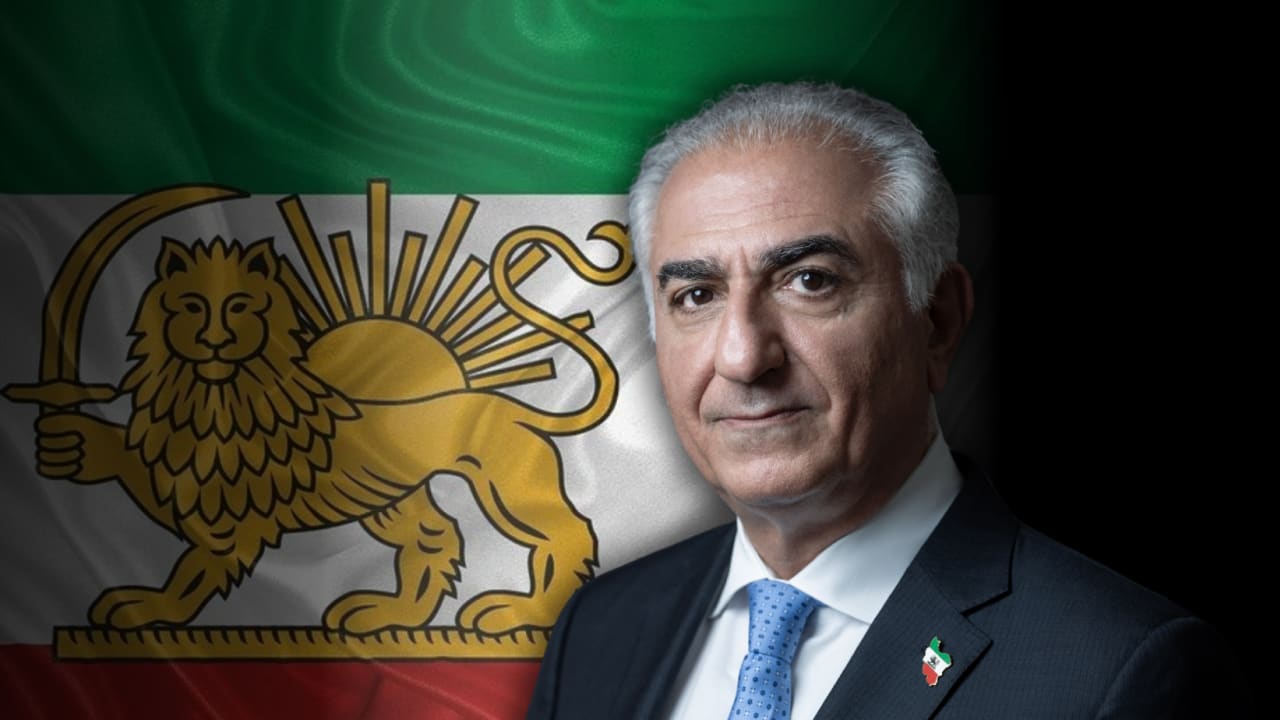
As protests erupted in December against the mullahs who rule Iran, and as the US and Israel continue to strike at the regime's infrastructure with the stated goal of engineering the fall of the state, the end of the Islamic Republic could be near.
For exiled Crown Prince Reza Pahlavi and the network of experts working with him, answering the question of what could replace the regime has become central to the opposition’s strategy. Inspired by the prince’s vision, and directed by Saeed Ghasseminejad at the National Union for Democracy in Iran (NUFDI), have sought to address the void in post-regime plans through the Iran Prosperity Project.
Through the project, Pahlavi and allied experts have developed a detailed “Emergency Phase” plan that proposes a structured path for governing Iran immediately after the fall of the Islamic Republic.
A transitional state
Under the plan, the immediate aftermath of the Islamic Republic’s fall would be governed by a transitional system, as the authors describe it.
This structure would operate under the authority of Pahlavi in his role as the “Leader of the National Uprising.” Its purpose would not be to permanently determine Iran’s future political structure, but to stabilize the country for several months until democratic institutions are elected.

The transitional state would consist of three central institutions.
The first would be the transitional Mehestan, a temporary legislative body that would act as a parliament during the transition. The second would be a transitional government, which would serve as the executive branch responsible for the day-to-day administration of the country.
The third pillar would be the transitional Divan, which would function as a transitional judiciary tasked with overseeing legal continuity and administering justice during the transition period.
Together, these institutions would maintain public order, manage state institutions, and ensure Iran’s territorial integrity during the transition period.
Notably, the proposal deliberately avoids deciding in advance whether Iran should become a monarchy again or a republic.
Instead, that decision would be made directly by the Iranian people in a referendum to be held four months into the project.
The political transition
The road map outlined in the plan sets out a strict sequence designed to produce a legitimate constitutional order within roughly 18 to 24 months.
Once the Islamic Republic collapses, the first political step would be a national referendum in which Iranians would determine the form of government. Voters would most likely be asked to choose between a parliamentary monarchy and a republic. Pahlavi has broad support across the Iranian diaspora – over 1 million Iranians turned out globally for his “Global Day of Action” on February 14, and within Iran, it is his name that has been chanted at protests and from rooftops across the country.
However, detractors have said that his support is overstated, so it would be interesting to see the results of a free and open vote in Iran.
Pahlavi himself has stated that he should be seen as a “bridge, rather than the destination” for such a political transition.
Within six months of that vote, elections would be held for a constituent assembly, whose members would be tasked with drafting a new constitution.
After the drafting process is completed, the proposed constitution would be put to a nationwide referendum. If the constitution is approved, Iran would then proceed to hold elections for a permanent parliament, known as the Mehestan, and presidential elections if the country adopts a republican system.
The transition would end with the inauguration of a fully elected government, at which point the temporary transitional institutions would dissolve.
The emphasis on the transition is deliberate and well thought out. Many revolutions collapse into instability because political structures are improvised under pressure or in circumstances of chaos, and the authors of the plan argue that a pre-planned road map reduces the risk of power vacuums.
Dismantling the Islamic Republic
The transition framework also proposes sweeping institutional changes aimed at dismantling the Islamic Republic’s ideological structure.
According to the proposal, the office of the supreme leader would be abolished immediately following the regime’s fall, along with the Assembly of Experts, the Guardian Council, and the Expediency Discernment Council. These institutions form the core of the Islamic Republic’s theocratic governance system, and their dissolution is intended to remove the religious authority embedded within the state.
The plan also calls for the dissolution of the Islamic Revolutionary Guard Corps. Its armed components would be integrated into a unified national military structure while its economic and political networks would be dismantled.
Other institutions associated with ideological enforcement would also disappear. These include the morality police and the religious revolutionary courts that have operated alongside Iran’s normal judiciary.
The intention is to remove the parallel power structures that have existed throughout the Islamic Republic while preserving enough of the administrative state to prevent the collapse of governance.
Transitional justice
A central element of the proposal is a transitional justice program designed to address crimes committed under the regime of the Islamic Republic.
The framework envisions the creation of a transitional justice court to prosecute the most serious crimes committed by regime officials, particularly human rights abuses and major acts of corruption.
Alongside the court system, a truth commission would be established to investigate abuses, collect testimony from victims, and document the history of the Islamic Republic’s repression.
Individuals involved in lower-level offenses could be eligible for conditional amnesty if they cooperate with investigators and provide information about the regime’s activities.
This approach attempts to balance accountability with national reconciliation.
The architects of the plan argue that mass reprisals could destabilize the country, while blanket amnesty would undermine justice.
Avoiding legal chaos
One of the more unusual features of the plan concerns how Iranian law would function immediately after the regime collapses.
Rather than abolishing every law enacted under the Islamic Republic, the blueprint proposes what it calls a hybrid legal approach.
Under this framework, existing laws would remain temporarily in force unless they directly conflict with Iran’s national identity, the Universal Declaration of Human Rights, or the functioning of the transitional state. Laws that clearly violate those principles, such as discriminatory religious statutes or certain ideological restrictions, would be repealed immediately.
All remaining laws would stay in place until they can be reviewed and reformed by a future elected parliament.
The reasoning behind this approach is pragmatic. Eliminating all legislation overnight could paralyze courts and create widespread legal uncertainty regarding legally binding contracts, etc.
Stabilizing the economy
The first six months after the regime’s collapse are expected to be the most volatile.
For that reason, the blueprint places heavy emphasis on what it calls the “Emergency Phase,” which focuses on stabilizing the country’s economy and maintaining essential services.
The transitional authorities would prioritize ensuring that government salaries and pensions continue to be paid, that energy and food supply chains remain intact, and that Iran’s banking system does not collapse under the pressure of sudden political change.
The plan also calls for efforts to access frozen Iranian assets abroad and stabilize the national currency.
The goal is to prevent the type of economic collapse that has followed revolutions in other states. Iran’s economy has been in free fall for months, with the exchange rate between the rial and the dollar reaching such low levels in December that the mercantile bazaar class protested.
A foreign policy reset
The plan also proposes a dramatic shift in Iran’s international relations. The transitional government would seek to normalize relations with the United States and the European Union, end support for terror proxy groups across the region, such as Hezbollah and Yemen’s Houthis, and allow unrestricted inspections of Iran’s nuclear facilities.
The framework also suggests that a future democratic Iran would formally recognize Israel as part of a broader regional stability arrangement.
According to the document’s authors, reintegrating Iran into the global economy would be essential for rebuilding the country after decades of sanctions and isolation.
Whether this blueprint will ever be implemented remains uncertain. The Islamic Republic has survived repeated crises over the past four decades, and its security apparatus remains formidable. But with the regime under unprecedented pressure, the prospect of its collapse is perhaps closer than realized.
For years, critics of regime change asked what would replace the Islamic Republic. Pahlavi and his allies believe they now have an answer.