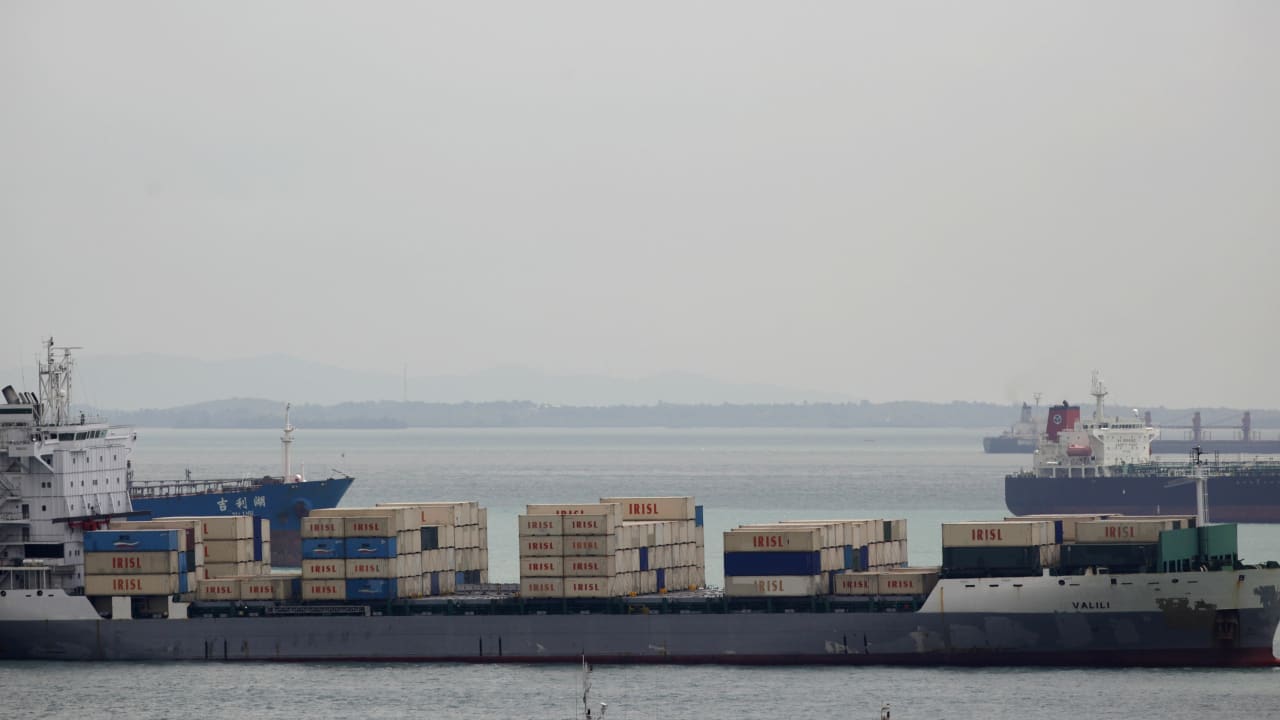
Two Iranian ships departed a Chinese chemical storage port this week, heading for Iran, according to a Washington Post analysis of ship-tracking data, satellite imagery, and Treasury Department records published on Sunday.
The ships, the Shabdis and the Barzin, are owned by the Islamic Republic of Iran Shipping Lines, a state-owned company which has been sanctioned by the US, the UK, and the European Union, and described by the US State Department as the “preferred shipping line for Iranian proliferators and procurement agents.”
The two vessels were docked at the Gaolan port in the southeastern Chinese coastal town of Zuhai. According to the Washington Post, experts said Goalan is a loading port for chemicals, including sodium perchlorate, a key precursor for solid rocket fuel Iran needs for its missile program.
The Barzin is also a known sodium perchlorate hauler, the Washington Post cited experts and media reports as saying.
While a dozen other IRISL ships have visited the port since the start of the year, experts emphasized that China's allowing a ship to depart for Iran with weapons-related material during a war in which they have called for restraint would be extremely notable.

Chinese Foreign Minister Wang Yi told reporters on Sunday that China’s position on the war in the Middle East is “objective and impartial.”
“We have stated our principled position on multiple occasions, which can be summarized into one key message: to bring about a ceasefire and end hostilities,” Wang said, adding that China calls for an “immediate stop to military operations.”
Chinese FM: Major countries should play 'constructive role' in Middle East
Wang said that major countries should play a “constructive role” in the region, acting in “the spirit of justice and righteousness, and contribute more positive energy to peace,” promoting the political settlement of issues. He called for all parties to return to the negotiating table.
However, Wang also specified that China believes in noninterference in internal affairs and specified that not only should the national sovereignty, security, and territorial integrity of Iran be respected, but that all regional affairs should be determined by regional countries independently.
Despite the stated support for peace and denunciation of violent hostilities, it appears that the IRISL ships were allowed to leave with what experts say is likely a cargo of sodium perchlorate, according to the Washington Post.
“China could have held these vessels at port, imposed an administrative delay, invented a customs hold, any number of bureaucratic tools, but didn’t,” the Washington Post quoted Isaac Kardon, a senior fellow at the Carnegie Endowment for International peace as saying.
“That’s a deliberate policy choice,” Kardon, who agreed that the ships were likely laden with sodium perchlorate, added.
Former US Treasury official Miad Maleki, who worked on Iran sanctions efforts and is now a senior adviser at the Foundation for Defense of Democracies, also assessed that the vessels carried sodium perchlorate.
“The Gaolan port hosts some of the largest liquid chemical storage terminals in South China,” Maleki told the Washington Post.
The US has also long accused China of providing Iran with missile-related technology and materials. However, sodium perchlorate is not a substance controlled by the Missile Technology Control Regime, and the UN does not specifically name it as banned for export to Iran.
China, therefore, has claimed that the US accusations overstate dual-use and commercial trade.
Sodium perchlorate is used to produce ammonium pperchlorate which is controlled by the MTCR and cannot be sold to Iran.
The US has sanctioned multiple Chinese-based companies accused of transferring sodium perchlorate to Iran, including Shenzhen Amor Logistics, China Chlorate Tech Co., Ltd., and Yanling Chuanxing Chemical Plant General Partnership in April 2025.
In September 2025, the Treasury Department sanctioned a multinational procurement network it claimed had procured and transported hundreds of metric tons of missile propellant ingredients from China since its establishment in 2023.