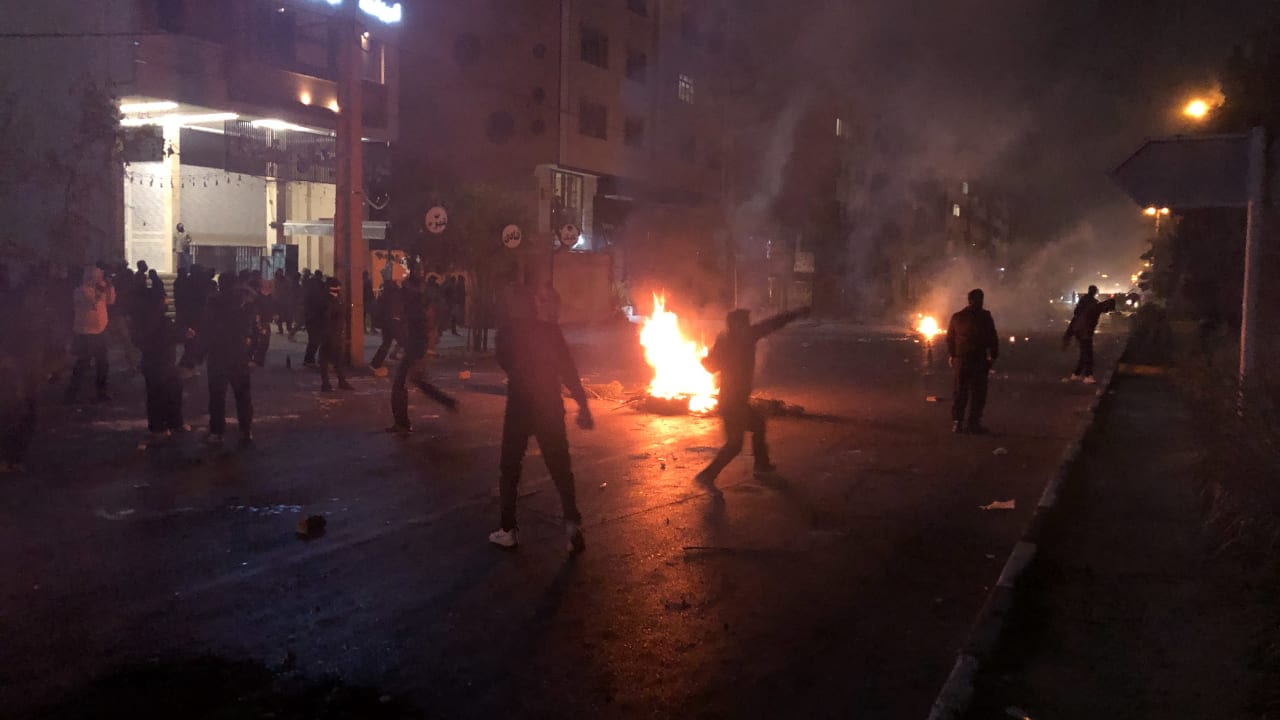
The Islamic regime has continued to crack down on signs of – and opportunities for – dissent, despite an apparent end to the protests seen in earlier months, according to statements by Tehran officials and continued actions and threats from the Islamic Republic.
Data monitoring site NetBlocks reported early on Wednesday that Iran has now experienced Internet connectivity at 1 percent of its normal levels for over 264 hours straight and published: “The regime’s spokesperson has confirmed observations pointing to a whitelisting system, stating that only the approved are given a voice.”
Experts, including UN Special Rapporteur on Iran Mai Sato, condemned the Internet shutdown in January during the UNHRC meeting last month. She said that the regime was using the blackout to restrict information about the atrocities it was committing from being communicated to the West, in addition to preventing the organization of peaceful protests.
Iran also arrested dozens of people, including a foreign national, accused of spying for the country’s “enemies,” the Intelligence Ministry said on Tuesday.
The regime’s apparent fear of returning to the January-style protests, in which security forces murdered and detained thousands of civilians, is apparent as officials warned demonstrators would be viewed as an “enemy.”

'An enemy, not a protester'
Iran’s police chief, Ahmadreza Radan, warned that “anyone taking to the streets at the enemy’s request will be confronted as an enemy, not a protester.”
He added, “And we will do to them what we do to an enemy. We will deal with them in the same way we deal with enemies,” Radan told state television IRIB. “All our forces are also ready, with their hands on the trigger, prepared to defend their revolution.”
Azerbaijani human rights activist Shahin Helali Khyavi told The Jerusalem Post that minorities often bore the brunt of Iran’s police crackdowns.
“Azerbaijani Turks, among the most active civil resisters, have consistently expressed hostility to the administration. This resistance has come at a high cost: activists are regularly arrested, sentenced to lengthy jail terms, tortured, exiled, barred from working, pressured through their families, and even killed,” he explained, estimating that around 4,000 of his community members have been murdered by the regime over the past five years while participating in a number of protests.
While the protests broke out in late December in response to the country’s economic crisis, Tehran quickly labeled the protests “foreign-backed riots,” rejecting narratives of legitimate domestic discontent with the regime.
Despite Radan’s threat, Information Warfare Analyst and Media Literacy Lecturer specializing in OSINT investigations, disinformation analysis, and AI-generated media, Tal Hagin told The Post that he had been unable to verify any footage, suggesting a return to the open calls for regime change seen in January.
Persian-Kurdish investigative journalist Truska Sadeghi told the Post that Radan’s statement represented the regime’s “deep sense of fear” at the destruction of their facilities, which weakens their power.
“The Islamic Republic has always reacted harshly even to the smallest and most peaceful protests. Therefore, statements like this do not change the fundamental nature of the regime. Throughout its history, it has repeatedly attacked protesters, used violence, and killed citizens, and if it has the opportunity, it will continue to do so,” Sadeghi said.
“However, there is one important point: Society has become much stronger and more courageous than before. This growing courage among the people is one of the regime’s deepest problems and a major source of its fear.
She explained: “Repression of dissent, dissatisfaction, or any form of protest has always been a fundamental behavior of the Islamic Republic.”
“However, at the moment, we have not yet seen people able to come out into the streets and protest openly. One of the reasons is that the attacks are still ongoing. While it is true that civilians have also been killed, many people in society have reacted differently to these strikes.”
Sadeghi said that “a significant part of the public sees them [the United States and Israel] as targeting the institutions and centers that enable repression by the regime, and, of course, most of them welcome these attacks.
“In other words, many of the facilities being targeted are viewed by people as parts of the system that has long been used to suppress society,” he explained.
Sadeghi added that many people were still afraid of the regime’s security apparatus, which “acts arbitrarily against civilians,” and prevents people from organizing protests out of fear.
“What has been weakened so far are mainly commanders, buildings, and certain administrative structures,” he continued.
“The regime still retains a large body of security forces and highly committed ideological supporters who are willing to do whatever is necessary to preserve the system and protect themselves… They [the security forces] have weapons, while ordinary people do not. This creates a major imbalance. Many people inside Iran still have the willingness to protest and participate in change.”
Unified support for Tehran?
The regime’s attempts to present an image of unified support for Tehran were also cracked earlier this week when members of the Iranian women’s soccer team fled from their handlers, receiving humanitarian visas to stay in Australia.
The women athletes were branded “traitors” by the country’s hardliners after they refused, on Monday last week, to sing the national anthem.
“They [Islamic regime] slaughtered more than 165 innocent Iranian schoolgirls in a double-tap Tomahawk attack in the city of Minab, and now they want to take our athletes hostage in the name of ‘saving’ them?” Iranian spokesperson Esmaeil Baqaei wrote on X/Twitter after the women were given the visas.
“The audacity and hypocrisy are staggering: ‘To Iran’s Women’s football team: Don’t worry – Iran awaits you with open arms. Come home.’”
Despite claiming that Australia was holding the athletes “hostage,” Barqaei didn’t comment on the fact that one of the players returned to Iran of her own volition. The players had been kept in a secure location after being interviewed separately from their minders with an interpreter and given the opportunity to stay.
“We know this [Islamic] regime has engaged in the brutal treatment of women and girls… which is why the [Australian] government put so much effort into making sure that people did get given the choice [to stay],” Foreign Minister Penny Wong told CNN affiliate 9 on Wednesday.
Noting there has been no shortage of Iranians who have fled the country over the regime’s brutality, Sadeghi shared that the regime pushes the narrative that those who leave “no longer matter.”
Khyavi stressed that even those who escape the country's physical borders are still often suppressed.
“Even after activists leave Iran, their families often experience intimidation and harassment, making security difficult even in exile,” he explained. “As a result, free thinking and expression in opposition to the state exist under constant fear. As in other authoritarian societies, authorities view free expression as a threat and tighten controls on the media, restrict internet access, and limit the flow of information, using these measures as primary tools to suppress opposition.”
Discussing the appointment of Mojtaba Khamenei, which, according to Iran International, led to significant debates within the Assembly of Experts, Sadeghi said there were “tensions and visible cracks within the system.”
The Islamic revolution of 1979 saw the monarchy overthrown, and accusations that the transfer of power from ayatollah Ali Khamenei to his son Mojtaba Khamenei made the position hereditary [contrary even to the late Khamenei’s dogma], led to a number of clerics boycotting the vote, according to the report.