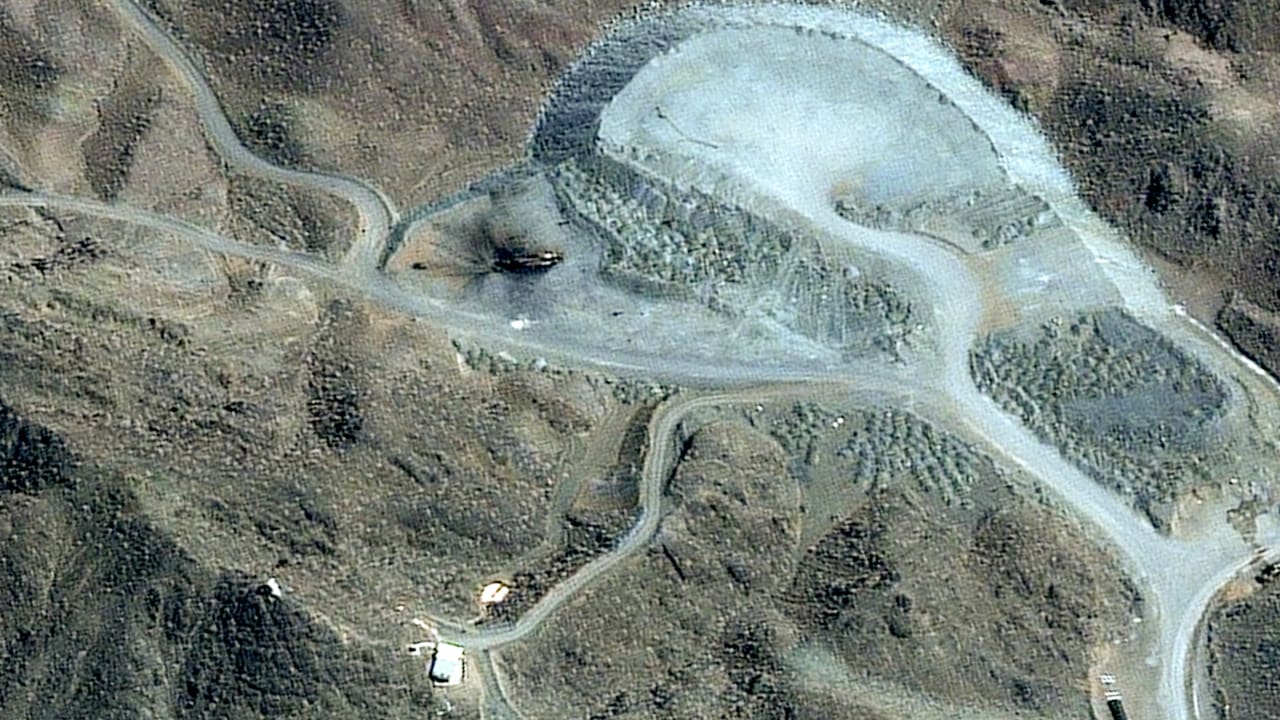
The two largest remaining nuclear threats from the Islamic Republic after the June 2025 war were the 400-plus kilograms of 60% enriched nuclear uranium covered in rubble after IDF attacks on nuclear sites and the Pickaxe Mountain nuclear facility.
As of Sunday, over two weeks into the war, neither Israel nor the US has announced any success in neutralizing these threats.
Further, the IDF declined to provide assurances that these two threats would be dealt with before the end of the war.
Foreign reports have heavily covered the possibility of sending in covert special forces to seize or dilute the enriched uranium, but to date, no announcement has been made about such an operation, though US President Donald Trump may end the war any day, and many other nuclear sites have been attacked.
Pickaxe Mountain is a nuclear facility built under a mountain even deeper than Iran’s infamous Fordow nuclear facility.

In mid-February, high-resolution satellite imagery of Iran’s largest and most crucial remaining nuclear facility showed a recent rush to protect it from potential American or Israeli aerial attack, according to the Institute for Science & International Security.
Satellite imagery from February 10 appears to show that Tehran has taken advantage of delays in any such attack since the December 28 protests started to better defend the facility, which is a large tunnel complex at Kolang-Gaz La Mountain, aka Pickaxe Mountain, a mountain near the series of Natanz nuclear facilities which were the center of the Islamic Republic’s nuclear program until the 12 Day War.
Why Pickaxe Mountain remains untouched
Most of the other numerous Natanz facilities, including existing centrifuges at the time, were destroyed in June 2025, but for reasons which have not been fully explained to date, this facility was not struck.
One possibility is that even US bunker busters – which, in any event, Israel lacks – may be insufficient to penetrate the facility.
Another possibility is that it was not yet fully operational in June 2025, and that the war focused on already operational nuclear facilities.
Construction at the site had begun by 2021, and the Institute for Science & International Security think tank and The Jerusalem Post revealed its existence to the public in early 2022.
According to the think tank, the enormous and relatively new underground facility is believed not to be operational yet, which may be one reason it was not struck previously. However, there are concerns that it could be used to enrich uranium – or even for some kind of clandestine rush toward a small nuclear weapon – at some point, if not dealt with.
Certainly, since June 2025, it has received extra attention and emphasis from Iran, as it is the single most important undamaged facility for potential nuclear program use.
From the start, Iran had been digging and building this new facility near the Natanz area deep under the mountain there, which is far larger than the mountain atop the Fordow facility which the US bombed with bunker busters in June 2025, making it even more impregnable.
The main mountain harboring the new Natanz tunnel complex stands at 1,608 meters above sea level. In comparison, the mountain that harbored the Fordow centrifuge enrichment plant, called Kūh-e Dāgh Ghū’ī, was some 960 meters high.
The think tank said that this makes the Natanz mountain about 650 meters, or well over 50% taller, potentially providing even greater protection to any facility built underneath it.
All this was true, even before June 2025.
In a previous report, the think tank’s president, David Albright, wrote, “Fordow is already viewed as so deeply buried that it would be difficult to destroy via aerial attack. The new Natanz site may be even harder to destroy.”
Additional think-tank reports revealed that there are “ongoing efforts to harden and defensively strengthen two of the tunnel entrances into the facility. Imagery shows ongoing activity throughout the complex related to this effort, involving the movement of numerous vehicles, including dump trucks, cement mixers, and other heavy equipment like backhoes and truck-mounted cranes.”
“As of February 10, concrete is being poured on top of the Western tunnel entrance extension. At one of the Eastern tunnel entrances, rock and soil can be seen pushed back and leveled on top of the tunnel portal. Additionally, over the last month, a concrete-reinforced headworks for the tunnel entrance extension was added. This allows for additional overburden in the form of additional rock, soil, or concrete,” the report said.
It further stated that, “These efforts strengthen the tunnel portals and provide additional protection against an airstrike. Nearby the eastern tunnel portals, piles of construction materials can be seen on the ground.”
Next, the report noted, “The ongoing presence of heavy construction machinery and materials around the site indicate that the facility is likely not yet ready for operations, however, over the last two months, smaller vehicles and closed-roof vehicles have also been observed near the entrances, indicating that Iran may be in the process of outfitting the interior of the tunnel complex.”
Moreover, the report continued, “In the past, Iran has tied the construction to rebuilding an advanced centrifuge assembly plant, but the size of the facility, as well as the protection provided by the tall mountain, raised immediate concerns about whether additional sensitive activities are planned, such as uranium enrichment.
“Whether the current levels of visible utility support in the form of one probable ventilation shaft with above-and below-ground power lines are sufficient to support such operations inside the tunnel seems doubtful.”
Accordingly, Israel can hope that the facility may not be capable of all of the nuclear activities Iran lost when its main facilities at Natanz, Fordow, and Isfahan were heavily damaged in June 2025.
But if Tehran is planning to expand the facility’s capabilities, the work on its potential vulnerabilities has only made an already extremely difficult target even harder to hit.