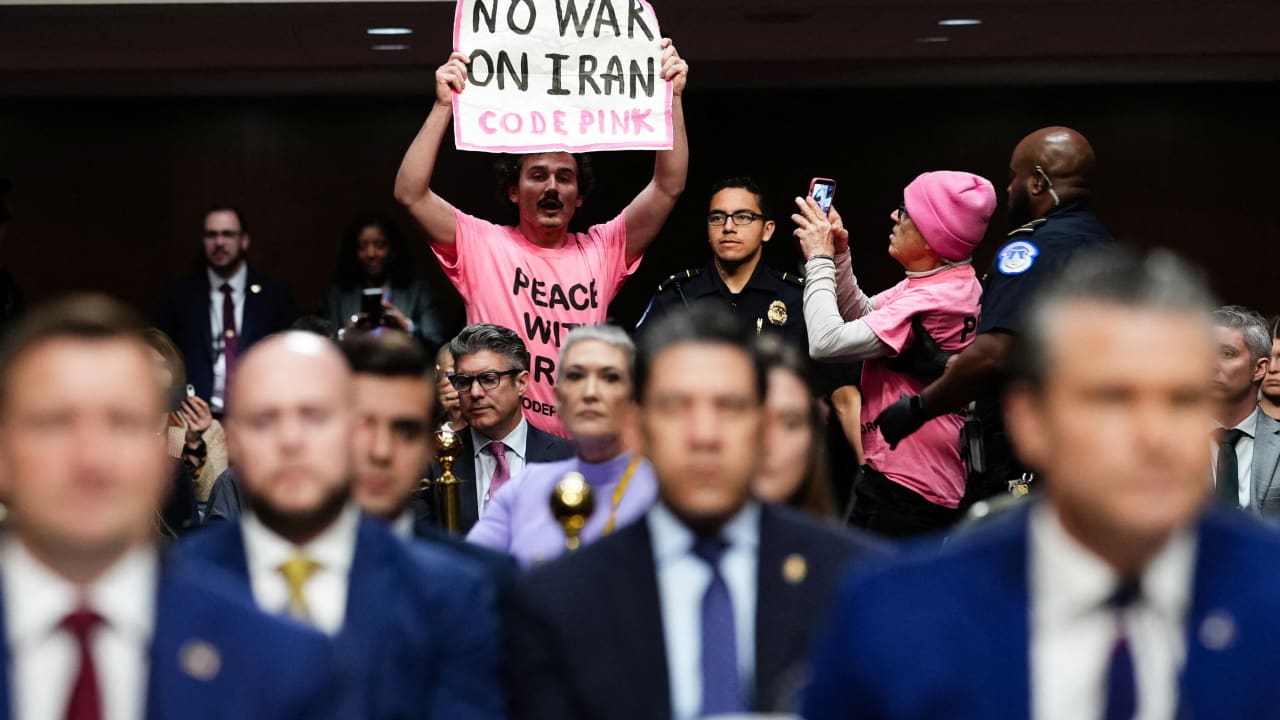
The US Senate backed legislation on Tuesday directing US President Donald Trump to halt US military action against Iran, the latest rebuke of the Republican president from an increasingly restive Congress.
The Senate voted 50-48 in favor of the war powers resolution, which passed the House of Representatives early this month, reflecting growing concern even among some of Trump's Republicans about the unpopular conflict that began on February 28 when the US and Israel launched an attack on Iran.
It was the first time both chambers of Congress had passed a resolution directing a president to remove US armed forces from hostilities since the War Powers Resolution, more commonly known as the War Powers Act, was enacted in 1973.
While likely to remain largely symbolic, the vote was a setback for Trump, who until recently had enjoyed near-unanimous support from Republican members of Congress.
It also comes as the administration is expected to ask Congress to authorize tens of billions of dollars to pay for the war.

Trump's Republicans hold slim majorities in both the Senate and House, but a few have broken with the president on a handful of issues ahead of mid-term elections in November, which will determine whether the party will retain control of Congress.
Some Republicans recently balked at Trump's $1.8 billion "anti-weaponization" fund to compensate political allies he says have been targeted by federal authorities and stalled a $70 billion bill to fund his immigration crackdown.
Reuters/Ipsos poll results released on Tuesday showed that just one in four Americans believe the war against Iran was worth its costs, and a majority worry that a truce with Tehran is unlikely to last.
The Senate vote was largely along party lines, with four Republicans joining all but one Democrat in favor. Two Republican senators did not vote.
In a post late on Tuesday, Trump criticized the vote, calling it "poorly timed and meaningless" and accused those who voted in favor of providing "comfort" to Iran and making his job "more difficult."
Trump's administration is working to negotiate a peace agreement with Iran. Support for the resolution in Congress is likely to put pressure on the president not to resume hostilities, something he has suggested he might do if negotiations falter.
Legal experts say the issue remains unsettled
Under the 1973 War Powers Act, the concurrent resolution - passed by both the House and Senate - does not go to the White House for Trump's signature. In the 1973 law, Congress intended such resolutions as a mechanism for ending military operations.
But legal experts said the issue remains unsettled. No war powers resolution had previously passed both chambers of Congress and a 1983 Supreme Court ruling said such a measure must be submitted for a president's signature or veto to have legal effect.
The White House has insisted the War Powers Act is not constitutional and thus not binding.
On Tuesday, a White House official said the Senate vote has no significance because the resolutions do not go to the president and have no force of law and the measure passed only because two Republicans were absent.
The official also said the resolution directs Trump to remove US forces from hostilities, which the White House says were terminated with a ceasefire on April 7.
Experts say the constitutionality of the War Powers Act likely will be settled in the courts.
"The executive branch will likely ignore it on constitutional grounds, and it’s not clear who might have standing to sue to enforce it," said Scott Anderson, a senior fellow at the Brookings Institution and senior editor of the online legal publication Lawfare.
Representative Gregory Meeks of New York, who sponsored the resolution in the House, said he viewed the resolution as binding and would pursue all legal avenues to ensure that the administration complies.
Democrats also noted that the US Constitution gives Congress, not the president, the right to take the country to war. "Congress has to own this responsibility," Democratic Senator Tim Kaine of Virginia said in a speech urging support for the measure.
Slim, but significant, support
The resolution had also passed the House with slim Republican support. The tally there was 215-208 with four Republicans and every Democrat voting in favor.
In the Senate, the four Republicans who voted for the measure were Susan Collins of Maine, Rand Paul of Kentucky, Bill Cassidy of Louisiana and Lisa Murkowski of Alaska. Democratic Senator John Fetterman of Pennsylvania voted against it.
Republicans Mitch McConnell of Kentucky and David McCormick of Pennsylvania missed the vote.
Democratic lawmakers have promised additional votes on war powers measures, saying they want to force Republicans to go on the record about the war.
Additionally, Congress has the right to review and vote on any peace agreement with Tehran if it affects Iran's nuclear program, under a 2015 law passed as then-President Barack Obama negotiated a nuclear agreement with Iran and other world powers.
Senate Republican Majority Leader John Thune of South Dakota said on Tuesday he expected Congress would review and vote on an eventual Iran peace deal.