
In a groundbreaking scientific study that could change our understanding of the Earth’s future, scientists from Swansea University in England have discovered an extraordinary geological phenomenon: Africa, the second-largest continent in the world, is in the slow process of splitting in two. What does that mean? Essentially, there is a massive crack beneath the surface that runs the entire length of the continent, from northeast to south, beginning in the Afar region of Ethiopia. The crack beneath the surface could eventually lead to the formation of two separate continents. This is not an event we will witness in our lifetime—it will take millions of years until the pulses beneath the African soil gradually split the continent and create a new ocean.
The discovery, published in the prestigious scientific journal Nature Geoscience, reveals evidence of rhythmic pulses of igneous rock rising from the Earth's core, right beneath Ethiopia. These pulses function like a "geological heart," gradually pushing the different parts of the continent apart and initiating the formation of a new ocean that will one day separate East Africa from the rest of the continent.
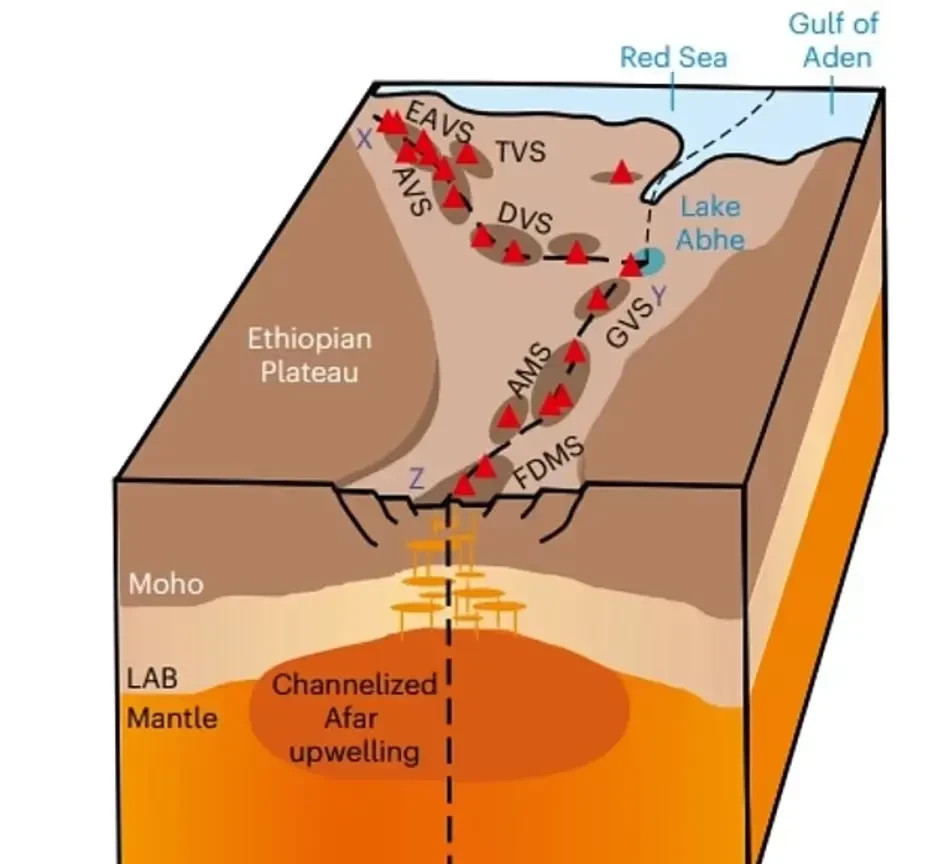
"Eventually, the split will extend the full length of Africa," explains Dr. Emma Watts, the lead author of the study, in an interview with the DailyMail website. "It’s already started and is happening right now, but at a slow pace. We're talking about a change of 5 to 16 millimeters per year in the northern rift. As for the timeline, the process of Africa splitting will take several million years to complete." The process has already begun in northeastern Africa off the coast of Ethiopia, where the Red Sea flows into the Gulf of Aden. Dr. Watts and her colleagues point to the Gulf of Aden as the starting point of the process—a relatively narrow body of water that separates Africa in the south from Yemen in the north. Like a small tear in a piece of fabric, this gradual separation event will begin in the Gulf of Aden and slowly spread downward. In about five to ten million years, when the process concludes, Africa will no longer be a single continent.
The larger continent will lie to the west and include most of the 54 African countries, such as Egypt, Algeria, Nigeria, Ghana, and Namibia. The smaller continent in the east will include Somalia, Kenya, Tanzania, Mozambique, and a large part of Ethiopia.

For the study, the team collected more than 130 samples of volcanic rock that formed from lava in Ethiopia’s Afar region. This area is quite rare on Earth. It contains three tectonic rifts: The Main Ethiopian Rift, the Red Sea Rift, and the Gulf of Aden Rift—collectively known as a triple junction because all three meet at the same point. The region is characterized by particularly high volcanic activity and stunning, rare coloration. The experts used these samples to study the structure of the Earth's crust and the mantle beneath it. The mantle, the planet’s thickest layer, is primarily solid rock but behaves like a viscous liquid. The movement of tectonic plates helps material from the mantle rise to the surface.

"We found that the mantle beneath Afar is neither uniform nor static—it pulses," explains Dr. Watts. "These upward pulses of partially molten mantle are directed by the rifting plates above them." Deep beneath Ethiopia's Afar region, there is a plume of molten mantle rock pulsing upward like a beating heart, and these pulses carry distinct chemical responses to the tectonic plates above them.
In the Afar region, the entire floor of the rift valley is covered in volcanic rocks. This indicates that in this area, part of the Earth’s crust has thinned almost to the point of complete rupture. When it reaches the breaking point, a new ocean will begin to form through the solidification of magma in the space created by the separating plates. Scientists also warn that a massive underwater volcano could erupt. Eventually, over tens of millions of years, the sea's expansion will continue along the entire length of the rift.

The Earth is composed of three main layers—the crust, the mantle, and the core, which is later divided into "inner" and "outer," and recent studies have even suggested the existence of an "innermost core." Tectonic plates are composed of the Earth's crust and the uppermost part of the mantle, and beneath them lies the asthenosphere—the hot, viscous conveyor belt of rock on which tectonic plates ride. Earth has fifteen tectonic plates that together have shaped the landscape we see around us today. Earthquakes typically occur at the boundaries of tectonic plates. An earthquake is essentially one plate diving under or pushing another plate upward, or plates whose edges are colliding. Although earthquakes rarely happen in the middle of plates, they can occur when ancient faults or rifts far beneath the surface become reactivated.