Washington’s efforts should aim at preventing Iran from becoming a nuclear-threshold state. This may be the only arrow left in Washington’s quiver to remind Riyadh who really has its back.
Follow us on Google King Ibn Saud of Saudi Arabia converses with president Franklin D. Roosevelt on board the ‘USS Quincy’ after the Yalta Conference in 1945.(photo credit: WIKIPEDIA)ByJOSHUA TEITELBAUM
I’ve always been partial to historians (not surprising, since I am one). Whenever headlines scream some “new” sensational news, historians are often able to give them some perspective. This is no truer than right now as Saudi Arabia, under Crown Prince Muhammad bin Salman (MBS), flexes its muscles, causing consternation in Washington. Yet the three issues currently in the headlines – rocky relations with the United States; the Gulf pivot to China, culminating in a March 2023 Chinese-mediated agreement to restore diplomatic relations between Saudi Arabia and Iran; and the ups and downs of a Saudi move toward establishing diplomatic relations with Israel – all stem from one thing: Saudi Arabia’s historically pervasive sense of insecurity.
Saudi Arabia seeks to leverage its oil wealth to strike a new, independent path in its foreign relations. At the same time, this is only the culmination of a long-developing Saudi disappointment with what Riyadh views as a lack of American commitment to the security of the royal family. While some might take umbrage at that statement, given that the US rescued the Saudi regime in 1991 from having to deal with Saddam Hussein as a hegemon, for historians who have pored over tens of thousands of archival documents and Saudi sources, one thing is perfectly clear. Ever since the mid-1920s, when the Saudi royal family captured the holy cities of Mecca and Medina, one issue has preoccupied it: security for the family and, by extension, for the state which bears the family’s name—Saudi Arabia. This was succinctly captured in the title of Nadav Safran’s 1985 seminal volume Saudi Arabia: The Ceaseless Quest for Security.
The 1945 meeting between US president Franklin D. Roosevelt and Saudi paterfamilias Ibn Saud was mythologized by US oil industry and business stakeholders as a meeting of the minds between two great leaders planning a future together. In fact, the US was initially very hesitant to extend military aid to an ultra-conservative monarchy that still supported slavery. To several US administrations, the Saudis seemed manifestly out of step in a post-World War II environment of human progress. It took a 1962 pro-Nasserist – and, by implication, pro-Soviet – coup in neighboring Yemen and subsequent civil war between the Egyptian-backed republicans and Saudi-backed royalists for the US to conclude its first major arms deal with Saudi Arabia, in 1966: $126 million worth of Hawk surface-to-air missiles manufactured by defense giant Raytheon. After that, arms and training contracts between the US government, private contractors, and the Saudi royal family expanded exponentially. The British withdrew from the Persian Gulf shortly afterward, and the US stepped in.
When the Saudi-initiated oil crisis of 1973 hit the United States, leading to long lines at the pump as Americans struggled to fill their gas guzzlers, US officials, including secretary of state Henry Kissinger, speculated publicly about occupying the Saudi oil fields. Congress, gun shy after Vietnam, held widely publicized hearings on the feasibility of such a move. King Faisal was outraged at this perceived US perfidy, and the Saudis secretly threatened to blow up the oil fields. The Saudis asked themselves: “Can we depend on America?”
Like today, back then the Saudis knew how to send signals when they perceived a lack of US commitment to their security. In 1978, Congress put up a struggle against the Carter administration’s proposed sale of F-15 fighters to the Kingdom because it feared they might be used against Israel. One “Abdul Karim Mansur,” a pseudonym for a “former State Department official with intimate experience in the Persian Gulf,” penned an article titled “The American Threat to Saudi Arabia” in the widely read Washington-based Armed Forces Journal. He argued that the dispute over the provision of the F-15s was a threat to the Saudis. The “former official,” not necessarily from the State Department, had likely just left the government and was now on his way via Washington’s revolving door to a defense industry job or to work as a consultant for the Saudi government.
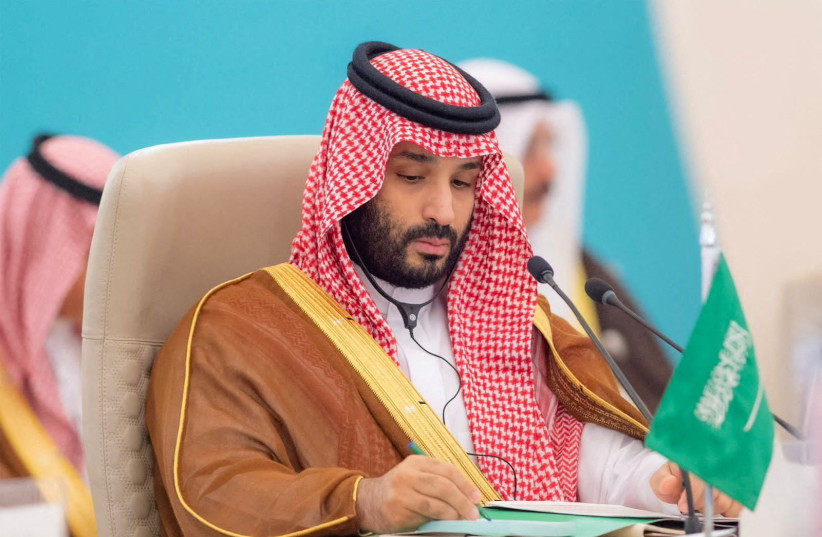
Saudi Crown Prince, Mohammed bin Salman attends the 18th consultative meeting of the leaders of the GCC & the Gulf summit with the central Asian countries C5, in Jeddah, Saudi Arabia, July 19, 2023. (credit: SAUDI PRESS AGENCY/HANDOUT VIA REUTERS)
Saudi-US relations are at another such inflection point. The US is signaling more strongly than ever before that it wants to downsize its Middle Eastern footprint. In 1968, Britain declared that it would withdraw “east of Suez,” hoping the US would assume its mantle. Washington slowly but inevitably did. But currently, faced with the military and technological challenge presented by an aggressive China, America is pivoting to Asia. The US is no longer dependent on Saudi oil (although Saudi production figures hugely in setting the price of oil). Despite the passage of time, the apparent involvement of at least two Saudi officials in the 9/11 terrorist attacks and the fact that 15 of the 19 hijackers were Saudis has not been forgotten in Washington. And neither has the gruesome 2018 murder of Saudi Washington Post commentator Jamal Khashoggi, despite attempts by former Trump administration officials to soft-pedal the killing. The CIA concluded that MBS was personally responsible, and the Biden administration saw fit to release this conclusion to the public. The Saudis were not happy.
As in the past, current Saudi concerns are security-dominated. But this, time the US is looking for a way out, and the Saudi royal family is run by a confident – perhaps over-confident – young ruler. So the Saudis are hedging their bets. The administration is sour on relations with Riyadh? China, which isn’t pivoting anywhere and is only strengthening its Gulf presence, doesn’t ask awkward questions about political murder. Riyadh struck a double blow at Washington by using China’s good services to re-establish diplomatic relations with Iran. If the US can pivot to China, so can Saudi Arabia. This sends a strong signal to Washington and is a popular move at home, where demonstrating independence from America is well received. The rapprochement with Iran has historical precedents but does not erase the historical tensions between these two regional powers. It is mostly a case of “keep your friends close and your enemies closer.”
Israel and Saudi Arabia
It took a while for the Biden administration to get out the words “Abraham Accords” without choking because it could not bring itself to acknowledge the Trump administration’s 2020 singular foreign policy achievement of normalization between Israel and several Arab states. But the Accords could not be ignored, and Washington is keen to build on them and bring about full normalization between Jerusalem and Riyadh. Yet brimming with confidence, and not a small measure of hubris, MBS is not keen to hand Biden that prize.
It is not very well known (except to a few historians) that clandestine relations between Israel and Saudi Arabia go back to the 1960s. Israel’s Mossad gave extensive aid to the pro-Saudi side in the Yemen war in an operation run by the British and funded by Riyadh. The royal family had no love for the Palestinians, who had carried out several terrorist attacks in the Kingdom and were seen as a pro-Soviet radicalizing force. Relations between Jerusalem and Riyadh have certainly picked up as the two countries share intelligence and perhaps missile technology in the face of the mutual threat from Iran. And even publicly, MBS has made several positive statements about future relations with Israel, and Saudi officials have visited Auschwitz. Israeli aircraft are now permitted to overfly Saudi Arabia. The Israeli national soccer team competed in the FIFAe video gaming World Cup in Riyadh in July 2023. Scholarly reports have shown a continuing decline in anti-Israel and antisemitic content in Saudi textbooks.
The Saudis really don’t need or even want full diplomatic relations with Israel. Israel has not conditioned security cooperation with Saudi Arabia on having mutual embassies in Jerusalem and Tel Aviv. And it is an awkward sell at home, particularly after the massive October 7 Hamas attack on Israel which brought the Palestinian issue once again dramatically to the fore.
But perpetually insecure Riyadh remains desperate for iron-clad security guarantees from Washington. And that is why, ironically, MBS has let Washington know that if President Biden desires to feather his cap with the singular achievement of Saudi-Israeli peace, the big ask will be aimed at the United States – not Israel.
And it is a big ask indeed. In exchange for normalization with Israel, Saudi Arabia has demanded the moon. America has been asked to provide a congressionally endorsed defensive alliance with the Kingdom close to the level of the NATO alliance; fast-tracked arms sales without the intervention of pesky senators and members of Congress asking awkward questions—just like NATO; and most ominously, US support to enrich uranium and develop its own fuel production system. On the face of it, these are non-starters for Washington. Jerusalem certainly objects. And whether MBS thinks he has the leverage to achieve these goals is an open question.
But the Crown Prince has a way of reminding Washington how generous the Saudi royal family can be. In March 2023, he inked a $37 billion deal with American aerospace giant Boeing for 121 787 Dreamliner aircraft. As the White House spun it, the deal will support “more than 140,000 American jobs, many of which do not require a four-year college degree.” With this deal, MBS also blew a dog whistle in the direction of US officials: “Get with the program now if you want a trip through the Saudi-funded revolving door.” Many US officials from successive administrations have profited as they stepped from government through the revolving door into industry or lobbying, and back into government once their party was back in power.
The 37-year-old Muhammad bin Salman will likely become king once his father, age 87, leaves this world. Since longevity runs in the family, he could easily be the king for the next 50 years, outlasting numerous US administrations. In the 1970s, America assumed the mantle of securing the Gulf. But just like London back then, today Washington is stretched thin. The Saudis are still highly dependent on US arms. It would take a long time to switch these out for Chinese or Russian systems. In the near term, Washington’s efforts should aim at preventing Iran from becoming a nuclear-threshold state. This may be the only arrow left in Washington’s quiver to remind Riyadh who really has its back. ■
Prof. Joshua Teitelbaum is a leading historian and expert on the modern Middle East, specializing in Saudi Arabia and the Gulf. He teaches Middle Eastern history in the Department of Middle Eastern Studies at Bar-Ilan University and is Principal Research Fellow at the University’s Begin-Sadat (BESA) Center for Strategic Studies. During the 2023-24 academic year, he is serving as a Visiting Fellow at Stanford University’s Hoover Institution, engaged in historical research about the Saudi armed forces. His forthcoming book, The Saudi Arabian National Guard: Tribalism, the Royal Family, and Politics in Modern Saudi Arabia, will be published by Stanford University Press. This article is reprinted with permission from Caravan, Hoover Institution, Stanford University.