
Many senior members of Iran's political and military echelons have been killed in strikes since Operation Roaring Lion began on February 28. In the past two days, Israel killed Ali Larijani and former intelligence minister Esmaeil Khatib.
Who is still believed to be alive, what roles do they play, and how influential are they in leading Iran?
Mojtaba Khamenei, the new supreme leader who succeeded his father
Supreme Leader Mojtaba Khamenei succeeded his father, Ali, who was killed in an Israeli strike on February 28. He was confirmed in the position on March 8, following a short interim period.
Closely tied to leadership within the Islamic Revolutionary Guard Corps, Khamenei is believed to have been the IRGC's preferred choice to succeed his father.
Khamenei is believed to have been seriously injured in Israeli strikes, including possibly in a coma. His wife and at least one of his sons were killed in the strike that killed his father.

As supreme leader, Khamenei holds absolute power over Iranian politics, policy, and the military, with all political bodies ultimately reporting to his office.
Masoud Pezeshkian, the president who temporarily took ultimate control
Masoud Pezeshkian has served as President of Iran since July 2024. The leader of the so-called Reformist Faction, he was elected over other, harder-line candidates.
While the office of the president is subordinate to the supreme leader, Pezeshkian serves as the head of the executive branch of the government and is responsible for the day-to-day running of the Islamic Republic.
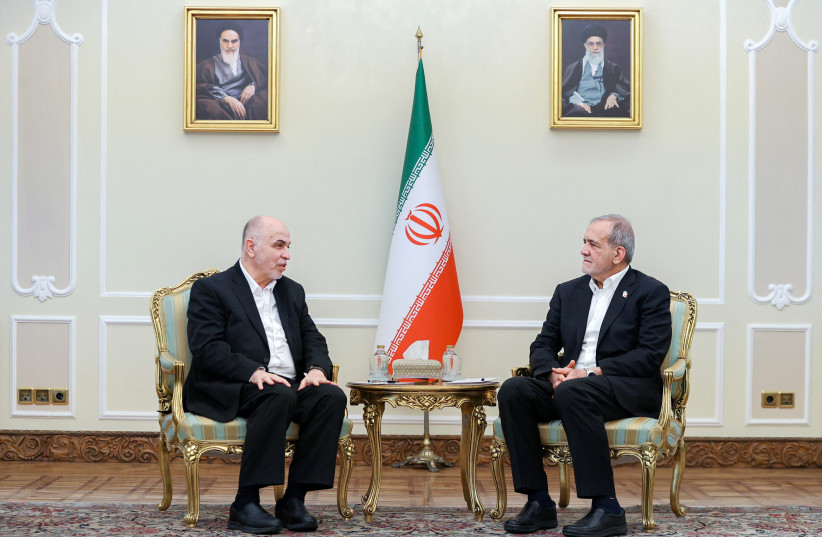
After Khamenei and other senior figures were killed on February 28, Pezeshkian was one of three political leaders who formed the Interim Leadership Council, along with Gholam-Hossein Mohseni-Eje'i and Alireza Arafi.
Gholam-Hossein Mohseni-Eje'i, Iran's Chief Justice
Gholam-Hossein Mohseni-Eje'i has served as Iran's Chief Justice since 2021. He also joined Pezeshkian and Arafi on the Interim Leadership Council earlier this month, during the interim between Ali Khamenei's killing and Mojtaba's ascension.
Mohseni-Eje'i served as intelligence minister from 2005 until July 2009.
He was sanctioned by the US State Department and the European Union in 2011 for repressing the protests following the controversial 2009 presidential election during the "Green Revolution."
During his tenure as chief justice, he has played a key role in suppressing anti-regime protests that have spread across Iran since December. He instructed prosecutors to show "no leniency" towards demonstrators, which resulted in the execution of many.

Using the crime of "moharebeh" (waging war against God) and "corruption on Earth" as charges, he handed down many death sentences. Activist and human rights groups have asserted that many of the executed were young adults who were denied due process and legal counsel, after confessions had been extracted under duress.
Alireza Arafi, the senior Shi'ite cleric and influential preacher
Alireza Arafi is a senior Shi'ite cleric and politician who has served as a member of the Guardian Council since 2019 and of the Assembly of Experts since 2022.
He has also served as the head of Iran's religious seminaries since 2016 and the Imam at Friday Prayers in the theological center of Qom since 2015.

Often overlooked because he held a theological position rather than an overt political one, Arafi's significance and influence were highlighted when he was appointed to the Interim Leadership Council alongside Pezeshkian and Mohseni-Eje'i, who acted temporarily as the Islamic Republic's supreme religious authority until a new supreme leader was appointed.
Ahmad Jannati, the elderly Guardian Council head
Ayatollah Ahmad Jannati, the 99-year-old Guardian Council Secretary, has served on the influential 12-member body since its establishment in 1980 and has chaired it since July 1992.
The Guardian Council, which plays a role similar to that of a supreme court in a Western democracy, holds considerable constitutional power and influence, including the mandate to veto unconstitutional legislation passed by the government, supervise elections, and approve or disqualify candidates.
In 2006, during the Second Lebanon War, Jannati preached that support for Hezbollah was a "duty." He has also preached that being lenient towards political dissidents is "un-Islamic."

"God ordered the prophet Muhammad to brutally slay hypocrites and ill-intentioned people who stuck to their convictions. The Quran insists on such deaths. May God not forgive anyone showing leniency toward the corrupt on Earth," he said in 2010, linking the message to a story about the Islamic prophet Mohammed ordering his son-in-law Ali to execute 70 Jews.
Parliament Speaker Mohammed Bagher Ghalibaf
Mohammed Bagher Ghalibaf, as speaker of Iran's Parliament, holds considerable influence over day-to-day politics in Tehran. Due to his position, he holds a seat on Iran’s Supreme National Security Council (SNSC) and the Supreme Economic Coordination Council.
Ghalibaf joined the Islamic Revolutionary Guard Corps during the Iran-Iraq War, quickly rising through the ranks.
A senior figure in the conservative, hardline Principalist faction, he previously held other influential positions during his rise in politics, including police chief, Tehran mayor, and as a member of the Expediency Discernment Council.

He has also run for the presidency several times, including coming second to Hassan Rouhani in 2013.
Abbas Araghchi, the foreign minister in the public spotlight
Abbas Araghchi has served as the Islamic Republic's foreign minister since 2024, taking over from Hossein Amir-Abdollahian, who was killed in a helicopter crash alongside then-president Ebrahim Raisi earlier that year.
He joined the ministry in 1989, holding positions including Iran's chargé d'affaires at the Organization of Islamic Cooperation in Jeddah, Saudi Arabia, and ambassadorial posts to Finland and Japan.
Araghchi also served as chief negotiator for then-president Hassan Rouhani in the nuclear talks with the P5+1 in the build-up to the 2015 signing of the Joint Comprehensive Plan of Action (JCPOA).

He later became chief nuclear negotiator and led the Iranian delegation in Oman and Geneva's talks with the US before both the June and current operations striking Iran.
Mohammad Reza Aref, the first vice-president, who recently survived an attempted Israeli strike
Mohammad Reza Aref has served as the first vice-president under Pezeshkian since July 2024, having also previously held the role from 2001 until 2005.
While the role itself does not carry significant power or influence, he could become more prominent during an interim period if President Pezeshkian is unable to serve.
Anti-regime London-based outlet Iran International reported that Aref attempted to resign at the end of December amid the growing anti-regime protest movement nationwide, but Pezeshkian rejected his request.
Reports indicated that Aref was present during an Israeli strike on the Foundation of Martyrs and Veterans Affairs (Bonyad Shahid) on Monday, but survived the strike.
IRGC leadership, the regime's hard power
Iran's system of hard power is divided between the IRGC and the military, also known as Artesh. However, the IRGC is far more powerful, not only in hard power but also in influence within Iran's political echelons.
Several senior Iranian politicians now in civilian life have held command positions within the IRGC leadership during their rise through the ranks.
Current IRGC leadership also holds high levels of influence throughout the Islamic regime, and is believed to have been key in supporting the eventual winners and appointees of key positions - an IRGC endorsement or backing goes a long way within Iranian politics.
The IRGC has several other names in Farsi, including Sepah, a word derived from an ancient term for a soldier, and Pasdar, meaning "guardian". In Iranian media, the group is often referred to as Sepah-e Pasdaran (Army of the Guardians) or Pasdaran-e Enghelab (Guardians of the Revolution).
IRGC leadership reports directly to the office of the supreme leader, bypassing the government. The IRGC chief is also appointed directly by the supreme leader rather than by the president or another official.
The current IRGC chief is Ahmad Vahidi, one of the most powerful people behind the scenes in Iran.
The corps is split into five branches: the Ground Forces, the Navy, the Aerospace Force, the Quds Force (IRGC-QF), and the Basij.
The Quds Force deals with Iran's proxy network and spreading Iranian influence and terror across the world, while the Basij is a paramilitary referred to as the regime's "Iron Fist," setting up checkpoints, suppressing anti-regime activities, torturing dissidents, and enforcing "modesty."
Currently, the Aerospace Force and Basij are leaderless after Israel killed their leadership in strikes on Tuesday.
The current IRGC-QF chief is Esmail Qaani, responsible for ties with Iran's proxies and terror network, including Hezbollah, the Houthis, and Iraqi militias. His deputy is Mohammad Reza Fallahzadeh.
The IRGC's Ground Force is currently led by Mohammad Karami, and the navy is commanded by Alireza Tangsiri, who has repeatedly threatened the US military positioned in the Persian Gulf and attempted to close the Strait of Hormuz.
Iranian military, powerful but overshadowed
Iran's military, on the other hand, is powerful in its own right but does not hold the influence of the IRGC.
While it likely has three times the budget of the IRGC, the military is less closely tied to the halls of power and therefore far less influential.
Iran's defense minister is filled in an acting role by Majid Ebn-e-Reza, as minister Aziz Nasirzadeh was killed in an Israeli strike earlier this month.
The head of the military is also vacant, as Abdolrahim Mousavi was killed in the Israeli strikes on February 28. The deputy chief is Mohammad-Reza Gharaei Ashtiani.
The military is split into several corps: the army, air force, air defense force, and navy. It also consists of the Khatam al-Anbiya Headquarters - a unified combat command under the general staff.
Interior Ministry and Police
Two other influential roles within Iran are the interior minister and the police chief.
Eskandar Momeni has been the interior minister since 2024, having previously served as police chief. He initially rose through the ranks of the IRGC.
Police Chief Ahmad-Reza Radan also rose through the IRGC. Before becoming head of police in 2023, he served as deputy police chief and chief of Tehran's police.
During that time, which included the protests around the killing of Mahsa Amini, who was beaten to death for not properly covering her hair, Radan became notorious for his clampdown on "un-Islamic" hairstyles and dress.
He was also sanctioned by the US and EU for human rights abuses committed while clamping down on the 2009 Green Movement protests, and traveled to Damascus in 2011 to aid the Assad regime in clamping down on anti-government protesters in Syria.
During the recent protests against the government, Radan warned that those "deceived into rioting" had three days to turn themselves in before facing consequences.