The guns have fallen silent since the ceasefire between Israel and Iran on June 24, but the real battle is just beginning in Iran’s oil fields, gas pipelines, and refineries.
The war exposed what sanctions and economic mismanagement had long been eroding: Iran’s energy system is vulnerable, overstretched, and increasingly unable to shield the regime from external pressure. The physical damage from the war was limited in scale but significant in impact.
Despite Iranian threats and rhetorical defiance, the country’s oil and gas sector never fully recovered from the war’s limited but well-placed strikes. Israel notably avoided bombing Kharg Island – Iran’s main oil export terminal – likely to avoid triggering a global oil shock.
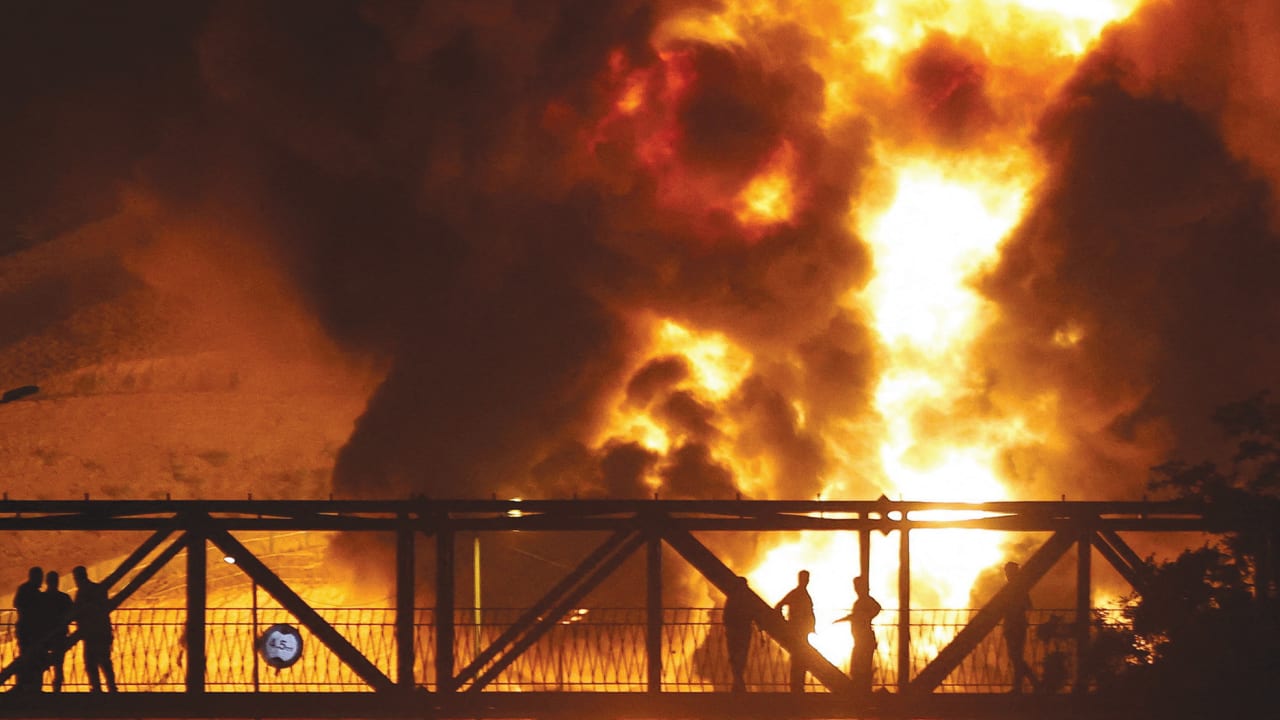
Yet it did strike Phase 14 of the South Pars gas field, halting roughly 12 million cubic meters per day of output. Fires raged for days. As of late June, only one damaged unit had returned to service. This alone cut deeply into Iran’s domestic gas availability, which was already strained by inefficiencies, flaring losses, and growing winter demand.
Meanwhile, crude oil exports fell from pre-war levels of about 1.7 million barrels per day to roughly 1.5 million. Some tankers resumed loading at Kharg’s eastern jetty, and Iran’s so-called “ghost fleet” of covert tankers continues to move discounted crude to Chinese and Venezuelan buyers. Still, the financial loss is significant – estimated at tens of millions of dollars per day – and further undermines Iran’s ability to fund domestic subsidies and Islamic Revolutionary Guard Corps (IRGC)-linked operations.\

Iran’s internal energy picture is no better. The country’s refining output remains capped near 105 million liters per day, according to data from the National Iranian Oil Refining and Distribution Company, while domestic demand often exceeds 130 million liters, especially in summer and winter peaks. The result is a shortfall of 15-40 million liters per day – one that has historically been plugged by expensive fuel imports, barter deals (such as exchanging mazut for gasoline), and poorly controlled smuggling routes through Afghanistan and Iraq.
To make matters worse, the Islamic Republic has limited strategic reserves. The June strikes damaged the Shahran depot near Tehran, which held a large portion of the capital region’s refined fuel reserves. This has reduced the government’s flexibility in responding to internal spikes in demand or disruption. And given the unreliability of many of Iran’s older refineries and transmission lines, even minor sabotage or targeted drone attacks could now have cascading effects.
The international picture is shifting fast. In early July, the US imposed fresh sanctions on smuggling networks that had disguised Iranian oil as Iraqi crude. On July 9, another round hit 22 entities across Hong Kong, the UAE, and Turkey accused of facilitating oil trade for the IRGC and its Quds Force.
However, the real pressure is now coming from Europe. Germany, the UK, and France have agreed to initiate snapback procedures if no nuclear deal is reached by the end of August, restoring all prior UN sanctions under Resolution 2231. These would include the reimposition of arms embargoes, asset freezes, and, most importantly, international restrictions on Iranian oil sales and financial services.
Tehran has responded with predictable fury. The Foreign Ministry warned that triggering snapback would “end European credibility and destroy the last bridge of diplomacy.” Behind the bluster is real concern.
UNLIKE US sanctions, which Iran has learned to evade through oil laundering and gray-market sales, UN sanctions reimposed through the snapback mechanism would cut deeper. The Islamic Republic could lose maritime insurance, flag registry access, and international legal protections. Even sympathetic buyers like China may scale back volumes to avoid reputational or secondary-risk exposure.
In this context, Western policymakers face an urgent question: Should this window be used to escalate or to strategically squeeze? The answer lies not in additional military strikes but in deepening the economic attrition that the war revealed to be both effective and sustainable.
There are four concrete moves the West and its allies should make immediately:
• Tighten enforcement on dual-use energy equipment, particularly turbines, compressors, and digital refinery controls. Iran cannot repair its infrastructure at scale without foreign parts.
• Crack down on smuggling corridors, especially in the Sistan and Baluchestan province and along the western Iraq border. Subsidized fuel is hemorrhaging through these routes, costing the regime $3-4 billion per year.
• Pressure barter partners – particularly China and Venezuela – to reduce or condition energy trade. Quiet diplomacy can raise the cost of these backdoor deals and force more crude into floating storage.
• Expand maritime inspections targeting the ghost fleet. Iranian tankers often disable Automatic Identification System beacons and transfer oil mid-sea to obfuscate origin. Spotlighting these operations can deter buyers and expose networks.
These measures are not an escalation. They are economic containment. If executed with precision, they can create leverage without further military engagement while accelerating internal pressure on the regime’s brittle foundations.
A second wave of conflict – whether deliberate or accidental – would be far more damaging. If Israel were to strike Kharg Island directly or disrupt shipping near the Strait of Hormuz, global oil prices could easily breach $100 per barrel, triggering energy price shocks and strategic reserve releases by consuming nations.
For Iran, the consequences would be even more dire: the loss of its last viable export infrastructure and total economic suffocation. Even without such escalation, however, the current post-war condition offers a rare and fleeting leverage point.
Iran is weakened but not collapsed. It is recovering, but slowly, and under pressure.
For years, the West has oscillated between deterrence and diplomacy. The June war and the economic aftershocks that followed offer a third way: erosion. Iran’s energy economy is too centralized, too overextended, and too dependent on vulnerable infrastructure to withstand prolonged attrition.
The snapback mechanism, if executed in tandem with precise enforcement, could turn post-war fragility into long-term leverage. Sustained pressure on the regime’s energy and financial lifelines can accelerate internal collapse, not through foreign intervention, but by empowering the Iranian people to bring down a system that can no longer sustain itself.
The writer is an Iranian-American research professor and energy policy expert. He is also active in political and human rights advocacy. Follow him on X: @Aidin_FreeIran