
It was, doubtless, a combination of factors that led Hamas’s leadership to conclude that its best interests lay in accepting the latest version of the ceasefire proposals, first suggested by US special envoy Steve Witkoff.
It came after months of arms-length and deadlocked discussions between Israel and Hamas, whose refusal to conclude a deal was reinforced when a flurry of nations proclaimed their intention to recognize a Palestinian state – France, the UK, Malta, Canada, and Australia.
These declarations effectively removed any incentive for Hamas to give away their main bargaining chip – the hostages – or even consider disarming, and for a time, they ceased negotiating.
The dire effect of this rush to recognition was revealed by Hamas’s messages of congratulation to the governments concerned, and by Ghazi Hamad, a senior Hamas official based in Qatar. During an interview on August 2, he is reported as saying: “The initiative by several countries to recognize a Palestinian state is one of the fruits of October 7.”
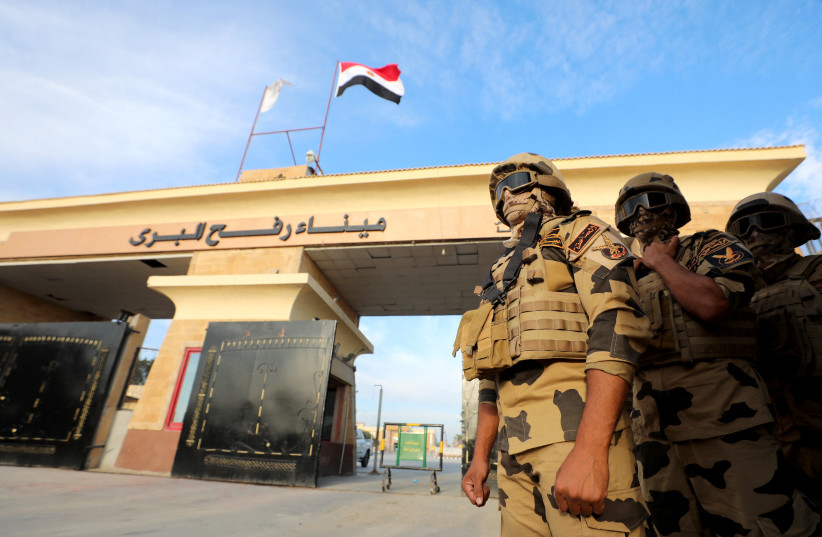
Egypt's mediation efforts
Egypt, along with Qatar and the US, has been central to recent mediation efforts. Egypt is also the progenitor of the only viable plan for the reconstruction, development, and administration of post-war Gaza. So there was a certain logic in Egypt’s recent assumption of the lead role in the ceasefire/hostage release negotiations, with the focus shifting from Qatar’s capital, Doha, to Cairo.
Taking the lead in mid-August, Egypt significantly intensified pressure on Hamas to agree to a ceasefire in Gaza. On August 13 in Cairo, Maj. Gen. Hassan Rashad, head of Egyptian intelligence, met with Hamas leaders – including politburo chief Khalil al-Hayyeh – to push Hamas toward flexibility.
Egyptian officials warned Hamas that there was a limited window of opportunity to reach an agreement. Israel was preparing its attack on Gaza City. The proposed deal included suspending Hamas’s armed activities for a transitional period, oversight by Arab and international mediators, discussions about the temporary administration of Gaza during the interim, its demilitarization, and the release of all remaining Israeli hostages in two phases, in exchange for Palestinian prisoners.
Media reports of the discussions that led to Hamas’s acceptance of the terms include a mention of Egypt inviting other Palestinian factions and the PLO to discuss a “comprehensive deal,” suggesting Egyptian willingness to sideline Hamas if it remained intransigent.
Linking its honest broker role with its plans for the reconstruction of Gaza, Egypt reportedly told Hamas that, contingent on a ceasefire agreement, it was ready to impose a temporary administration for Gaza and take practical steps toward rehabilitation.
Details of the proposed deal
After a while, reports from Cairo indicated that Hamas officials were starting to ease some of their previous red-line demands, particularly those that had led to the collapse of earlier talks.
At the heart of the emerging deal was a 60-day ceasefire, serving as a window for hostilities to halt, aid to resume, and negotiations to progress.
The hostage release terms, however, are proving to be a new bone of contention. The proposal accepted by Hamas specifies a two-phased sequence for their release: 10 living hostages and the bodies of others in the first phase; the remainder in a second.
But Israel’s position on the release of the remaining captives has recently hardened. A statement from the Prime Minister’s Office on August 16 said: “Israel will agree to a deal on condition that all the hostages are released simultaneously.”
Whether Israel will backtrack on this is possible, but not likely. Meanwhile, it has proceeded to implement its plans to chase Hamas out of Gaza City.
Gaza reconstruction
Egypt's reconstruction plan for Gaza was always intended to run alongside ceasefire negotiations. It was presented to a meeting of the Arab League on March 4, where it was approved unanimously. UN Secretary-General Antonio Guterres, who was present at the meeting, “strongly endorsed” the Egyptian plan and pledged the UN’s full cooperation in implementing it.
The president of the African Union, Joao Lourenco, also attended the Cairo summit and gave the plan his explicit support and a commitment to help realize it. Since then, it has been endorsed by the EU.
Egypt’s plan envisages a six-month immediate phase that would concentrate on removing rubble, the provision of temporary shelters, initial repairs to partially damaged homes, and restoration of core infrastructure.
The first reconstruction phase that follows would last about two years, and would include the construction of some 200,000 new residential units and establish vital supply networks.
The second reconstruction phase would last two and a half years, and would involve the creation of an economic infrastructure, including industrial zones, a commercial port, and an airport.
Regarding governance, Egypt’s blueprint calls for a technocratic committee to manage initial reconstruction, leading to the Palestinian Authority eventually taking over.
There has been some real progress in implementing the initial stages of the Egypt reconstruction plan – progress that has largely failed to reach the world’s headlines.
In February 2025, during the ceasefire that lasted from mid-January to mid-March, construction vehicles from Egyptian companies – particularly from the politically connected Organi Group – began operating in Gaza.
Their main activities were focused on clearing rubble, especially along Salah al-Din Street, the key north-south artery in Gaza, and preliminary site preparation for the construction of up to 200,000 temporary housing units for displaced residents.
Leading Egyptian construction firms and engineering syndicates are eager to participate in implementing the plan. The Talaat Moustafa Group, for example, proposed a $27 billion, three-year initiative, involving 50 top contractors.
Meanwhile, the Egyptian Syndicate of Engineers has teamed up with its Palestinian counterpart, and Egypt and Jordan have initiated training programs for Palestinian police to prepare them for security duties in Gaza. Egypt is currently preparing for a large international donor conference to secure funding and pledges for its $53.2 billion reconstruction plan.
In short, Egypt has begun taking concrete steps to implement the early stages of its plan, but the major phases are dependent on a stable ceasefire, donor commitments that translate into real funding, and the establishment of an effective governing mechanism for Gaza.
Prime Minister Benjamin Netanyahu has sent negotiators to Cairo and Doha to continue ceasefire discussions. Two interesting possibilities are in the balance: Israel could accept the deal that Hamas has accepted or, if Hamas is desperate enough for a 60-day respite, it could agree to release all the hostages in one go.
Then there is the report last October in The Wall Street Journal that during meetings with Egyptian officials, Israel’s chief negotiator, David Barnea, who heads the Mossad, offered safe passage to Hamas members in exchange for laying down arms and releasing hostages.
More likely, perhaps is stalemate on the ceasefire, and Israel proceeding with its plan to invade Gaza and defeat Hamas.
The writer was the Middle East correspondent for Eurasia Review. His latest book is Trump and the Holy Land: 2016-2020. Follow him at www.a-mid-east-journal.blogspot.com.