
It’s that time of year: American Jews are gathering with their communities after summer breaks, walking their children to the first day of school, and preparing for High Holy Day celebrations later in September into early October. However, for millions of Jews across the land, these basic acts of American life come with a price tag.
“For you to walk your child to a synagogue down the street – you have to pay for extra security,” Leo Terrell, the head of the Justice Department’s Antisemitism Task Force, told hundreds of college students at the Israel on Campus Coalition Summit in July. “It makes no sense. It’s unfair. It’s wrong. I find it offensive that it’s being allowed throughout this country. I’m doing everything I can to eliminate it.”
Terrell called this burden what it is: a “Jewish tax.” He’s right. And Congress must act.
Building flourishing Jewish communities
Jewish Federations seek to build flourishing Jewish communities – communities that are healthy, safe, caring, welcoming and inclusive, educated and engaged, involved in society as a whole, and connected to Israel and the global Jewish people. However, Jewish communities cannot be any of those things if they are not secure.
Our ability and confidence to participate in Jewish religious and cultural life depends on feeling safe to attend worship services, safe to drop our children off at the Jewish Community Center for pre-school or day camp, safe to walk down the street wearing visibly Jewish attire, and more.
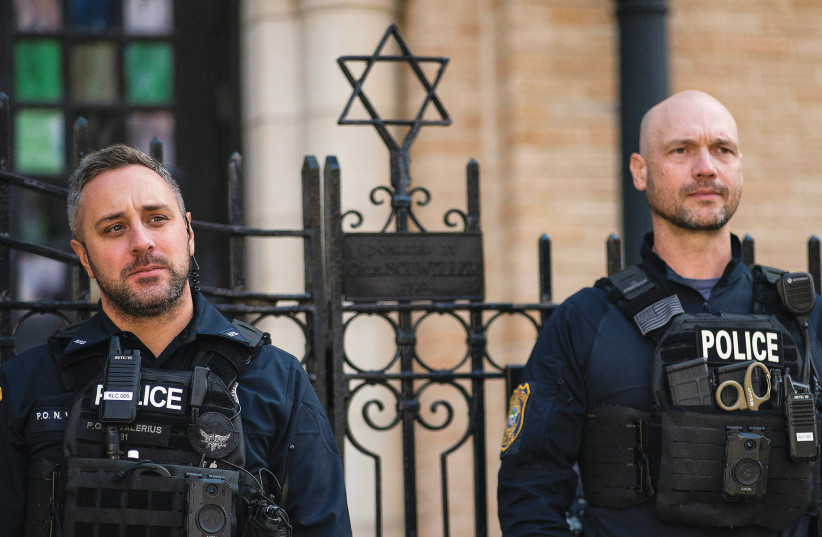
Across the country, Jewish organizations are forced to spend more than $765 million annually on security – money that could otherwise fund education, social services, or cultural programming. A typical Jewish organization devotes 14% of its budget just to stay safe. The cost of a single security guard? $90,000 per year. A full-time security director? $160,000.
These are not luxuries; they are lifelines. In an era of rising hate, Jewish institutions are forced to harden their buildings, hire armed guards, and install surveillance systems just to function.
This threat is pervasive and real. In 2025 alone, Jewish Americans have endured a Molotov cocktail attack in Colorado that killed an 82-year-old woman, a deadly shooting outside the Capital Jewish Museum in Washington, DC, and an antisemitic arson attack at the Pennsylvania governor’s residence on Passover.
According to the Anti-Defamation League, antisemitic incidents in the US have skyrocketed by 893% over the past decade. The Combat Antisemitism Movement calls this the “most severe wave of antisemitism since the end of the Second World War.” According to our own studies, half of American Jews have heard people justify violent actions against our community.
Seeking equal protection
We in the Jewish community are not asking for special treatment. We are demanding equal protection under the law.
That’s why more than 400 Jewish leaders from across the country, representing more than 100 Jewish communities from coast to coast, came to Washington this summer as part of the United for Security Emergency Mission, urging lawmakers to act, and why we are headed back to Capitol Hill for a High Holy Day security briefing ahead of Rosh Hashanah, the Jewish New Year.
In these impactful meetings, we are promoting a Six-Point Security Policy Plan, a practical, bipartisan road map to expand the Nonprofit Security Grant Program (NSGP) – which helps houses of worship of any faith cover security costs – fund security personnel, enhance FBI capabilities, support local law enforcement, hold social media platforms accountable, and prosecute hate crimes with urgency and resolve.
These are not theoretical policy proposals or partisan demands. They are the lived priorities of communities that are being forced to divert resources from education, social services, and spiritual life to pay for armed guards, cameras, and bulletproof glass.
This unjust burden on one community sets a dangerous precedent for all. If one group is forced to self-fund its basic safety due to identity-based threats, what prevents this “tax” from being levied against other faiths and minority groups when they face similar prejudice? We recognize that such efforts must be a public-private partnership, which is why our system has raised $130m. to ensure that each of our communities has a professional security program to coordinate security with every synagogue, school, camp, and community center, to develop and strengthen relationships with local law enforcement, and provide state-of-the-art security protocols and best practices. Nevertheless, the costs in the current threat environment eclipse that amount by several orders of magnitude.
While Jews are among the groups most disproportionately affected by violence and security challenges, we know many others are concerned for their safety as well. Our Catholic brothers and sisters in Minneapolis faced horrific tragedy late last month when a deranged shooter opened fire at the Annunciation school, murdering two innocent children and injuring many others. The security measures we are proposing would benefit everyone affected by the unfair burden of security needs, not just the Jewish community.
The first responsibility of government is to keep its citizens safe. The fight to eliminate the “Jewish tax” is, therefore, a fight to uphold the promise of liberty and justice for all, ensuring that no American citizen ever has to choose between their safety and practicing their faith.
Every American has the fundamental right to practice their faith without fear or intimidation. Congress has been a stalwart ally in the effort to protect faith. In the new reality the Jewish community faces, we ask them to again stand with us, help lift this burden, and ensure that no American must pay a penalty because of their background or faith.
The writer is president and CEO of Jewish Federations of North America, representing over 350 Jewish communities, raising and distributing more than $2 billion annually. Through planned giving and endowment programs, JFNA builds flourishing Jewish communities at home, in Israel, and around the world.