The international consensus for ending Hamas rule in the Gaza Strip and for its disarmament cannot be achieved without the use of military force. Therefore, the conquest of Gaza City, the final stronghold of Hamas, is imperative for removing Hamas from power and for Israel being perceived as the victor in the war.
After two years of debilitating Hamas in Gaza, of pushing Hezbollah away from Israel’s border, and destroying the Iranian key nuclear installations, Israel cannot claim it won the war. Those satisfied with the hitherto results suffer from strategic myopia. This war is not a boxing match where winning by points is possible. In Gaza – where the victory will be determined – a knockout is a must.
Historically, the losing side in a battle leaves the battlefield. If defeated, Hamas will leave Gaza. A victory picture amounts to ships evacuating the terrorist army to another destination (Turkey, Algeria, or Qatar). This desirable graphic emulates the July 1982 departure of 14,000 PLO terrorists from Lebanon to Tunisia. Without the eviction of Hamas – an unequivocal victory – Israel lost the war.
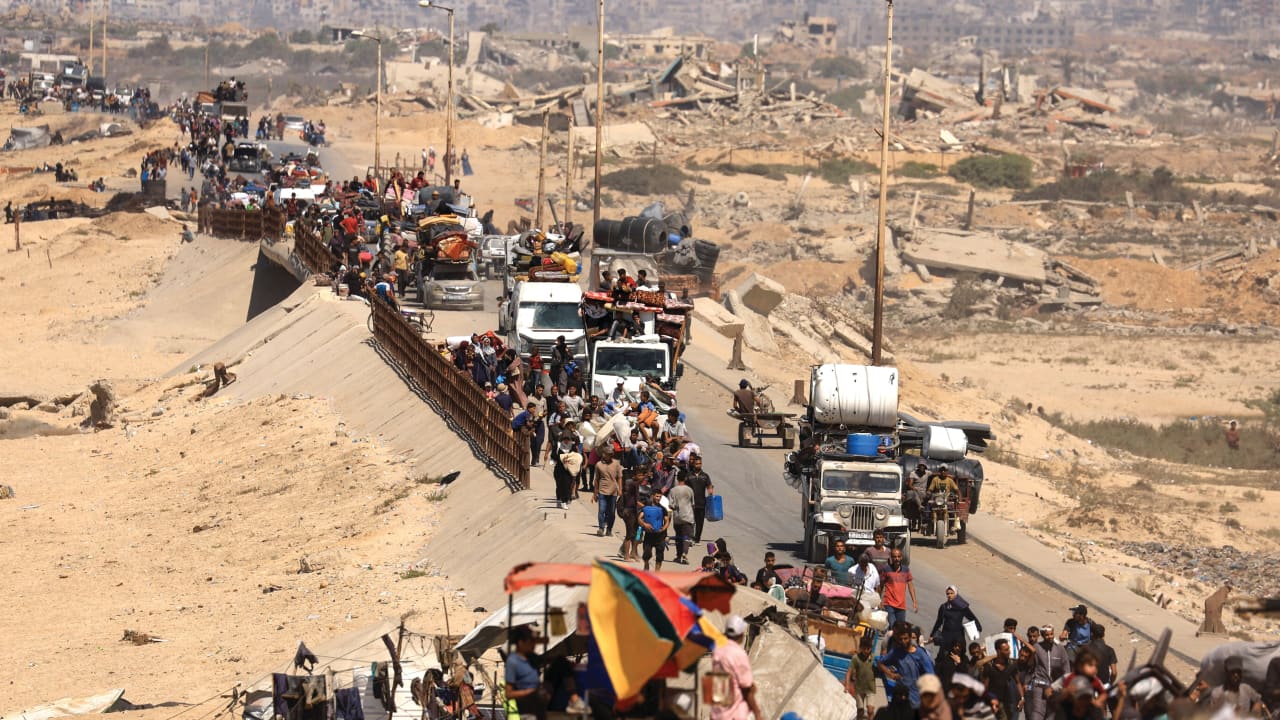
So far, the balance sheet of the war on Hamas is mixed. Its immediate threat to Israel has ceased to exist. Hamas is no longer deployed along Israel’s border and was deprived of its capabilities to produce and launch missiles. It lost most of its ruled territory and probably 15,000 to 20,000 combatants. The Gaza population largely moved to humanitarian areas, and vast destruction occurred.

The operations in an urban setting, the unprecedented scale of subterranean warfare, and the ceasefires imposed on Israel to free the hostages prolonged the war. Similarly, the Biden administration’s interference in the conduct of the war and its arms boycotts extended the war.
The length of the war allows Hamas, the flag bearer of the resistance (Mukawama), to claim victory because it survived for almost two years in the contest with Israel, the strongest military power in the Middle East. Hamas won the propaganda war, propagating the messages that Israel starves the people of Gaza and commits genocide.
It succeeded diplomatically, bringing about greater isolation of Israel in the world. Its greatest achievement was triggering a multi-front war against Israel – a historic objective of Palestinian strategists.
At this point, Israel cannot claim victory. Moreover, Israel is running out of time. The world doesn’t like long wars, and continuous American backing is not assured. Therefore, a patient siege is not an option for attaining victory. A swift frontal attack to conquer Gaza City is needed to preempt the imposition of a ceasefire and to achieve victory.
The overthrow of Hamas has to reverberate in the Palestinian context, but also in the Middle Eastern and global arenas.
Inflicting pain
The October 7 atrocities were intended to destroy the Jewish state. The commensurate response should be another decisive defeat. Israel must signal determination to fight and willingness to take losses in the protracted conflict with the Palestinians.
In every war, the result is determined by two equations. The first focuses on which side can inflict more pain.
Obviously, Israel has the upper hand on this matter. The second equation, no less important, is about who can take more pain.
So far, the Palestinians have demonstrated great ability to sustain pain. Actually, the glorification of victimhood has become part of their collective identity. Alas, their cumulative defeats have not changed their intense opposition to the existence of Israel.
Moreover, they, like other enemies of Israel, believe that Israeli society is weak, eventually crumbling under the weight of the violent conflict. The spiderweb is a famous metaphor. The political rifts over the legal reform in Israel and the obsession with the hostages seem to confirm this image. Israel must dispel such beliefs by defeating once more the violent Palestinian attempt to destroy it.
Expelling Hamas is also needed for a transition to “the day after,” whatever that means. There is no “day after” if Hamas units are allowed to stay in Gaza. Who will come to maintain law and order, risking Hamas terrorism?
A victory over Hamas also strengthens regional stability and the peace with Israel. All the states that have peace treaties with Israel – Egypt, Jordan, the Emirates, Bahrain, and Morocco – abhor Hamas, an offshoot of the Muslim Brotherhood.
These states view the Muslim Brotherhood and its financial backer, Qatar, as a danger to their regimes and to regional stability. Qatar’s media network, Al Jazeera, is a Muslim Brotherhood voice, broadcasting aggressively anti-Israeli, anti-Western content.
A victory over Hamas will also constitute a setback to the emerging radical Sunni axis. As Israel weakened the Shi’ite axis led by Iran, Turkey tries to fill in the vacuum.
President Recep Tayyip Erdogan and his party, a Turkish version of the Muslim Brotherhood, are leading Turkey, a strong country with a military presence all over the Middle East.
Turkey has hegemonial ambitions fueled by Islamist and Neo-Ottoman impulses. It is backed by the financial prowess of Qatar. Such a Sunni radical axis could become more dangerous than the Iranian Shi’ite crescent.
A Hamas beating would also preempt the emergence of an Islamic lake in the Eastern Mediterranean. Hamas-ruled Gaza, a stretch of coastal land along the Mediterranean, has been backed by Turkey, a Mediterranean naval power with a military presence in additional Mediterranean states such as Cyprus, Libya, and Syria.
Turkey is increasingly involved in Lebanon, a potential part of such a configuration, while Egypt could also become a part, if the Muslim Brotherhood, the strongest political force in Egypt, returns to power.
The defeat of Hamas is crucial also from a global perspective. Islamists, Sunni or Shi’ites, are modern barbarians committed to the downfall of the West. They are active all over the world. In the West, local Islamist cells cooperate with the radical Left, a “red-green alliance.” An Israeli victory in Gaza is a blow to this alliance and will diminish the appeal of Islamism beyond the Middle East.
A victory of Israel will inject encouragement to the conservatives and the nationalists in the free world, who mostly view Israel as a Western nationalist bastion in a rough neighborhood. Ironically, the anti-Western red-green alliance shares this view, leading to support for Hamas.
Finally, victors write history. Therefore, Israel must fight hard even if the price for attaining victory is high.
The writer is head of the Program for Strategy, Diplomacy and Security at the Shalem Academic Center and a senior researcher at the Jerusalem Institute for Strategy and Security (JISS).