
Over the past 30 years, I have often shared my memories of prime minister Yitzhak Rabin. The memories haven’t changed. But I have – and so has the country and the prism through which we recall events.
I grapple with the fact that while many Israelis remember exactly where they were when they heard about Rabin’s assassination on November 4, 1995, there is an entire generation that knows him only from history and civics lessons.
If Rabin’s assassination was Israel’s “Kennedy moment,” the Hamas invasion and mega-atrocity on October 7, 2023, was Israel’s “9/11” on steroids. It has colored the way we look at everything, “before” and “after.”
An AI search – the stuff of science fiction in Rabin’s day – describes him as “an Israeli statesman, military general, and two-time prime minister who pursued peace with the Palestinians and other Arab neighbors. His career culminated with the signing of the Oslo Accords, for which he received the Nobel Peace Prize, before he was assassinated by a right-wing extremist in 1995.”
It is, of course, a simplified version of his life. Had Rabin died of natural causes, he would be remembered by Israelis mainly as chief of staff in the 1967 Six Day War; the prime minister who helped the IDF recover after the 1973 Yom Kippur War, and who ordered the stunning Operation Yonatan hostage rescue in Entebbe during his first term in office.
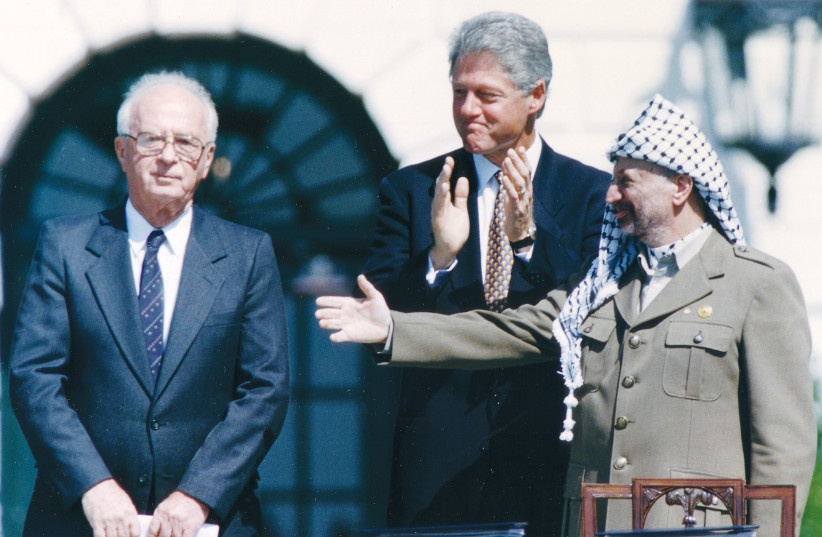
During his second term in office, he became an international icon after signing the Oslo Accords with the Palestinians, led by arch-terrorist Yasser Arafat, with whom he was awarded the Nobel together with Shimon Peres, although the accords were hugely divisive in Israel. The peace treaty with Jordan was far more popular.
As The Jerusalem Post’s parliamentary reporter, I regularly saw Rabin close up. I grew familiar with his distinctive half-smile, dismissive hand gesture, and dry wit. I also wrote about the massive failure by the Shin Bet (Israel Security Agency) to protect the prime minister and the later revelations that it had operated agents provocateurs like Avishai Raviv (“Champagne”) to whip up the anti-Rabin rhetoric at rallies opposing the Oslo Accords.
I was present at the brief ceremony in the Prime Minister’s Office in Jerusalem in September 1993 when he initialed the First Oslo Accord, recognizing the PLO. This was not a festive event, and journalists far outnumbered the “celebrants.” There were no Palestinians, just a few Israeli officials, and the four Norwegian diplomats who put the “Oslo” into the accords’ name.
I might have been the only person present who had publicly warned about the Oslo process – concerned about where the “Gaza and Jericho First” concept would end up. Rabin did not look any happier than I did. Oslo was largely the work of his political nemesis, Peres.
UNLIKE OSLO, I wholeheartedly celebrated the peace with Jordan, which I followed from the initial talks in an air-conditioned tent at Ein Evrona in the Arava desert. The signing of the peace treaty, 31 years ago this week, was truly historic and – although the peace is cold and far from Rabin’s vision – it has withstood even the tests of the post-October 7 war on seven fronts.
I had the opportunity to see the clear chemistry between Rabin and Jordan’s King Hussein, as they strolled together on the grounds of the Winter Palace in Aqaba, not long after the peace treaty was signed.
Incidentally, one of my memories from the ceremony is of the prime minister’s wife, Leah Rabin, mobilizing soldiers to search for a brooch that she lost somewhere at the desert site. I can just imagine what the headlines would say were Sarah Netanyahu to do something similar today.
It was the discovery that his wife had a dollar bank account in the US, in violation of Israeli foreign currency regulations, that caused Rabin to resign from the Labor Party leadership ahead of the 1977 elections. These were the elections that brought the Likud, under Menachem Begin, to power and changed the political face of the country.
That Israel managed to reach agreements with Egypt, Jordan, and with the Abraham Accords countries (for which US President Donald Trump deserves the Nobel Peace Prize), shows that peace is possible when there are partners who are genuinely willing to accept the existence of the Jewish state.
It is often overlooked that Rabin’s last term as prime minister was also marked by the rift caused by talk of leaving the strategic Golan Heights. The shocking and tragic nature of his death changed the way the public remembered him. The soundbite of Rabin in the Knesset comparing “settlers” opposed to withdrawal to “spinning propellers” has faded with time.
Today, we can understand just how disastrous handing the Golan Heights over to the Assad regime in Syria would have been. In the same way, even those who ardently supported Ariel Sharon’s unilateral withdrawal from Gaza in 2005 now realize that it was a stepping stone to the October 7, 2023, calamity. Indeed, the roots of October 7 can be traced back to the Oslo days.
ONE OF MY favorite Rabin recollections is from a 1993 tour of the Mandate-period detention camp at Atlit, where the British authorities used to imprison newly arrived Jews. Rabin told of his experiences as the deputy commander of a Palmach operation that helped more than 200 immigrants break out one night.
The Palmachniks had to get the newcomers up Mount Carmel to the safety of Kibbutz Beit Oren. He placed a two-year-old on his shoulders and set off as fast as he could. “Halfway up, I thought, ‘I’m really sweating,’” Rabin recounted. “Then I realized the warm, wet trickle down my back was coming from the toddler.
“But this is just one of the things I had to do to serve my country,” he added, with that trademark half-smile.
This was obviously a pleasanter memory for him than the shooting of the Altalena – a ship carrying arms for the Irgun in the early years of the state. It was largely the response of opposition leader Menachem Begin that prevented civil war.
Just after Rabin’s assassination, I met Likud MK Dov Shilansky, a former Knesset speaker, who was distraught. He had arrived as an immigrant on the ship on that fateful journey, but told me he had forgiven Rabin after Rabin had paid a shiva call to the Shilansky family when their son was killed in the military reserves.
One of my last memories of Rabin was of the prime minister joking and in unusually good spirits at the Labor faction meeting, just days before he was fatally shot at the peace rally in Tel Aviv. I remember, too, the incredible parade of international leaders who passed by his coffin at the Knesset, paying their last respects.
What would have happened if Rabin had never been assassinated?
THERE IS NO way to know what would have happened had Rabin not been assassinated. (And I can’t help wondering what would have happened had Trump not survived the two assassination attempts ahead of his last election.)
While the Left often claims that Rabin’s assassination killed the peace process, Palestinian suicide bombers were blowing it up from the start. Would Rabin have continued along the path that Peres was pushing him down or backtracked? After all, as defense minister during the First Intifada, Rabin deported hundreds of Hamas terrorists to Lebanon and was known for his “Iron Fist” policy.
The Israeli “pro-peace” camp has never forgiven Benjamin Netanyahu for beating Peres in the elections that followed Rabin’s assassination. In fact, the Left has never forgiven Begin for beating Rabin in the 1977 “Upheaval.” Among other things, this was the catalyst for the shift of power from the government and Knesset to the attorney-general and courts.
This led to its own chain reaction. The turmoil over the proposed judicial reform and the response to it that preceded October 7 considerably weakened the country and contributed to the disaster.
Political assassinations threaten democracy, whichever side they come from. Earlier this year, a woman was arrested for allegedly plotting to kill Netanyahu. In an era when hate speech is literally viral, courtesy of social media – in a way that was unimaginable 30 years ago – much greater care must be taken to avoid demonizing the country’s political leaders. They are human beings, neither saints nor satanic.
Rabin’s legacy has been eroded over the past three decades, but the lesson about the dangers of political extremism must not be allowed to die.