
Mojtaba Khamenei is infinitely more dangerous than his predecessor and father, Ali Khamenei, as he is more willing to lie and places less value on human life, a former study partner of the new supreme leader told The Jerusalem Post.
Jaber Rajabi, who worked as a foreign-policy adviser to then-Iranian president Mahmoud Ahmadinejad and as a go-between for the regime-backed militias in Iraq, spoke with the Post through a written translator from his home, where he has been living under local protection in exile since 2021.
From a family loyal to the regime, Rajabi’s father fought in the Iraq-Iran War, and his mother worked for a short time in the office of the now-assassinated supreme leader. It was this history that led the regime to recruit him after discovering that he fought in Muqtada al-Sadr’s terrorist groups against US forces in Iraq.
During the 2004 Battle of Najaf, where the United States and Iraqi government forces fought against the Shia militia led by Sadr, Rajabi was shot in the right shoulder and taken to hospital, where the Islamic Revolutionary Guard Corps discovered him and recruited him to groom the Iraqi militias.
He would go on to become a founding member of both Asa’ib Ahl al-Haq, a prominent Iran-backed Iraqi Shia Islamist paramilitary organization and political party, and Harakat al-Nujaba, a Shia paramilitary group once active in Syria but now predominantly based in Iraq.
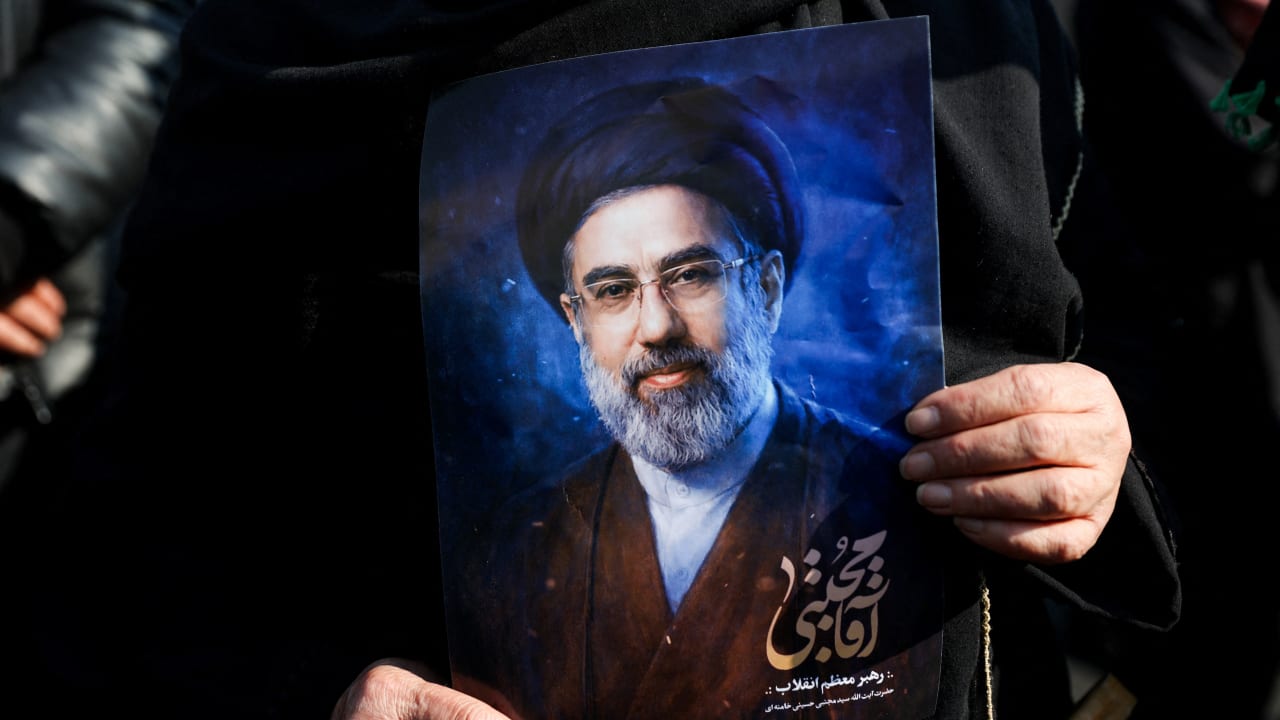
Rajabi first encountered Motjaba Khamenei in Qom, where he began studying alongside him at a religious seminary. The Qom Seminary, known as the Hawza Ilmiyya of Qom, is the most highly regarded center for Twelver Shia Islamic scholarship in Iran.
Hidden intentions
“Mojtaba, at that time, was very hypocritical. He says something, but inside him there is something totally different,” Rajabi recounted to the Post. Rajabi had earlier told The Atlantic that his former study partner was obsessed with the end of days and had believed “he himself will have a special part in hastening humanity down that path.”
Twelver Shia belief holds that the 12th Imam, Muhammad al‑Mahdi, who is believed to be in hiding, will return at the end of times to establish a period of global justice in which oppression is eradicated. Islamic apocalyptic traditions also describe major conflicts preceding this era; in Sunni hadith literature, one such event is the Malhama al‑Kubra, a great battle sometimes interpreted as a confrontation with Western powers.
“I remember Khamenei spoke in Hawza studies [and] said the nuclear issue and the soldiers are his heritage. Mojtaba’s ambitions will not be impacted by airstrikes,” he recalled. “There are other matters I can’t mention... They need the nuclear issue as a protection for their regime and their hegemony in the region.”
“I said many years before, if war breaks out, that Mojtaba will try to control the region,” Rajabi asserted. “Let the Americans know that they do not expect that if Mojtaba takes steps back and looks to live in peace, that it is an actual intention from Mojtaba.”
Mojtaba has a complete disregard for the value of human life, Rajabi described.
“If he can kill 13,000 of his own people, then he has no problem killing 100,000 in Tel Aviv, because if you don’t care about the lives of your own people, why would you care about the lives of others in Tel Aviv?” he continued.
Predicting what the coming months, and possibly years, would look like under the new supreme leader, Rajabi said, “Mojtaba will not, from the first day in power, claim to want to take Al-Quds (Jerusalem). He is opposite to his father, who gets angry, and it is visible… Mojtaba can lie in a much better way and knows how to play.”
“He wants to win time. He wants to trick the Americans and the region to win trust… he thinks that first he needs to control the Middle East region, and for him it is more of a religious matter than a geopolitical matter,” he explained, seemingly hypothesizing that Mojtaba will first approach the West with a softened tone.
Rajabi is familiar with the ease with which Mojtaba Khamenei lies, he continued, recounting his perception of the attempts on his life by the Islamic regime. Rajabi said he left his government position in the regime alongside Esfandiar Rahim Mashaei, a former senior aide to Ahmadinejad, in 2017, adding that the pair were imprisoned together. His “closeness” to Mojtaba protected him, he told the Post.
“They were a bit afraid to harm me while I was criticizing the regime,” he claimed but added that his apparent ability to openly discuss corruption came to a halt when he started talking about Mojtaba’s financial networks. “Now the world knows he has strong financial power,” he said.
Mojtaba Khamenei controls a vast financial empire worth at least $3 billion in London, Britain, the UAE, and several other European countries, in addition to Iran, The Media Line reported, adding that none of the assets are in his name officially.
Rajabi said he survived a poisoning attempt by the regime, though the arsenic destroyed his teeth, in addition to a later electrocution attempt.
“When I was poisoned, Mojtaba came to me and said he would investigate the matter, and the poisoning had nothing to do with my (his) side,” Rajabi recounted. “I am, however, sure it came from the Khamenei household. For example, it was after I spoke about Mojtaba’s financial network that the word started to investigate this matter. Now the world knows he has a strong financial power.”
In addition to surviving multiple assassinations by the Islamic regime, Rajabi has survived several battle injuries from his time fighting in the Iran-backed militias. Bullet fragments remain lodged in his head from a sniper shot during his 2017 battles against the Islamic State.
Irans 'Axis of Resistance'
Rajabi has fought across the region as part of Iran’s ‘Axis of Resistance,’ including spending a brief time with Hezbollah. He told the Post that he had noticed the level of Iran’s influence did not reach neighboring Iraq as it did in Lebanon and said he believed many of the Shia forces had a softer approach when it came to Israel.
“Hezbollah, I have a known letter sent to Qasem Soleimani. I have many interactions with Hezbollah leaders. We cannot remove Hezbollah from the IRGC and they are part of Quds Force and just like the IRGC members have registration numbers with IRGC, Hezbollah [is] the same [as the] IRGC. They cannot be separated,” he asserted.
“As for Iraq, it is a different matter.
“Some [militias] are forced to work with Iran, such as Kataib Hezbollah and Nujaba. Others are allied with Iran. In my opinion, there are Shia forces ready to join the Abraham Accord and live in peace with everyone,” he claimed. “But Iran wants to ensure that if the regime collapses, they will create circumstances that force them to create a new ‘Axis of Resistance’ from Iraq, Lebanon, and Yemen.
“Ahmadinejad understood that Khamenei was luring the people in Iran and the region and the world. I mentioned Ahmadinejad as one example. There are several like Ahmadinejad in Iran… they are ready to join us, and they would join the Abraham Accords, they would stop the hegemony ambitions of Iran in the region and stop interfering in the internal affairs of other countries.
“International law will be implemented in Iran, also UN resolutions. The Iranian people has to choose their future in free and fair elections under the UN supervision.”
A strong proponent of the former president, Rajabi asserted that any new leadership must be selected internally and have the support of the Iranian people.
“As for Israel, they [the Iranian leadership] need to understand that there is a segment in Iran that doesn’t see them as an enemy and instead views them positively,” he said. “But they do not want Israel to try to impose someone from outside on them,” he continued, hinting that the exiled crown prince would not be welcomed.
Despite spending decades working on behalf of the Islamic regime, Rajabi has preached to Western media about his desire to see a liberal Iran.
“I want to wake up and see no [religious] turbans, no mention of an Islamic Republic. I never want to hear of such things again,” he told The Atlantic.
“We will go on television, and as statement No. 1, we will declare that we do not want war with the world or hostility of any kind with America and Israel.”
While preaching in support of a return to a secular Iran, Rajabi asserted that there was no way to remove the IRGC from the future of the country.
“There are a million fighters in IRGC. They need to know that they will have a role in the future of Iran, and they need to know there won’t be revenge… This is a golden opportunity for Israel,” he claimed, mirroring comments he made in The Atlantic suggesting the majority of the guards could either be repurposed or retired and only the leadership killed. “If they don’t get guarantees, they will find the last bullet,” he warned.