
“F–k the Jews!” We heard shouting as our Friday night walk was abruptly interrupted. I looked at my friends, David and Tuli, and asked, “Did you hear that?” David nodded yes. Tuli, naturally, the cynic of the group, muttered: “Oy oy oy… another Jew falls victim to an antisemitic attack.”
Instinctively, we checked ourselves. David, who has payos, tucked them tightly into his hoodie. I adjusted my cap. We didn’t say anything; we were simply trying to make our identity less visible, less recognizable.
We reached the corner, and a white male in his thirties stepped towards us. With an Irish accent, he repeats, this time louder, as if he's testing us: “F–k the Jews, F–k the Jews, right?”
Frightened, Tuli mumbled, “Cheers, mate.” The man let us pass. For a few minutes, our conversations went silent. Then I looked at Tuli and said quietly: So… what now? Another Jew fell victim?”
This wasn’t my introduction to the country. I first visited Ireland in November 2018 with my wife for a little getaway. Even then, I noticed a visible sympathy for the Palestinian cause in the streets of Dublin. At the time, having a less-than-fulfilling understanding of Ireland's complex history and its instinctive desire to identify with the oppressed, I made a note to myself: I need to come back one day and understand this sentiment a bit better.
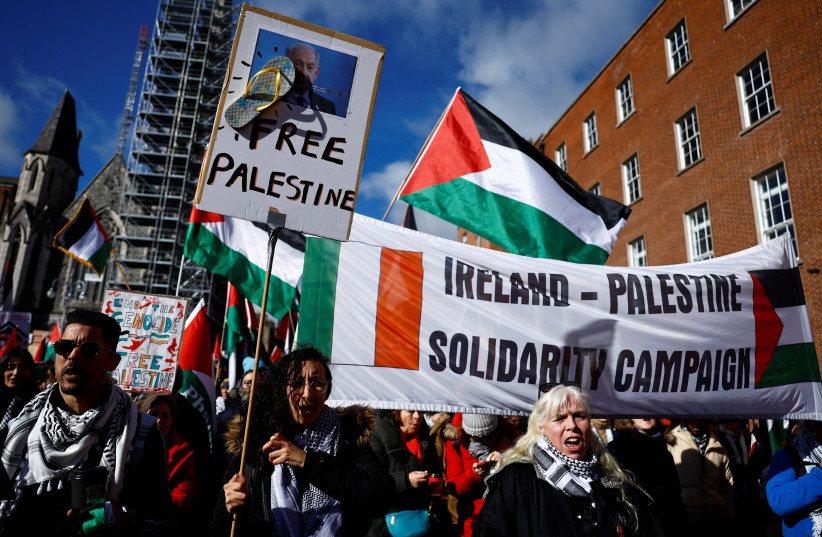
Jewish perspective on travelling Ireland
Now, with the Palestinian cause dominating global conversation, I decided it was time to return and look more deeply. And there seemed to be no better place to begin than at the heart of the island’s history. The city of walls, division, and historical resentment: Belfast.
In Belfast, we crossed both sides of the wall in one night. We visited both the Royal Bar in the loyalist Shankill Road and the Felons Club in the nationalist Falls Road. Making our way from one to another, our driver looked back at us and said, “Decades I have been driving these streets. This route is a first, and probably a last,” he added with a smile.
Sitting with the loyalists in the Royal Bar was amusing. They knew I was Jewish; one of them even bought me a beer and cracked some humorous cultural jokes at me, none of them hostile. When I asked if there would ever be peace in Northern Ireland, he answered, “Never,” and impulsively added, “There will never be peace in the Middle East either. It gave me the sense that in his mind, the Israelis and Northern Ireland's loyalists have similar struggles.
A sentiment reinforced the following day when we visited the loyalist side of the peace wall, finding Israeli flags plastered across the bricks with open declarations of support in Hebrew for the Israel Defense Forces and the current Israeli government.
The Felons Club on the nationalist side felt entirely different. The entrance was plastered with “End the Genocide” stickers. Inside, green Irish club shirts hung on the wall, the back of the shirts, a large Palestinian flag. We were also met with many solidarity posters for the Palestinian cause. It felt as though Palestinian liberation is a central part of the club’s identity, even more than Irish nationalism.
When I said that I am a Jew of New York, eyebrows were lifted, as if “the Jew” had arrived. It didn’t take long for someone to ask me what I think about the “Genocide in Gaza”. I told him that I was pained to see so much bloodshed on both sides, that as a Jew, I carry deep sorrow over the many Palestinian children killed, and that I pray every day for an end to the human loss and for a lasting, real peace.
The conversation stalled. There was discomfort in the air. When I gently asked what they thought needed to happen with the eight million Jews currently inhabiting parts of the land and whether they believed Jews had a right to national aspirations, just as they, the Irish, had fought for theirs, the reply was elusive: “Maybe come back tomorrow… I drank a bit too much,” someone said.
That strong sense was felt once again the next morning when we walked along the peace wall. The nationalist side was covered with murals of dead Palestinian children, mass graves, and slogans like “Free Marwan”.
Stepping into a gift shop on the nationalist side, I was met with a huge Palestinian flag behind the counter. The shelves were filled with militant patches, keffiyehs, keychains with rifles, and slogans like “When injustice becomes law, rebellion becomes duty.” A discount store, a few streets over, had a small Palestinian section. In parts of Belfast, I felt that Palestine wasn’t a passion; it had become part of the Irish identity.
After seeing all that, my mind kept going back and forth. Maybe the sympathy is genuine. Maybe they do deeply feel for the Palestinian cause, after all, Ireland has its fair share of colonial history, struggles, and trauma.
I myself feel profoundly for the Palestinian civilians just as I feel for the Israelis who have endured so much. The subject is not black and white; it never has been. But the intensity these streets had, the obsession, was hard to ignore. It felt to me as if this was the only conflict or current case of oppression in the world, like a single lens through which everything must be seen and understood. I couldn’t come to a clear conclusion.
Back in Dublin, we set out to visit the oldest Jewish cemetery in Ireland. Established in 1718, it is the country’s oldest surviving Jewish site. Yet when we arrived, the cemetery looked abandoned. Hazard tape surrounded the perimeter, no posted hours, no contact information, no sign of any official oversight. For a place of such deep significance to Jewish life and to Ireland’s own story, the neglect was clearly evident.
We then headed to the Irish Jewish Museum, founded by President Herzog, who was born in Dublin and whose father served as Ireland’s chief rabbi. We arrived during its brief opening window, just a few hours a week. Inside, I met Shlomo, an 83-year-old keeper of a fading world.
He told me a little about the history of Irish Jewry. “This city has been home to many synagogues,” he said. “Now we only have two left.”
He urged me to look around, and I saw photos of a once thriving community, Judaica artifacts of all holidays, and evidence of vibrant Jewish life. Upstairs, a humble sanctuary remained. I opened the old ark, kissed the lonely Torahs, whispered a prayer, and made my way back down.
Filled with emotion, I ask Shlomo, “How is the community holding up?” His eyes filled with tears. Seeing an 83-year-old man crying on a Sunday morning was not easy. “We’re not doing well,” he said. We just sold the land of the last standing Orthodox synagogue in Ireland. This is the last year it will be in use. It will be demolished.” One hand on his heart and the other wiping his tears, he added, “If my father were alive, he wouldn’t be able to bear it.” I pressed him: “Shlomo, is the Irish government helping in any way?” He answered in broken Yiddish: “Gurnisht mit gurnisht.” Nothing with nothing.
From there, we went straight to the airport. My heart is sinking deeper by the minute. How did a centuries-old community, once numbered in the thousands, burn out? How is it possible that in this day and age, a modern “Western democracy” is facing the prospect that within a decade, it may have no Jews left at all? Reduced to a small museum, a memory. The Jewish people have gone extinct on Irish soil.
It left me with a deeply painful question: Is the multicultural experiment of the West inclusive of everyone except the Jew?
I am not sure who to blame. Fate, perhaps. Or the Israeli government’s actions, combined with its long-standing policy of presenting itself as the representative of world Jewry, something that leaves Jews everywhere answerable for the actions of a directorate they did not choose and do not control.
Or perhaps the failure of the Irish to distinguish between Middle Eastern politics and conflict to its own centuries-old Jewish community, and its government's deep failure to protect and preserve its Jewish community with the mere basics. Or maybe it is simply the tribal “us-versus-them” instinct that becomes visible in trying times.
I don’t know. It is probably a mix of all of these.
What I am certain of is: Coming home from Ireland, I am worried about my continuity as an American Jew, more than ever before. It is our responsibility, as American Jews, to ensure that what happened in Ireland does not happen in America