The unprecedented US military raid in the Caribbean that seized Venezuela’s president and replaced him with his deputy has sent shockwaves through Iran’s ruling elite, who now fear that they could be next.
As preparation, psychological warfare has already begun:
US Sen. Lindsey Graham amplified these sentiments by threatening to “use military force” against religious “Nazis” in Iran. For Washington’s political constituency, if “narcoterrorism” justified military intervention in Venezuela, then religious “Nazis” ruling Iran should rationalize another.
In Israel, former prime minister Naftali Bennett posted a 12-hour countdown threatening Iran: “Tick, Tock, Tonight.” He is capitalizing on anti-Iran sentiment ahead of the upcoming elections.
In the Islamic Republic, the Defense Council warned “enemies” of a preemptive strike. This alarming declaration came even after Russian President Vladimir Putin conveyed Prime Minister Benjamin Netanyahu’s assurance that no Israeli attack was intended. Ayatollah Ali Khamenei confirmed receiving the message but called Netanyahu “a deceiving liar” whose assurances cannot be trusted.

In exile, Iranian Crown Prince Reza Pahlavi has given extended interviews amplifying claims that the regime is fractured and that a democratic transition is imminent.
The turbulence in Venezuela has intensified the Iran vortex.
Venezuela as Iran’s blueprint
Having subdued Caracas, Washington now corners Iran’s supreme leader: accept US-Israeli regional hegemony or face removal. Khamenei confronts a devil’s dilemma – capitulation or decapitation – with regime preservation as the sole caveat.
The first signal came via US President Donald Trump’s social media post a day before the Caracas raid, warning Tehran that “America is loaded and locked” to “rescue” Iranian protesters. After Nicolas Maduro’s capture, Trump repeated the warning aboard Air Force One: if Iran “starts killing people,” Khamenei “will get hit very hard” – though no specific redlines were set.
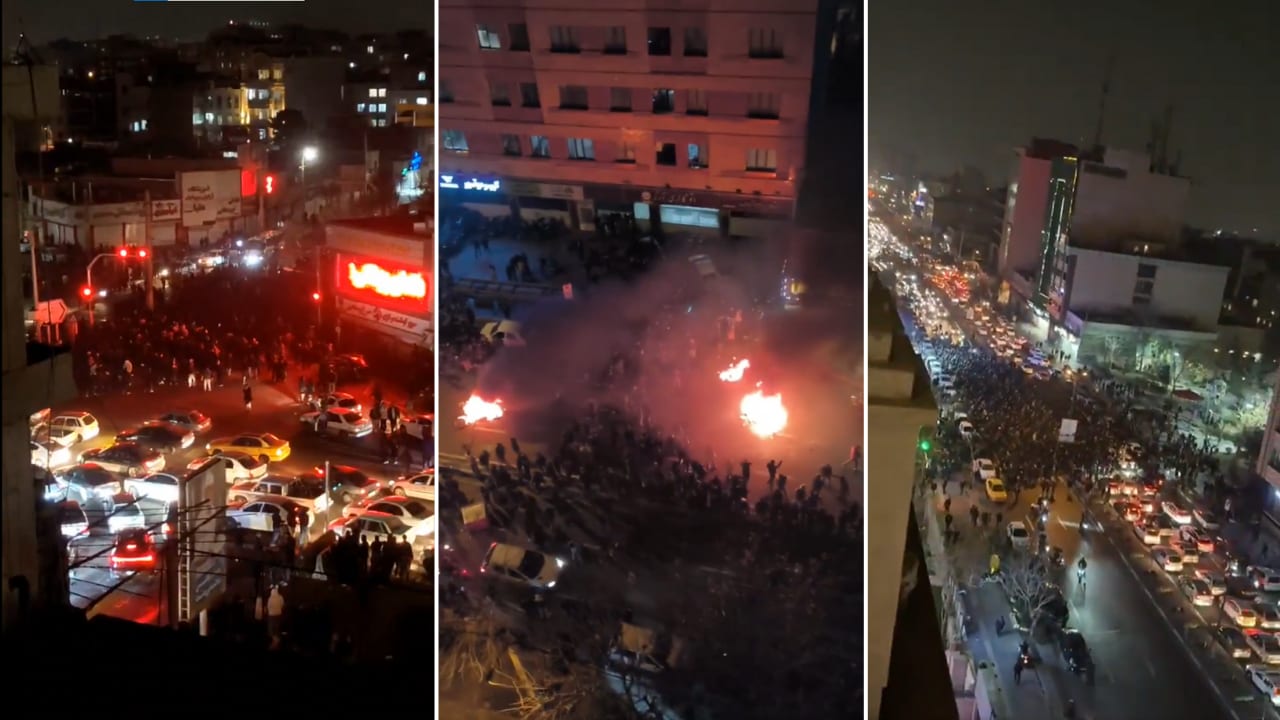
Since Trump’s empathetic promises, protest deaths in Iran have doubled and hundreds have been arrested. Protecting peaceful protesters without American boots on the ground appears implausible and contradicts Trump’s National Security Strategy of avoiding fruitless “nation-building” wars. Last June’s airstrikes on Iran failed to weaken its repression apparatus, as events today demonstrate.
Iranian officials’ sharp reactions confirm that Washington’s threats landed in Tehran as more than rhetoric. Trump’s statements could be dismissed as bluster – energizing unrest to weaken the regime before forging a deal. Yet Tehran’s reading is stark: for the first time, its archenemy has directly threatened regime survival and the Supreme Leadership itself. Such perceptions breed miscalculations that have historically triggered devastating interstate wars.
Targeting the supreme leader reverses Trump’s earlier opposition to Israel’s plan to kill Khamenei during last June’s war. Leaked transcripts from a top-secret Israeli cabinet meeting quoted Netanyahu as saying: “If Khamenei reacts to an American strike, it could be the end of the regime.” Iran retaliated by launching two dozen missiles at a US base in Qatar but signaled de-escalation, sustaining a ceasefire since then.
Tehran’s perception has now shifted. De-escalation attempts have failed to deter Washington. Iran’s lesson since Qassem Soleimani’s assassination six years ago is that sparing American lives did not restrain Trump’s threats. This reading is evident in a recent social media statement by the head of Iran’s National Security Council threatening to kill American soldiers in the next conflict.
The signals suggest Tehran’s next moves will follow the logic of the “game of chicken” and escalate – a break from a decade of restraint and a tactic that impelled Trump toward a ceasefire deal favoring the Houthis, an Iranian proxy, in May 2025.
Prospects for Washington of a post-Khamenei era
Washington’s revised posture – targeting Khamenei and engineering a power vacuum – suggests behind-the-scenes intelligence dialogue with senior Iranian officials over succession planning. Illustrative is the former UK security minister, who, following a BBC Persian interview, posted unusually in Persian on X/Twitter, subtly inviting officials to defect before the ship sinks.
Iran’s political developments are accelerating as the supreme leader’s house of cards trembles. Khamenei’s fall – without ending dictatorship – would empower security and military apparatuses closely aligned with Beijing and Moscow, which are poised to dominate post-Khamenei Iran.
Iran’s political gravity now orbits a core question: Who can orchestrate this transition while easing public unrest?
The Venezuela blueprint suggests that Washington prefers an insider to manage transition – someone akin to Maduro’s deputy Delcy Rodríguez, whose brother heads parliament and commands deep military ties. Even a like-minded pro-Israel opposition figure, however popular or Nobel Prize-backed, appears less palatable to Trump’s security calculus. What unfolded in Caracas – and may soon reach Tehran – marks only the end of the beginning of global disorder.
Prospects for Iranians of a post-Khamenei era
The tragedy of Iran, in US Secretary of State Marco Rubio’s words, is that “no nation like Iran shows a wider gap between its ancient people and its rulers who do not represent the nation.” Yet Washington’s power politics may simply replace clerical rulers with military ones, despite Rubio’s empathetic rhetoric.
The critical question is whether Iran’s growing public protests – notably absent in Venezuela – will shape political outcomes or be subsumed by Washington’s agenda.
Given the absence of an effective, pluralistic, inclusive Iranian opposition capable of serving as a viable transition mechanism, Trump would rather strike a deal with a regime strongman than invest in what Rubio disingenuously framed as Iranians’ aspirations for a grassroots liberal democratic alternative outside the system.
The bitter reality is that the West backed the illusion of internal reform for two decades but never invested strategically in a liberal democratic opposition – one that builds coalitions across divides, commands institutional influence, controls military levers, offers credible governance, and balances Iranian national interests with US demands while accommodating Russian and Chinese concerns. Without such investment, any uprising merely fuels great power rivalry and produces death and misery without shifting power toward a representative Iran.
Globally, the military intervention of Venezuela signals great power geopolitics in real time. US violation of Danish sovereignty over Greenland would surprise no one. Great powers now carve spheres of influence through raw military, economic, and technological force. Russia has effectively surrendered Syria to Washington via Turkey, while America appears prepared to cede Ukraine and Europe to Moscow. The US claims the Western Hemisphere, beginning with Venezuela; China prepares to seize Taiwan for pride and prestige.
In the emerging regional security architecture, Iran is slated to fall under Israeli hegemony backed by American military power. Yet even cornered – with or without its supreme leader – the Islamic Republic retains options, from blunt domestic repression to regional preemptive war.
Beyond the regime’s playbook, Iran’s complexity as both a civilization and nation-state will challenge this Washington-Jerusalem order – unless a political solution emerges in which Iranians feel genuinely represented by their new state.
The writer is a strategic Iran analyst at the Hague Institute for Geopolitics and a lecturer at the Hague University.