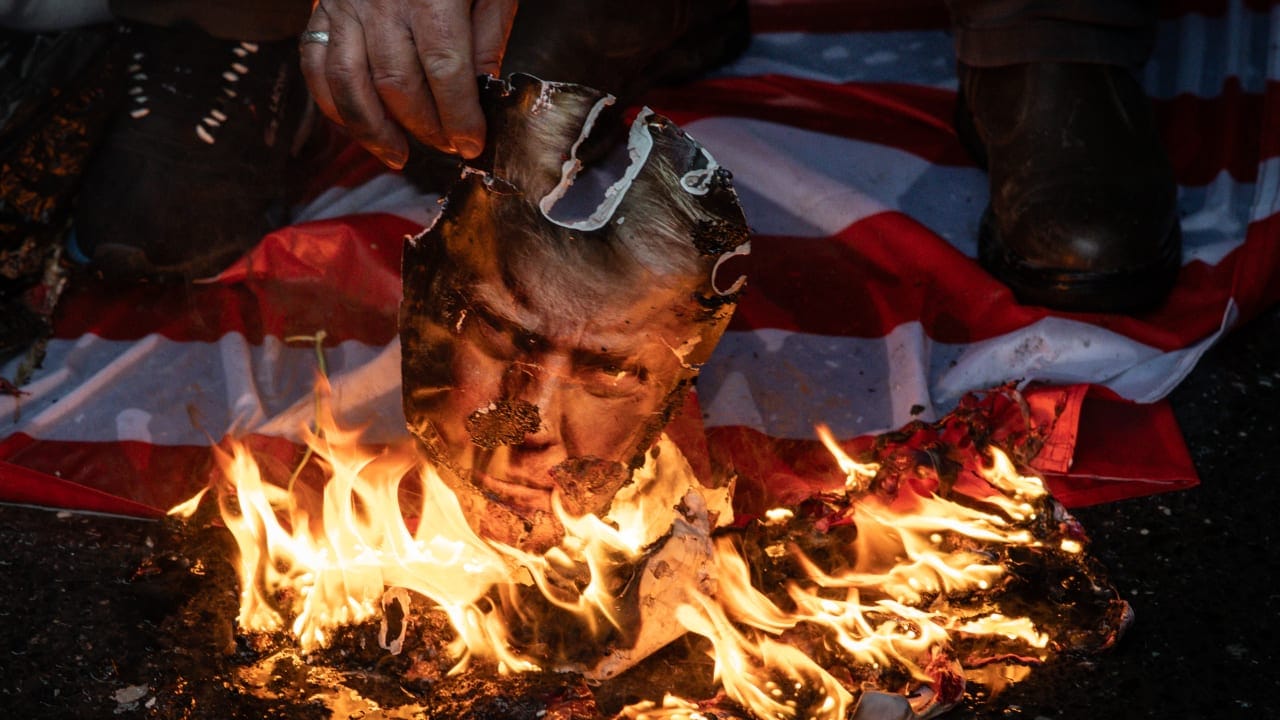
The oh-so-sophisticated foreign policy specialists and expert defense analysts are out in full force explaining to anybody who will listen that it would be a mistake for US President Trump to attack Iran.
A military assault on Tehran will not save the brave Iranian protesters from savage repression by the Basij and Islamic Revolutionary Guard Corps, say the “experts.” It won’t bring about regime change; it will only rally Iranians around the regime. At best, it will bring to power an alternative Iranian dictator, a military general perhaps, who will be as repressive and aggressive as the ayatollahs. It will only dent and delay the Iranian nuclear weapon and ballistic missile programs.
All that may be partially true, but this (mis)analysis misses the point: A significant US strike on Iran is critical to resetting the regional and international balance of power.
A crushing military blow on Iran is necessary to create a Middle East and a broader world where Washington and its friends are far stronger, and their enemies far weaker, than ever before. Indeed, that is what Trump’s second term as president is all about.
As Elliott Abrams wrote last spring in Foreign Affairs, “The United States now has a chance to keep Iran and its allies off balance. Because the only true solution to the problem of the Islamic Republic is its demise, the United States and allies should mount a pressure campaign on behalf of the Iranian people – who wish for the regime’s end more fervently than any foreigner.”

According to Abrams. “(Occasional) negotiations (with Iran) should be viewed as a tactic in the long struggle for a peaceful Middle East – a goal that cannot be reached until the Islamic Republic is replaced by a government that is legitimate in the eyes of the Iranian people and that abandons its terrorist proxies, its hatred of the United States and of Israel, and its desire to dominate other countries in the region. Until that day, the military presence of the United States must not diminish.”
To which I add that Trump’s plans for winning in the global struggle against China and his hopes for a reset in relations with Russia depend to a great extent on proving his mettle in confrontation with Iran.
If his bluster against Iran and his promises to the Iranian people that “help on its way” occasion just another Obama-style soft deal that kicks the Iranian nuclear can down the road – then Trump’s presidency is finished. He will never be the transformational president with historic achievements in international affairs that he so explicitly wants to be.
US Ambassador to Israel Mike Huckabee said it colorfully this week. In his trademark forthright and folksy style, he noted that “many plates of poison” are coming from Iran, and that it is best to “burn the kitchen down.”
“Many plates of poison – Hamas, Islamic Jihad, Hezbollah, the Houthis – are being all served out of the same kitchen, Tehran,” Huckabee noted at the International Conference on Combating Antisemitism in Jerusalem. “You can change the menu; better to burn the kitchen down and not let them serve those plates anymore.”
Resetting the balance of power
There is so much that must be done to put Iran back in its box and to end its hegemonic advances.
According to US Adm. James Stavridis (former head of global operations for NATO, dean emeritus of the Fletcher School of Law and Diplomacy at Tufts University, and author of a chilling must-read book about a war with China, 2034: A Novel of the Next World War), the US can strike high-value leadership targets (including the mullahs), and command-and-control facilities of the IRGC and the conventional military.
The US can hit Iran’s logistics supply chain for both the military and the civilian police, including the ironically named “morality police,” as well as critical elements of the Islamic Republic’s energy infrastructure, such as maritime installations, refineries, and port facilities.
Non-kinetic options listed by Stavridis include offensive cyber activity against Iran’s energy sector, consumer supply chains, military command and control nodes, police and IRGC facilities, telephone systems, and military-production infrastructure, notably facilities that produce drones and ballistic missiles.
And then, maybe, the so-called international community will get serious about implementing the multiple rounds of sanctions against Iran that have been passed by the UN Security Council (but never taken too seriously by America’s Western allies).
These include six UNSC sanctions resolutions (numbers 1696, 1737, 1747, 1803, 1835, and 1929, passed between 2006 and 2010) that were reimposed last September after Iran was found by the IAEA to be in “continuing significant non-performance of its nuclear commitments.”
And then, there are the new rounds of restrictions on business and government dealings with Iran passed by the European Union after Tehran’s recent slaughter of its protesting citizenry (and in response to Iran’s support for Russia’s war against Ukraine). The EU, finally, even agreed to include the IRGC on its list of terrorist organizations. Even the supercilious French agreed.
There is more to be done. Richard Goldberg of the Foundation for the Defense of Democracies in Washington has published a manifesto demanding “maximum pressure” on Iran that goes far beyond “maximum sanctions.” Among the actions he lists are: abolishing all sorts of waivers and licenses that facilitate Iranian world trade, enforcing rigorous sanctions (mainly targeting Iran’s oil trade with China), and imposing multilateral sanctions on third-party countries (including European countries) that allow Iranian banking and Iranian-backed radical Islamist NGOs in the West.
Gregg Roman of the Middle East Forum has published a comprehensive strategy for democratic transition in Iran that should have been put into place years ago.
This involves an aggressive information campaign, amplifying internal pressure, backing opposition ethnic groups, leveraging regional cooperation networks, and kickstarting transition planning for post-regime scenarios.
This would include political warfare against the regime: Constant criticism of its economic failings and brutality, and overt and covert aid for efforts by Iranians to protest a regime most of them clearly loathe.
Nadim Koteich deserves credit for his important article this week titled “Khamenei Can’t Give Washington What It Wants.” He points out that the prevailing (and mistaken) consensus in Western capitals, articulated most recently by Trump envoy Steve Witkoff, is that when faced with the specter of total collapse, Iran will trade its ideological soul for its material skin. After all, from a Western, neo-liberal perspective, a “Great Bargain” with Trump is Iran’s only logical exit from the current crisis.
But this rests on a fundamental category error: That the Iranian regime is a rational, utility-maximizing actor. It is not. Rather, as Koteich says, the ayatollahs “preside over a Byzantine structure where reform is not a lifeboat but a torpedo. They are running a regime based on a theology of absolute power, on metaphysical claims to divine legitimacy.”
Khamenei sees himself as the guardian of a holy revolutionary state whose preservation supersedes even the fundamental pillars of Islam. “By descending from the sacred to the negotiable, Khamenei would effectively abolish the theological basis of his own office.” As a result, he cannot and will not “discard theology for the hard metrics of realpolitik,” Koteich writes.
Therefore, Iran is a brittle system that has mistaken rigidity for strength. “When Khamenei says that American demands are impossible, we should believe him. The regime he has spent a lifetime fortifying is designed to break, not to bend.”
It is time to break Iran, to burn down its kitchen, and to manage the consequences of a fracture that is now historically inevitable. The alternative is far worse.
Surrendering to Iran will inexorably lead to surrendering to Hamas in Gaza, to Turkey and Qatar in Syria and Lebanon, to China in Taiwan and in Africa, to Russia in Ukraine, and to the forces of radical Islam in Europe and in America itself.
The writer is managing senior fellow at the Jerusalem-based Misgav Institute for National Security & Zionist Strategy. The views expressed here are his own. His diplomatic, defense, political, and Jewish world columns over the past 30 years are at davidmweinberg.com.