
What is prayer?
The Oxford Dictionary defines prayer as “spoken or unspoken words addressed to God, specifically to give thanks or ask for help.”
It is a simple definition, almost disarmingly so.
Words spoken. Words unspoken. Gratitude. Need. A reaching upward or inward.
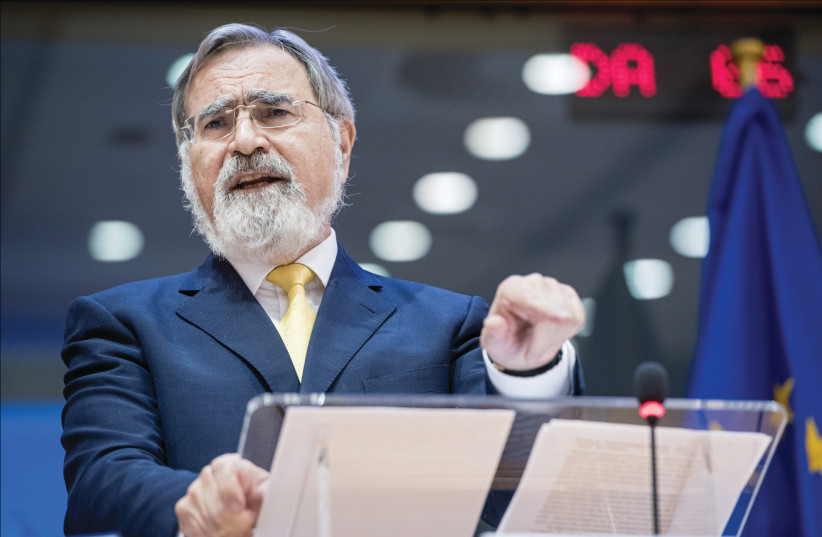
The late Rabbi Jonathan Sacks described prayer as “the food of the soul.”
For several years now, I have been teaching a class on tefilah – the Jewish word for prayer. Like so many things in Jewish life, the Hebrew word carries more depth than its English counterpart. Tefilah shares a root with lehitpalel, a reflexive verb – to judge oneself, to examine oneself.
'Allowing God to speak to us'
Prayer, in Judaism, is not merely speaking to God: It is allowing God to speak to us. It is introspection wrapped in liturgy; it is vulnerability structured into words.
My life has been immeasurably enhanced by teaching this class – not only by my own preparation but, even more so, by the insights of my students. They ask questions I would never have thought to ask. They challenge assumptions I did not realize I held. They remind me that prayer is not an abstract theological exercise but a lived human experience.
Last week, I began teaching a new class to my Nigerian friends – about whom I wrote in these columns back in September (see link below).
None of them came with preconceived Jewish notions about prayer. I asked each one a simple question: “What does prayer mean to you?”
The responses were beautiful.
“Prayer comes from the heart.”
“Prayer is a deep connection to a greater and higher being.”
“Prayer lights up my life and lightens my burden.”
There was no cynicism. No politics. No performance. Just sincerity, longing, and hope.
Prayer, in their words, was light.
And then, almost jarringly, I read of the events surrounding the visit of President Isaac Herzog to Sydney.
The president had traveled to show solidarity with the devastated Bondi community following the horrific Hanukkah massacre.
It should have been a moment of collective mourning and moral clarity.
Instead, it became something else.
A protest march to the NSW State Parliament had been banned by police and the ban upheld by the court.
Despite this, the march went ahead.
When police attempted to enforce the law and prevent the illegal procession, violence erupted.
And then something extraordinary happened.
Members of the Muslim crowd suddenly dropped to their knees to pray.
Let us be clear: this was not a spontaneous realization that the time for prayer had arrived.
It was not an urgent, unrepeatable moment of religious devotion.
It was an orchestrated act – a calculated tactic.
Prayer was weaponized.
Instead of being a bridge to heaven, it became a shield against law enforcement.
Instead of being an intimate act of humility before God, it became a public relations tool.
There was mock indignation that the police had the temerity to remove illegal protesters while they were “praying.”
The footage is painful to watch. As officers tried to perform their civic duty, screams were hurled at them: “They are f**ing praying. F** off and leave them to pray!”
The profanity is not the worst part. The tragedy is deeper.
Prayer – something sacred, something intimate, something that countless human beings across faiths have clung to in moments of despair – was reduced to a stick with which to beat the police.
When prayer is used this way, it strikes at the very heart of all faiths.
I have stood in hospital corridors as families whispered Psalms while waiting for news of a loved one.
I have seen soldiers murmur words of faith before going into danger.
I have watched parents pray for their children, their lips barely moving, their eyes moist with hope.
No cameras. No slogans. No choreography.
Just fragility.
To cynically twist such a moment into a political tactic defiles not only one religion but the very concept of faith.
It cheapens every sincere act of devotion.
It makes prayer suspect.
It turns the sacred into theatre.
And perhaps worst of all is the self-righteous indignation that accompanies it. “How could the wicked police interrupt a prayer session like this?”
It is a moral inversion.
If prayer is sacred, then it must be sincere.
If it is sincere, it cannot simultaneously be a calculated strategy.
One cannot both manipulate and sanctify at the same time.
Of course, public prayer has its place.
Judaism itself mandates communal prayer. We gather three times a day. We stand together; we respond together.
Faith is not purely private.
But communal prayer is meant to elevate the public square, not hijack it.
It is meant to remind us that there is something higher than politics, not to serve as a political weapon.
The Talmud tells us that prayer without intention – kavanah – is like a body without a soul.
What we witnessed in Sydney was worse. It was a body deliberately animated for effect. It was prayer emptied of its transcendence and filled with tactical purpose.
That should disturb every person of faith – Muslim, Jewish, Christian, or otherwise.
Because once prayer becomes a tool, it loses its purity.
Once it becomes a shield for lawlessness, it ceases to be a submission to God and becomes an assertion of power.
And power dressed up as piety is among the most dangerous of human combinations.
The irony is that the Nigerian students in my class, thousands of miles away, understood prayer more profoundly than those who weaponized it in Sydney.
“Prayer lights up my life and lightens my burden,” one of them said.
Light. Burden. Connection. Heart.
There is humility in those words.
True prayer diminishes the ego. It does not inflate it.
It softens anger. It does not harden it.
It opens us to accountability. It does not insulate us from it.
When I stand in synagogue and whisper the silent Amidah prayer, I am not making a statement to the world: I am confronting myself. Have I lived up to who I am meant to be? Have I shown kindness? Have I acted justly?
Prayer is precious precisely because it is vulnerable.
It is the admission that I am not self-sufficient. That I need help. That I am not the center of the universe.
To weaponize and politicize prayer is to sink to new depths. It is to take something luminous and use it as camouflage. It is manipulation draped in sanctity.
We must call it out – not out of hostility to any faith, but out of loyalty to all faiths.
If prayer means anything, it must mean sincerity. If it is to remain sacred, it must be protected from being twisted into a tactic.
Otherwise, the next time someone kneels in genuine anguish, or bows their head in quiet gratitude, we will all be poorer – because we will wonder whether we are witnessing devotion or strategy.
Prayer deserves better than that – and so do we.
The writer is a rabbi and physician. He writes and teaches on Jewish ethics, leadership, and resilience. His work appears on rabbidrjonathanlieberman.substack.com and youtube.com/@rabbidrjonathanlieberman.
For the class to my Nigerian friends, see: https://rabbidrjonathanlieberman.substack.com/p/would-you-choose-to-be-jewish