
Last Friday, I was planning to write an article about Lucy Aharish. Aharish, a Muslim Arab who was born in Nazareth and grew up in Dimona, was the only Arab in one of the local schools in Dimona, in which Meir Cohen, today a Yesh Atid MK and a former mayor of Dimona, was headmaster.
Today, Aharish, who is married to Jewish actor and musician Tsahi Halevi, is the host of a news program on Channel 13. Aharish is a proud Israeli who neither touts nor hides the fact that she is Arab, but she occasionally finds herself attacked by extreme Jewish right-wingers who object on principle to Arabs playing prominent roles in Israel’s mainstream media and to Arab women being married to Jews.
She has recently been the target of badgering by the right-wing bully Mordechai David, who is the darling of certain Likud politicians and, unfortunately, has so far not been denounced by Prime Minister Benjamin Netanyahu, even when he has crossed redlines.
David and his accomplices have been “demonstrating” near and inside the building where Aharish lives with her husband and son, and have given various excuses. Recently, it was that she had expressed the hope on one of her TV programs that Israel’s Arab citizens would come out in large numbers to vote in Israel’s next general elections.
She added to this the Arab exclamation “inshallah” (God willing), the Arabic equivalent of “be’ezrat Hashem” (with God’s help), which is not meant derogatively or negatively. It is simply a term in Arabic, which, until Basic Law: Israel as the Nation-State of the Jewish People was passed in 2018, was one of Israel’s two official languages. Since then, “Arabic has a special status in the state,” and “Nothing in this [law] shall compromise the status given to the Arabic language in practice before this basic law went into force.”
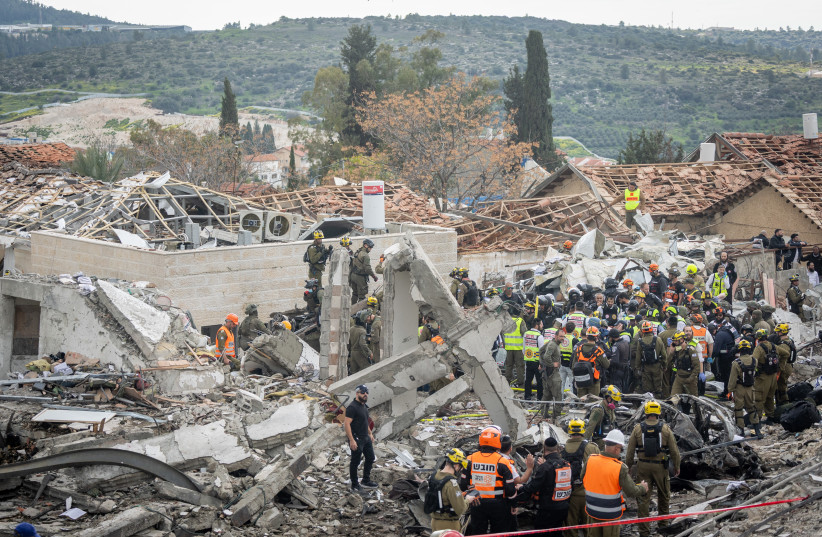
But, of course, the American and Israeli attack on Iran on Saturday morning and Jerusalem’s assassination of Iran’s supreme leader, Ali Hosseini Khamenei, have temporarily pushed the anti-democratic and racist defects and ailments of Israel’s society, which must be addressed, to second place. Existential issues must come first, and the current war must certainly be viewed within this context.
It cannot be denied that the Islamic Republic of the ayatollahs is opposed to Israel and wishes to terminate its existence on the basis of the fact that it is a Jewish state in the midst of Shi’ite and Sunni Muslim states. However, from Israel’s perspective, it is not any Iranian state that poses an existential threat to Israel, but Iran under its current extreme Shi’ite regime.
It is the current Iranian regime, with its jihadist intentions and proxies in other Muslim states or territories (such as Gaza), that is the target for defeat, with hopes for an alternative Iran – hopefully a more democratic version of the Iranian state that existed at the time of Shah Mohammad Reza before the Islamic Revolution in 1979.
Israel and the US are in total agreement that the nuclear ambitions of the current Iranian regime must be terminated. At the moment, they also seem to be in agreement that regime change is vital.
However, the fact that US President Trump does not hide the fact that he would prefer a diplomatic solution to the current conflict to a military one – even now that a fierce war is being fought – means that he would be willing to let the current regime continue to exist if it would agree to change its attitude on the issue of nuclear capabilities.
Khamenei is more moderate than potential heirs
One of the conundrums in this respect is that, despite his political and religious extremism, Khamenei was much more moderate in his attitude toward the issue of nuclear capabilities for Iran than some of his potential heirs, who are considered more moderate from other perspectives. One of the reasons Israel – especially under the premiership of Netanyahu – has been so adamantly opposed to negotiations with the current Iranian regime is precisely because it does not believe there is anything positive that can emerge from such negotiations.
At the time of writing, the joint Israeli-American airstrike attack on Iran has lasted less than 48 hours, but its achievements are impressive. This has included the destruction of extensive sections of Iran’s retaliatory capabilities, military production capabilities (both nuclear and non-nuclear), government and military facilities, and the elimination of numerous military and non-military leaders (in addition to Khamenei himself).
Trump has already gone on record saying that these achievements have been achieved much faster than he had expected, but while Netanyahu has no desire to cut the fighting short, it is generally believed that the US president would be happy to do so.
Trump has traditionally been opposed to American involvement in foreign conflict, but there is another reason for his wanting a short war: His popularity in the US has fallen for various reasons, and the war against Iran is likely to cause a further deterioration. He must also confront opposition to the war from isolationists within the Republican Party, including none other than Vice President JD Vance.
This is worrying. First and foremost, Israel’s goal is that Iran’s current regime should be defeated completely, and despite the serious damage already caused to the regime – militarily and economically – a total defeat also requires an effective popular uprising capable of taking over the institutions of government.
Though the internal opposition to the current Iranian regime is widespread, the opposition does not have the visible support of any sort of internal military power, and it is not clear how anyone – including exiled Crown Prince Reza Pahlavi, who appears to have a certain amount of support in Iran – can assume power. Nobody can tell, at this stage, whether a prolonged war will change this reality, but cutting the current war short would certainly be counterproductive.
Only the future will tell how the war will evolve and end. However, there is one additional factor that, at some point, will have to start being reckoned with. Though the Israeli economy appears to be surprisingly resilient under the circumstances, by December 2024 – 15 months after the Israel-Hamas War began – Israel’s national debt reached an astronomical NIS 1.33 trillion – around 69% of GDP (figures for 2025 are not yet available). The country’s expenditure in the current war against Iran is expected to reach another NIS 15 billion-NIS 25 billion. Someday, Israel will have to repay these sums.
The writer has written journalistic and academic articles, as well as several books, on international relations, Zionism, Israeli politics, and parliamentarism. From 1994 to 2010, she worked at the Knesset Library and the Knesset Research and Information Center.