At a major outdoor concert a few years ago, a famous singer stepped forward to sing the chorus of his biggest hit, and his microphone failed. For several long seconds, all you could hear was the backing vocal group and the band. The rhythm was steady. The harmonies were beautiful. But the star of the show that everything revolved around was gone. The absence was louder than the presence.
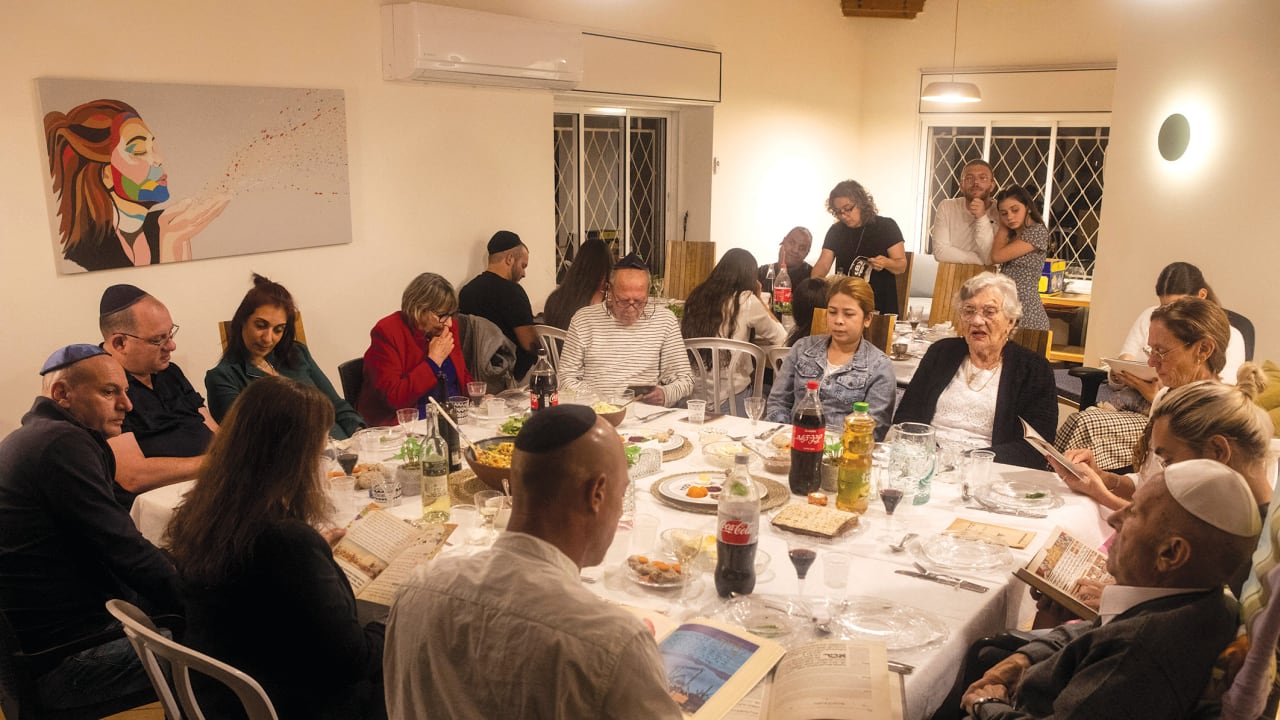
On Seder night, something similar happens. Our table is full. We drink four cups of wine, eat matzah and maror, tell the story with passion, and sing Hallel. And yet, if you stop to think about it, the central star of the night is missing.
The Korban Pesach (paschal sacrifice) – the original heart of the Seder – is not there.
Redemption as a nation
In Temple times, the Seder was not just a storytelling evening. It was built around a real offering brought in Jerusalem. The Mishna describes how the Jewish people would gather in the Temple courtyard in organized family groups. The priests would stand in rows, passing bowls of blood with precision. Every family was represented. This was not a private ritual taking place in homes around the world. It was a national act performed in the nation’s capital.

Every aspect of the halachic laws of the Korban Pesach reinforces that national message.
The lamb had to be roasted whole – not boiled, not cut into pieces. Roasting keeps the meat attached tightly to the bone. Boiling causes separation. The Torah insists that it remain intact.
This is not just a culinary detail. Redemption creates a nation, not just free individuals. The flesh clinging to the bone is a powerful image of unity. A nation redeemed from slavery must hold together. It cannot afford to dissolve into separate fragments.
Even more striking is the prohibition against breaking any of the bones of the offering. Slaves crack open bones in hunger; free people eat with dignity. But beyond dignity lies symbolism. The Korban Pesach represents the national body. To break a bone would be to fracture that body.
We are broken if any part of us is missing.
The significance of the details
The halachic structure deepens the point. A person had to register in advance to be included in a specific family group. The offering could not be eaten alone. It could not be removed from the designated house. And, once the Jewish people entered the Land of Israel, it could only be brought “in the place that God will choose” – Jerusalem – and eaten within its walls.
The Korban Pesach demanded a family gathering. It demanded a defined space. It demanded shared responsibility. It demanded that the Jewish people live not merely as families bound by memory but as a nation bound to its land.
Redemption in Egypt meant leaving slavery. Redemption in Jerusalem meant building national life in a particular place.
While the Temple stood, the Korban Pesach was eaten at the end of the Passover Seder meal, and nothing could be eaten afterward, to ensure that its taste would linger in our mouths. Today, we eat the afikoman matzah in its place. It too is eaten last so that its flavor remains with us.
The afikoman quietly preserves the framework of what is missing. Ideally it should be eaten before midnight, just as the original offering was. It is divided carefully among those present, echoing the requirement that the Korban Pesach be apportioned to registered members. We recline as we eat it, as free people.
Passover in exile
The structure is still here. The center is not. And that absence speaks volumes.
Many mitzvot can be fulfilled wherever Jews live. But the Korban Pesach cannot. It belongs to a people living together in its land, gathering in its capital, acting in unity within shared boundaries. It assumes sovereignty. It assumes collective presence. It assumes a nation living in its eternal home.
On Seder night we celebrate the Exodus. But the Torah’s vision of redemption moves beyond escape. It moves toward wholeness – a people intact like the roasted lamb, unbroken like its bones, counted and gathered within the walls of its city.
Today, the afikoman leaves a taste in our mouths not only of matzah but of unfinished redemption. It reminds us that Jewish freedom is not complete until the star of the show returns.
The band still plays at our Seder tables. The harmonies are rich. But once you remember the Korban Pesach – its unity, its boundaries, its rootedness in Jerusalem – you begin to hear the silence.
And that silence points unmistakably to the vision of Jews living together as a whole people in our own land, unbroken and complete. May it happen speedily in our days!
The writer is a rabbi and educator living in Efrat. His second book, The Seven Facets of Healing, is dedicated in memory of his wife Lucy who, together with his daughters Maia and Rina, was murdered by terrorists in April 2023. It is available from Amazon at amazon.com/Seven-Facets-Healing-Leo-Dee/dp/9659329105 and in Israel from bookpod.co.il/product/the-seven-facets-of-healing/