The concept of an energy war has long been confined to the strategic manipulation of pipelines or the imposition of economic sanctions. But today, it has mutated into something far more visceral and visible.
We are witnessing a collision between high-stakes geopolitical brinkmanship and environmental degradation, centered on a singular, vulnerable point of failure: Iran’s Kharg Island. This small outcrop in the Persian Gulf, responsible for the vast majority of Iran’s crude exports, has become the epicenter of a desperate theater where economic survival, military posturing, and ecological catastrophe are indistinguishable.
Recent reports of empty jetties, dwindling shipments, and mysterious oil slicks are not isolated incidents of maritime logistics or accidental pollution; they are the jagged edges of a nation grappling with the exhaustion of its primary leverage in a world that is increasingly closing in.
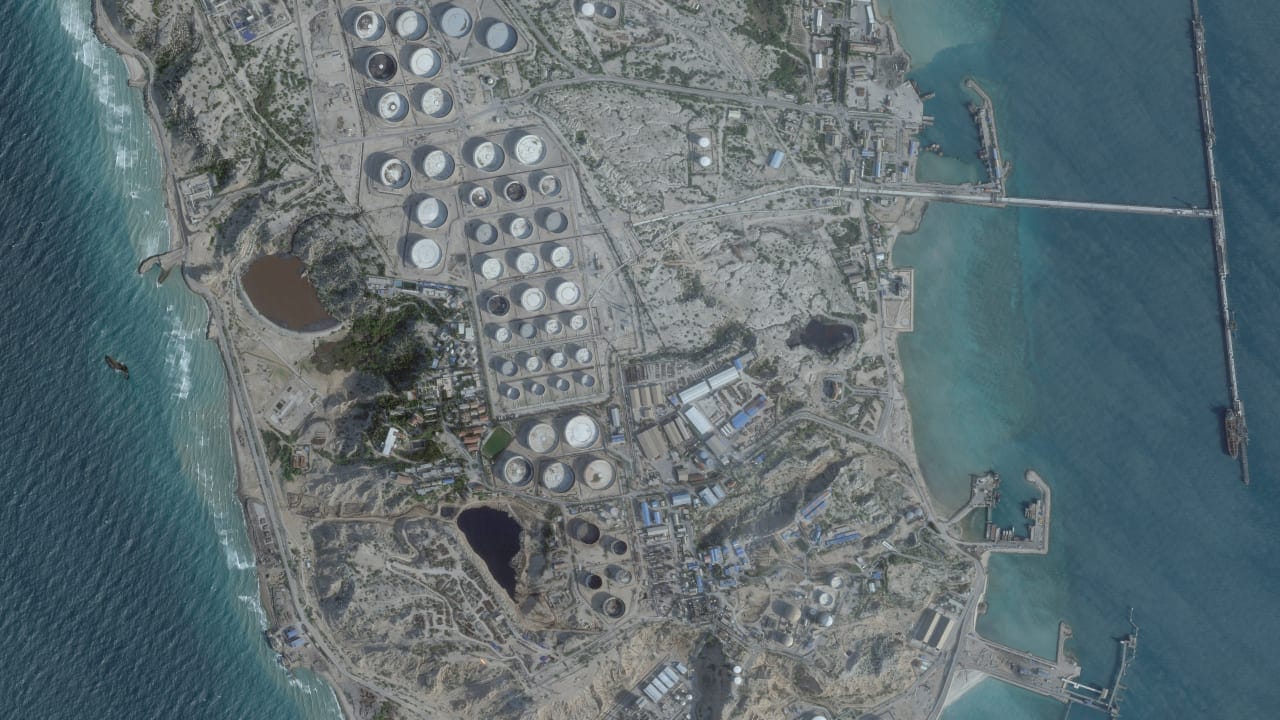
For decades, Kharg Island was the beating heart of the Iranian economy, a fortress of infrastructure that symbolized the Islamic Republic’s defiance against Western pressure. To look at recent satellite imagery and witness the Kharg Island oil jetties standing empty is to see a vacuum where power used to reside.
This emptiness is a profound sign of strain, signaling a breakdown in the traditional flow of the “ghost fleet,” the clandestine network of aging tankers that Iran relies upon to circumvent international sanctions. When the jetties go quiet, it suggests that the friction of the energy war has reached a tipping point where the risks of transport, the difficulty of payment, or the physical deterioration of the facility have finally begun to outpace the state’s ability to improvise.

In the context of an energy war, an empty jetty is as loud as a battlefield explosion; it is an admission of restricted mobility and a narrowing of options.
However, the strain of this conflict is not merely felt in the absence of trade; it is manifesting in the physical poisoning of the waters surrounding the terminal. The recent emergence of a massive oil slick off Kharg Island, which Iranian officials have attempted to deflect as the result of a tanker dumping wastewater, reveals the darker, messier reality of sanctioned trade.
In an energy war, the rules of environmental stewardship are often the first casualty. When a nation is forced to operate in the shadows, using “dark” tankers that lack proper insurance, oversight, or maintenance, the probability of catastrophic failure skyrockets.
Whether the slick was an intentional discharge to lighten a load or the result of a leaking, derelict hull, it serves as a grim metaphor for the state of the Iranian energy sector: a system leaking under the pressure of its own isolation.
The connection between the empty jetties and the oil-slicked waters is a narrative of desperation. The energy war has forced Iran into a corner where it must prioritize immediate cash flow over the long-term health of its maritime environment and the integrity of its infrastructure. The wastewater excuse is a classic maneuver in the information warfare component of this struggle.
By blaming a rogue tanker, the state attempts to distance itself from the systemic decay that its energy-at-all-costs policy has invited. Yet the reality is that the entire ecosystem of Iranian oil, from the pumping stations to the final delivery, is operating under a state of permanent emergency. When vessels are forced to linger in the Gulf for months, acting as floating storage because they cannot find a buyer or a safe port, they become ticking ecological time bombs.
This is the true face of modern energy warfare: a grinding war of attrition where the objective is to make the opponent’s primary resource more of a liability than an asset. By squeezing the logistics of the Iranian oil trade, the international community has effectively turned Kharg Island into a bottleneck. The resulting strain leads to the mechanical failures and environmental “accidents” we are now seeing. It is an indirect form of siege warfare.
Instead of bombing the terminal, the strategy is to let the terminal choke on its own output. The empty jetties represent the success of the economic blockade, while the oil slicks represent the collateral damage of a cornered state trying to bypass that blockade by any means necessary.
Furthermore, we must consider the psychological dimension of this energy war.
Kharg island a symbol of Iranian sovereignty
Kharg Island is more than just a terminal; it is a symbol of Iranian sovereignty. For the Iranian leadership, admitting that the jetties are empty is an admission of vulnerability. This explains the frantic efforts to redirect the narrative toward “external” causes for the pollution.
To acknowledge that the oil slick is a symptom of a crumbling, sanctioned infrastructure would be to acknowledge that the energy war is being lost. Instead, they frame it as a violation of maritime norms by others, a tactic that seeks to maintain a veneer of control while the reality beneath the waves suggests otherwise.
The geopolitical implications of this strain extend far beyond the Persian Gulf. As Iran’s ability to export oil from Kharg fluctuates, the global energy market becomes increasingly twitchy. The “energy war” isn’t just between Iran and its rivals; it is a battle for the stability of global supply chains.
Every time a jetty at Kharg goes empty, or a new slick appears, it adds a “risk premium” to the global price of oil, affecting economies thousands of miles away. The instability of Kharg Island is a reminder that in a globalized world, there is no such thing as a localized energy crisis. The environmental degradation of the Gulf is a cost that will be borne by the entire region, long after the current political tensions have shifted.
Ultimately, the events at Kharg Island illustrate that the energy war has entered a phase of diminishing returns for the Iranian regime. The physical infrastructure is failing, the environmental costs are becoming impossible to hide, and the “ghost fleet” is struggling to maintain the flow.
The empty jetties are a visual representation of a dried-up lifeline, and the oil slicks are the toxic residue of a strategy that has prioritized survival over sustainability. We are no longer talking about a theoretical conflict of numbers and barrels; we are looking at a landscape that is physically breaking under the weight of geopolitical ambition.
As we look at the empty berths of Kharg, we should see more than just a dip in export statistics. We should see the exhaustion of a nation’s primary weapon. The energy war, once fought with the threat of closing the Strait of Hormuz, is now being fought in the maintenance logs of tankers and the cleanup of oil spills. It is a war of attrition where the environment is the silent victim and the infrastructure is the fraying frontline.
The empty jetties and the blackened waters are two sides of the same coin, the terminal symptoms of a resource-dependent power that is running out of both oil and time. The “energy war” is not just about who controls the flow; it is about what happens when the flow becomes a burden that the state can no longer safely carry.