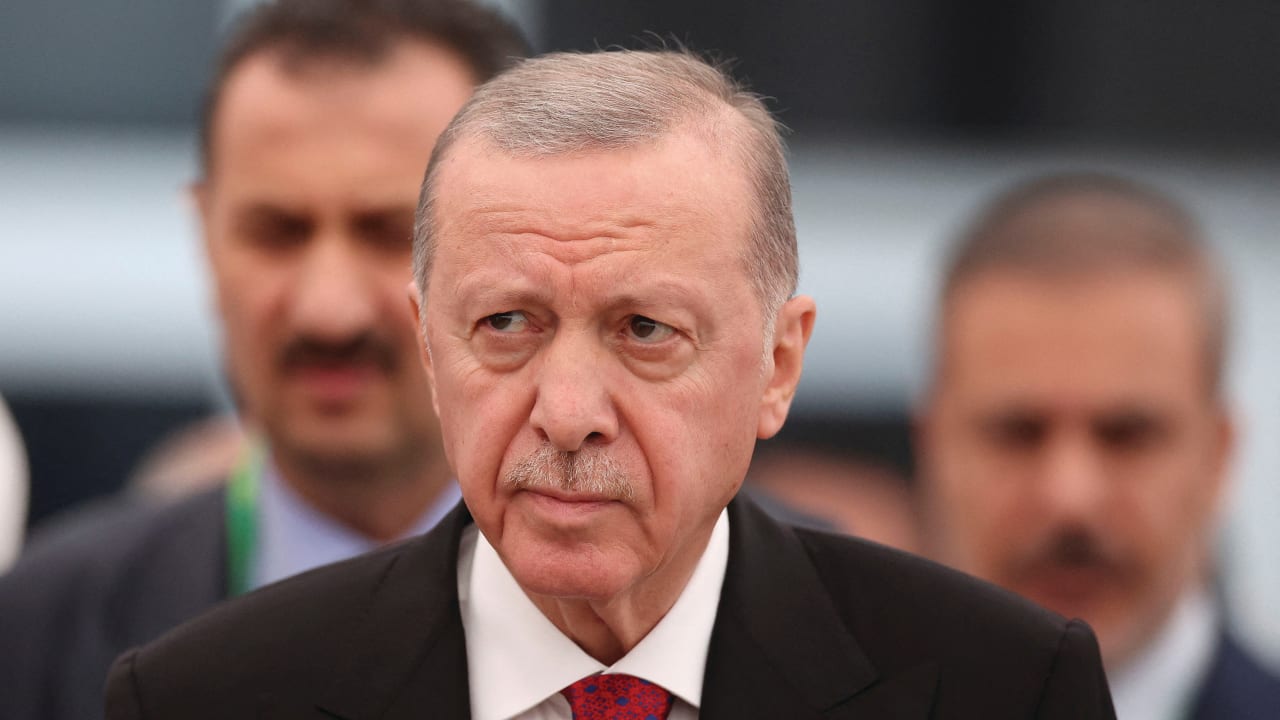
Turkey’s President Recep Tayyip Erdogan is preparing to host the 2026 NATO summit in Ankara on July 7 – a high‑visibility platform, if ever there was one.
The occasion will emphasize how central Turkey has become in Western planning, following Russia’s invasion of Ukraine. Turkey faces Russia across the Black Sea. In the light of NATO’s new 10-year Russia-focused strategy, adopted in 2022, Turkey’s geography and capabilities have assumed key significance.
In elevating Erdogan to the chair of this NATO summit, however, Western leaders have had to turn a blind eye to a number of uncomfortable facts.
For example, their host – a key front line member of NATO which is totally opposed to Russia’s war in Ukraine – is helping to fund that very war by purchasing Russian gas in enormous quantities. Russia is Turkey’s largest gas supplier, providing more than half of Turkey’s pipeline imports.
Nor is Erdogan in any way moderating his position. Turkey had already renewed two gas supply contracts with Russia in December, but in the last few weeks it has actually enhanced them. The expansion agreement with Gazprom, Russia’s energy corporation, was announced on May 31 at the Baku Energy Forum by Turkey’s energy minister, Alparslan Bayraktar.

At a time when Moscow has lost most of its European customers and is waging war on Europe’s doorstep, NATO’s leaders will once again have to look the other way as Erdogan engages with their principal adversary.
In fact, they have been indulging Erdogan’s erratic behavior for years. For example, they have long turned a blind eye to Erdogan’s disdain for democratic norms.
Erdogan has been leading Turkey since 2003, first as prime minister and latterly as president. Over those 23 years, he has constructed a highly autocratic system within the country.
His key method, honed by long use, is to mount prosecutions against political opponents, often charging them under critical speech legislation. He has not only increased the use of existing speech crimes, but has introduced new categories, notably “insulting the president” and “disinformation.”
These steps were justified as essential when the nation’s security was threatened. Turkey has endured a succession of such crises under Erdogan, some genuine, some exaggerated, some manufactured.
Between 2014 and 2020, tens of thousands of investigations and over 35,000 prosecutions were mounted under the critical speech provision. Nearly 13,000 people were sentenced, including children. Comparable, detailed official statistics for the period after 2020 are difficult to obtain. Researchers rely on monitoring undertaken by journalists’ unions and human rights groups.
Between late 2022 and late 2024, the government introduced a new offence of “disinformation.” It led to some 4,100 investigations involving 4,590 people, including at least 56 journalists. At the end of 2025, more than 20 journalists were still in prison.
The CHP is Turkey’s main Center‑Left, secular political party. It led the decisive 2019 victories in the Istanbul and Ankara mayoral races, marking an unprecedented electoral setback for Erdogan.
Under the leadership of Ozgur Ozel, the CHP frames itself as a defender of social justice against Erdogan’s dictatorial presidency.
In May 2026, an Ankara appeal court annulled the 2023 CHP congress at which Ozel was elected leader, effectively ousting him and reinstating the previous leadership. This ruling is widely seen as an attempt to neutralize Turkey’s largest opposition party. Ankara’s mayor Mansur Yavas said the decision was aimed at “breaking” the CHP and rendering it ineffective.
Ekrem Imamoglu, the CHP mayor of Istanbul and widely seen as Erdogan’s most formidable rival, was arrested in March 2025 on corruption and terror‑related accusations just days before he was expected to be nominated as a presidential candidate.
Authorities accused him of leading a “criminal organization”, committing fraud and extortion, and assisting the PKK – the armed Kurdish militant organization that Erdogan’s government has long designated a terrorist group.
In November 2025, prosecutors filed a nearly 4,000‑page indictment charging Imamoglu with 142 offences, including running a criminal enterprise, bribery, misappropriation of public funds, and money laundering. The combined potential sentence is calculated at up to 2,430 years in prison.
With the main opposition leader facing legal disqualification and the most popular rival detained under the threat of a multi‑millennium sentence, the field of credible challengers to Erdogan is being drastically narrowed.
This contributes to what some now describe as a transition from “competitive authoritarianism” to outright autocracy, in which elections remain, but the regime systematically removes viable opponents before they can contend for power.
Erdogan's economic policies
Turkey's economic deterioration is a crucial backdrop to understanding why Erdogan finds external crises politically useful.
For years, Erdogan pressured Turkey’s central bank to maintain very low interest rates, arguing, contrary to orthodox economics, that high rates cause inflation.
By 2023, inflation was around 40%, the lira had lost over 80% of its value in five years, and foreign reserves were critically low. By 2025, Turkey had technically entered recession, with GDP contracting 0.2% for two consecutive quarters, household consumption falling, and annual inflation near 49%.
This combination of recession and high inflation has severely eroded living standards and public support, and fueled public protests.
Erdogan systematically downplays domestic economic problems as global phenomena, often deflecting blame onto foreign conspiracies.
Autocrats do not relinquish power easily. Under Turkey’s 2017 constitutional changes – actually engineered by Erdogan – his period in office should end in 2028. The constitution created an executive presidency with a two‑term limit of five years each. Erdogan was elected under this system in 2018 and again in 2023.
The constitution allows a president to run again if early elections are called by parliament during the second term. Some opposition figures fear he could engineer just such a snap poll to reset the clock. He would need 360 MPs out of 600 to call a referendum, or 400 for direct adoption in parliament.
His current bloc falls short of both. Nevertheless, his main nationalist ally, Devlet Bahceli, has recently been calling for a constitutional amendment to let Erdogan stand again in 2028. It is clear that his own camp is already preparing arguments to keep him in play.
Erdogan is not likely to go quietly.
The writer, a former senior civil servant, is the Middle East correspondent for Eurasia Review. Follow him at: www.a-mid-east-journal.blogspot.com