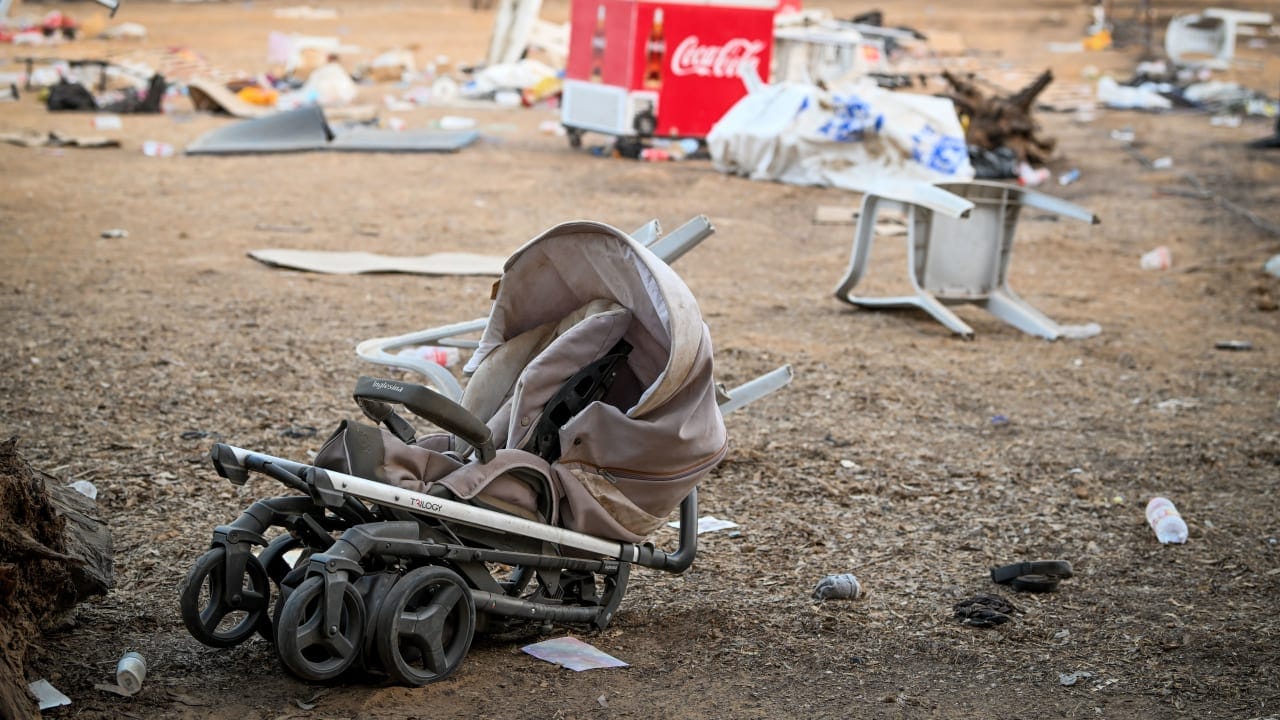
On July 7, the Freud Museum London will host an online event titled “How do we even talk about Palestine and Israel?” It is organized around a 2025 publication by the Tavistock Working Group, 12 child psychiatrists, psychologists, and psychotherapists who began meeting fortnightly after October 7, 2023, to discuss what the museum’s own announcement calls “the insurmountable difficulties of the Palestine-Israel conflict.” This conference was brought to my attention by Wendy Dickerstein.
As a psychoanalyst who has spent decades studying terrorism, political violence, and the unconscious dimensions of radicalization, I read the announcement with real concern – not because the museum is hosting a discussion but because of how that discussion appears to have been framed.
The event description opens by acknowledging suffering in both Gaza and Israel. But the emphasis, in the description and in the speaker biographies, moves quickly and almost entirely toward Palestinian narratives, Palestinian suffering, and “social justice.” That is a legitimate subject. What is missing is any indication that the panel intends to examine the psychology of the predatory perpetrators who carried out the October 7 massacre, or the ideology that produced it.
Speakers taking part in the discussion
Look at the group’s own published biographies. Several describe a personal history of Palestinian advocacy or humanitarian work – family histories of displacement, work with a Palestinian humanitarian organization, and outrage at the indifference of those in power to Palestinian suffering. These are sincere commitments, and I do not begrudge anyone their history or their politics.
Of the 12 members of the group, one identifies herself in her biography as Jewish and as trained in trauma work generally. That is a genuine credential, and I note it because precision matters here.

But nowhere among the 12 biographies published by the museum is anyone identified as a specialist in terrorism studies, hostage psychology, military psychiatry, or trauma work with Israeli survivors of October 7. There is no one identified as working with the hostages, the survivors of the Nova music festival, the residents of the Gaza border communities, or the Israeli soldiers who went in after.
The language of the announcement follows the same pattern. It promises empathy, dialogue, reflection, memories, and poetry. It says nothing about the unconscious dynamics of genocidal ideology, paranoid mental states, primitive defenses, projective identification, dehumanization, collective sadism, or the intergenerational transmission of hatred – the actual clinical vocabulary this profession has developed for understanding organized violence, and the vocabulary October 7 most urgently calls for.
Concerns about the topics of focus
I want to be precise about what I am and am not saying. The announcement does not endorse Hamas. It does not deny the atrocities of October 7. It does not use antisemitic language.
My concern is narrower and, I think, more serious for a psychoanalytic institution specifically: It adopts a framework in which the humanitarian consequences of the war receive extensive, careful attention, while the psychology of the predatory perpetrators – the very thing psychoanalysis exists to illuminate – receives almost none.
A panel convened to discuss the aftermath of a massacre, hosted by the museum that bears the name of the man who gave us the vocabulary for the unconscious, that cannot find room for a single voice trained in the psychology of terror is not neutral. It is a choice about where attention goes and where it does not.
The irony is not incidental. Four of Sigmund Freud’s own sisters – elderly, unable to secure exit visas – were deported from Vienna to Theresienstadt in 1942. Three were then sent on to Treblinka and murdered in the gas chambers within hours of arrival; the fourth died of starvation at Theresienstadt. Freud himself died in September 1939, before any of it happened, and never learned his sisters’ fate.
A museum built on the memory of a man whose own family was annihilated by an ideology of dehumanization might be expected, of all institutions, to make room for that vocabulary when the ideology in question is aimed at Jews again.
An institutional pattern
This is not an isolated pattern, and the wider Jewish world should recognize it as such. In the United States, the American Psychological Association is currently under federal investigation by the Department of Health and Human Services, following an August 2025 complaint from the Louis D. Brandeis Center for Human Rights Under Law alleging systemic antisemitism within the organization.
The complaint centers in part on Lara Sheehi, the former president of the APA’s own Society of Psychoanalysis and Psychoanalytic Psychology, who described Zionism as a “settler psychosis” and has not been disciplined by the association. More than 3,500 mental health professionals have signed a letter to APA leadership documenting conference sessions, listserv posts, and “decolonizing therapy” frameworks that treat Zionism itself as a pathology.
The APA has since passed its own resolution condemning antisemitism and opened listening sessions, but only after sustained external pressure, and only after the damage had already been done.
The pattern in London and in the American professional associations is the same: a field that has built real intellectual tools for understanding hatred, dehumanization, and violence, and that declines, again and again, to point those tools at the one act of mass violence committed against Jews in this conflict.
It brings to mind Dara Horn’s now-famous argument: people love dead Jews. A profession that studies projection, splitting, and denial should recognize those mechanisms operating in its own choices about who gets a microphone and who does not.
I am not asking the Freud Museum to cancel this event, and I am not accusing its organizers or speakers of antisemitism. I am asking a narrower question, and asking the field to sit with it rather than look away: If a panel convened in the name of psychoanalysis to discuss October 7 has no room for the psychology of the predatory perpetrators, what exactly is being avoided, and why?
The writer is a psychoanalyst, counterterrorism scholar, and the author of A Soldier’s Guide to Hamas’s Genocidal Psychosis – The Unconscious in Psychological Warfare: Beyond Ideology, Before Words (Atzmaut Press, Tel Aviv, 2025).