
Among the endless political maneuvering, one question must be asked: In 50 years, will Israel be in a stronger or weaker position because of the next government?
Every advocate of their preferred coalition will emphatically answer “stronger,” but let us examine the three issues that threaten Israel’s ability to make it to 2076: the haredi (ultra-Orthodox) community, external security, and internal cohesion.
Nearly one in three Israelis will be haredi by 2065, according to the Central Bureau of Statistics. If their representatives have their way, most of their constituency will be supported by the other two-thirds while not serving in the army. If our enemies have their way, we will not make it to 100. And if we do not learn how to live together, they will not have to lift a finger.
Solving the country's problems
The opposition’s minority coalition can solve the first problem, and Prime Minister Benjamin Netanyahu’s current coalition may solve the second, but neither has a solution for the third beyond the other side’s surrender.
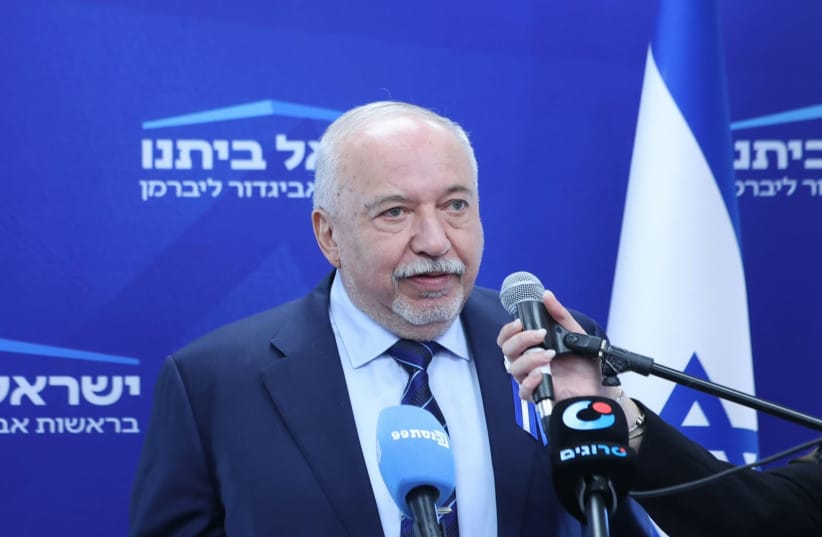
It goes without saying that Avigdor “100 for those who serve, zero for those who don’t” Liberman’s new plan to sit with the haredim on the basis of a draft law eight years out of date is not a solution to the problem.
Meanwhile, Gadi Eisenkot’s plan to sit with the Arabs can pose a threat to security. We can quibble over the degree of Mansour Abbas’s moderation, but will Ra’am approve what would likely be a destructive campaign in Gaza to root out Hamas? That may not be necessary in the next four years, but on the chance that it is, Israelis in 2076 may still be running into shelters. In either scenario, a tyranny of a Zionist minority bolstered by Arab parties has no prospect of internal reconciliation.
Only with unity will Israel be able to tackle all three threats simultaneously: a genuine government of those who serve, one that can draft the haredim, contend with Israel’s security threats, and unify the country.
Without the haredim at the table, the first becomes a matter of time.
As for the second, whatever one might have to say about Bibi’s character, in the past three years Israel has emerged as the preeminent power in the region, and surely not all of that can be attributed to feats of arms. If his becoming a synonym for “reviled” in major swaths of the international community is what holds back support for unity, I would argue that a unified front is more important than any one man.
Beyond silencing Itamar Ben-Gvir, Israel will have to take actions not appealing to much of the electorate, to appease the West. The only way to keep the right wing of the country in step with what will be an elaborate dance is with the man who can kosher anything with his mere presence.
The significance of unity
Perhaps less obvious is how keeping an incredibly divisive prime minister in office reconciles Israel’s warring halves. Bibi is a man who thrives on division and may even sit with the Arabs if it would not cause his already eclectic coalition to break into open bloodshed.
The answer is simply that unity is more than an arrangement of seats: Having one’s voice represented does much to lower the distress felt by many, as does focusing on collective problems rather than endlessly attacking the other for electoral advantage.
For those concerned with accountability, I share your worry: A commission of inquiry into October 7 must take place. But whether it is a purely judicial affair like the post-Yom Kippur War Agranat Commission or government-appointed like the Winograd Commission after the Second Lebanon War is of less significance, and whether it publishes its findings in 2026 or 2030 is, from the perspective of 2076, trivial.
Hate him as you may, Netanyahu will not govern until 120. At 77, his era is nearer its end than its beginning, and, excruciating as it feels for some, one more term will look like a blip in 50 years’ time.
Less obvious than what is better in the long term is how it can be achieved.
Trusting Netanyahu blindly would be the definition of insanity, as would going to another election hoping that, unlike the previous six, lucky number seven will succeed in finishing the job. What guarantees, agreements, and assurances are sufficient to prevent Bibi’s tricks and shticks remains a mystery.
But for the sake of the future, unity is worth a shot.