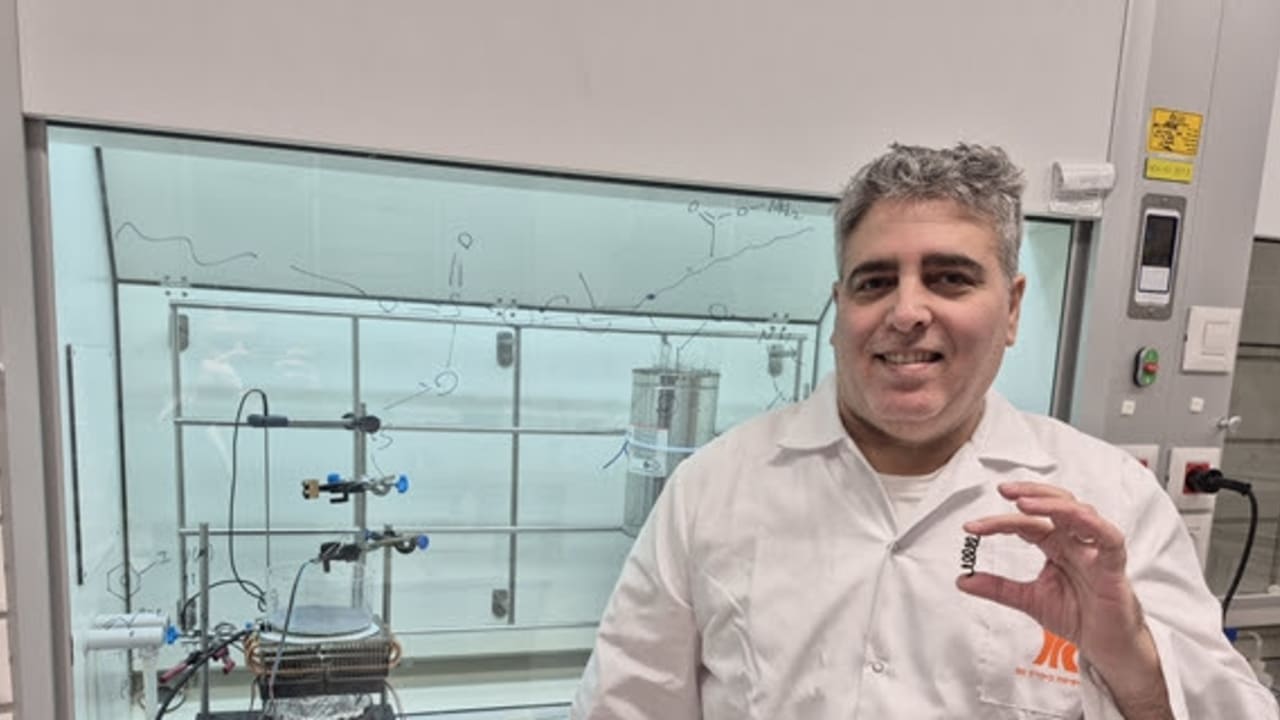
Ben-Gurion University of the Negev researchers have developed a “smart,” plastic-like material that stays liquid until activated by light or gentle heat, enabling safer, more efficient production, printing, and repairs.
The discovery, published last month in the peer-reviewed journal Nature Chemistry, introduces a new class of latent monomers - stable liquid building blocks that remain dormant for weeks and only solidify when triggered. The materials could simplify industrial curing processes, enhance 3D printing flexibility, and reduce waste.
“This work demonstrates a new way of thinking about a general problem in polymer science and will hopefully inspire scientists in the field to look at the challenges in their own work with a fresh point of view,” said PhD student Nir Lemcoff, one of the lead authors.
Additional researchers on the project include Ronny Niv from Prof. N. Gabriel Lemcoff’s group, as well as Keren Iudanov from the Lemcoff lab, as well as Gil Gordon, Aritra Biswas, Uri Ben-Nun, and Ofir Shelonchik from the Weizmann lab.
Rather than designing a complex dormant catalyst - a common industry approach for decades - the Ben-Gurion team embedded the on/off mechanism inside the plastic’s building blocks. This innovation eliminates the need for fragile or expensive catalyst systems.

What does the liquid contain?
The new liquids contain three key ingredients: Building blocks that can link together into long plastic-like chains; a standard industrial catalyst that drives the chain-forming reaction; and tiny gold nanoparticles that act as microscopic heaters when illuminated with near-infrared light.
These latent monomers are built from small molecules called norbornadienes, which can be opened and linked into long chains by a standard plastic-making method called ROMP (ring-opening metathesis polymerization).
When UV light is shone on them, they change into a different form called quadricyclane, which is basically the “sleeping” state - it is inactive and does not build chains. Later, gentle heating with tiny gold nanoparticles switches quadricyclane into an “active” state, forming the reactive norbornadiene, so chain building can start again on demand.
Since nothing happens until the trigger is applied, manufacturers could in principle store and ship a ready-to-use liquid formulation for weeks without it thickening or hardening; fill, coat, or print parts first, and only then turn on curing in selected regions using light patterns or masks; and reduce waste and energy use by avoiding the need to constantly mix fresh batches or heat entire volumes for long periods.
The study also shows that this idea of switchable building blocks can do much more than simply turn a reaction on and off. By mixing building blocks that are active from the start with others that remain asleep until heated, the team can make plastics whose chains have two distinct sections, yielding materials with combined properties in a single product.
They can first create a soft material that is easy to shape and later harden it into a tougher, more durable solid, all in a single process.
“Instead of a ‘sleeping’ catalyst, we created ‘sleeping’ building blocks of the material itself,” Prof. Yossi Weizmann of the Department of Chemistry at Ben-Gurion University, who led the study, explained.
“The mixture can sit quietly on the shelf for weeks and will snap together into a solid only when you shine light on it or warm it up. That kind of on-demand, light-driven curing could make industrial production, printing, and repair processes safer, simpler, and more energy-efficient.”