It’s a foggy and cold morning on one of the shortest Shabbat days of the year. Today, I’ve decided to walk out to one of my favorite places on the Path of the Patriarchs, right near my home. I carry along a prayer book and a thermos full of steaming hot tea. My plan: to sit on the ground and spend some solitary time in nature before I return to the chaos and commotion of a regular Shabbat with guests at home.
I hike out for a while, and the fog seems to intensify. A gentle wind is blowing – I feel touched by the elements, embraced in a pillar of cloud that seems divinely provided for me this morning. To me, there is nothing more comforting, more grounding than being wrapped in a blanket of fog.
I find a spot in a patch of earth, perfectly perched over a majestic view of the sweeping valley and low hills below. Here, I spread out my jacket in lieu of a blanket and sit cross-legged with my tea in hand. I notice the grass and how green it looks, with little droplets of winter dew clinging to the blades as they blow gently in the foggy breeze. There are the beginnings of winter flowers here, too, a few stray crocuses and the first yellow mustard blossoms of the season.
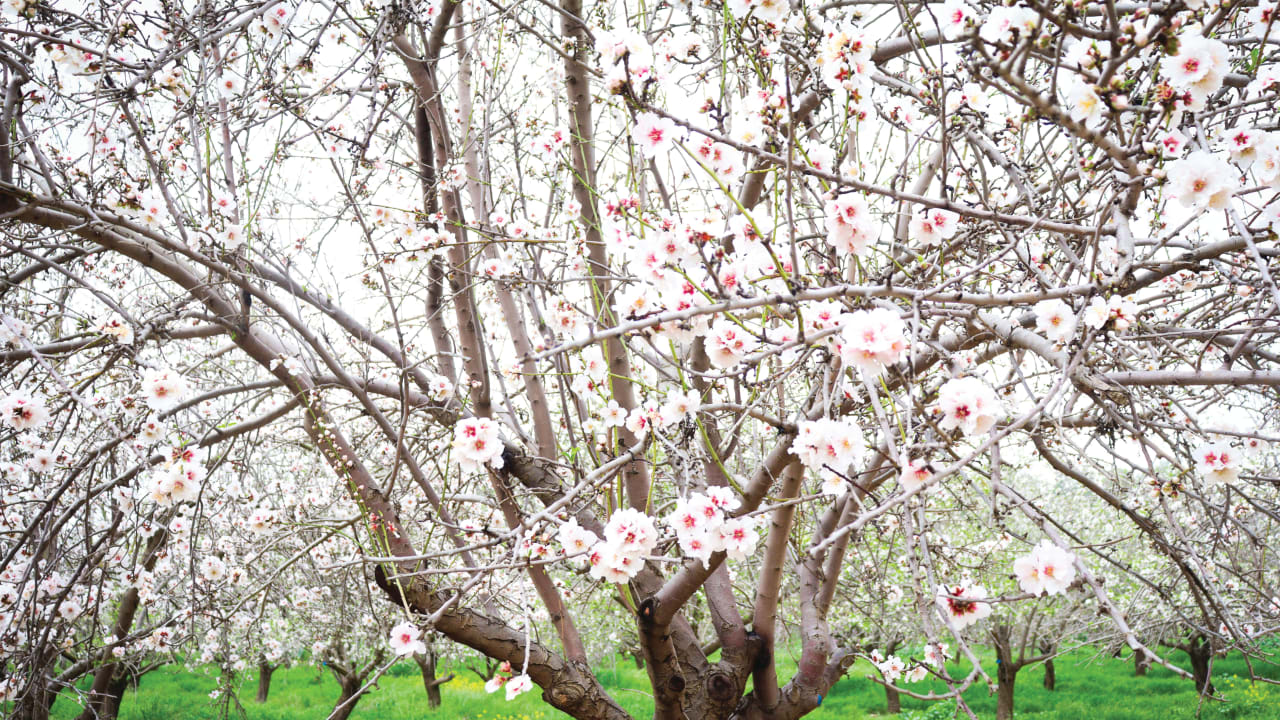
I open up my prayer book, and ancient words and song rise up within me, thanking the Creator for this life, this land, and this perfect morning. My eyes close for a moment – I tune into the sound of the wind in my ears and a lone, distant birdsong. And when I open them again, I see something I hadn’t noticed before: white almond blossoms, just beginning to unfurl, clinging to a scraggly almond tree by my side.
This sight brings a huge smile to my face. Here it is: right in the middle of winter, when things seem darkest and coldest, a harbinger of spring, the first almond blossoms of the season. Their delicate white petals seem completely at odds with the scenery around me – the fog, the rain, the cold. There’s no spring here, yet blossoming almonds in Israel signify the arrival of Tu Bishvat, the new year for trees, a time when some seasonal quality has shifted.

After an hour or so of quiet contemplation in nature, I pack up my things and head back the way I came, walking along this ancient pathway, which I now notice is peppered with flowering almond trees. An old familiar song runs through my head: “The almond tree is growing, the golden sun is glowing, the birds sing out in joyous glee, from every roof and every tree. Tu Bishvat is here, the birthday of the trees!”
AS A kid back in New Orleans, I’m not sure that I had much concept of what Tu Bishvat looked like in Israel. But judging by the words of that song, I certainly wouldn’t have imagined the cold, foggy landscape that I see around me. In Louisiana, mid-February meant gray skies and bare branches – hardly a time to celebrate trees.
Our Hebrew Day School teachers served us dried figs and carob imported from Israel, played festive songs, and spoke of planting saplings. But I never understood why this springtime celebration fell in the dead of winter.
The answer, I’ve since learned, lies in a debate recorded in the Mishna nearly two thousand years ago. The school of Shammai declared that the New Year for Trees should fall on the first of the month of Shvat. The school of Hillel disagreed, insisting it should be the 15th – Tu (15) Bishvat (in the month of Shvat). As is usually the case, the law follows Hillel. But why the disagreement, and why does the date matter at all?
The new year's rains
The Jerusalem Talmud offers a poetic explanation: until Tu Bishvat, trees live on the water of the previous year. After Tu Bishvat, they begin to draw sustenance from the new year’s rains. By mid-Shvat, the majority of Israel’s winter rainfall has already soaked into the earth. The ground is saturated. And deep beneath the surface, invisible to human eyes, the sap begins to rise.
This is what the almond tree knows. While we see only fog and cold, the almond senses the shift happening underground. It is the first of Israel’s fruit trees to blossom, announcing to the world what remains hidden: that the new year has begun, that life is stirring, that the long process of renewal is underway.
Perhaps this is why, when God first appeared to the prophet Jeremiah, He showed him an almond branch. “What do you see?” God asked. “I see a branch of an almond tree,” Jeremiah replied. And God responded: “You have seen well, for I am watching over My word to perform it.”
The Hebrew contains a wordplay impossible to capture in translation: the almond tree is called shaked, from the root meaning “to watch” or “to be diligent.” God is shoked – watching, hastening – just like the almond tree that watches for the first signs of change and hastens to bloom before any other.
The almond doesn’t wait for proof of spring. It trusts what it cannot yet see.
This tree has been watching over the Land of Israel for longer than we can fathom. Archaeologists have found almond shells at Gesher Benot Ya’aqov in the Galilee dating back 780,000 years. Long before Abraham walked these hills, long before the Torah was given, the almond was here – blooming each winter, marking the turn of the year, keeping time.
Now, walking back through the fog on this Shabbat morning, I understand the Tu Bishvat holiday differently. It isn’t about what we can see above ground. It’s about tuning into the transformation happening beneath the surface. The sap is rising. A new season has begun. And the almond tree, Israel’s faithful watchman, is the first to tell us so.
The writer is the author of From Southerner to Settler: Unexpected Lessons from the Land of Israel and founder of Hiking the Holyland.