The Torah portion of Noah, which we will read this Shabbat, concludes with a powerful verse: “And Terah took his son Abram, his grandson Lot, and his daughter-in-law Sarai, and they went out together from Ur of the Chaldees to go to the land of Canaan.”
Jewish travelers don’t simply read what the Torah says; we want to see where it happened. There are places where the Bible stops being a story and becomes the soil beneath our feet.
We read a passage, board a plane, drive a road, and find ourselves wondering what Abraham’s path actually looked like. In these moments, the earth acquires a narrative, and that narrative begins to feel almost tangible.
Traveling to the 'City of the Prophets'
The biblical “Ur of the Chaldees” (Ur Kasdim) is modern-day Urfa, located in southeastern Turkey, 80 km from the Euphrates River, and less than two hours by air from Israel. The Turkish government renamed it Sanlıurfa in 1984, but in Kurdish, it is still known simply as “the City of the Prophets.” The local university bears the name Harran, a designation that immediately resonates with anyone familiar with Abraham’s journey.
A trip to Urfa is a spiritual and religious experience, not merely a geographical one. It doesn’t offer the shallow excitement of a typical tourist site where you snap a photo and move on. Instead, it leaves an almost physical impact, difficult to put into words.

But before the biblical narrative even enters the picture, Urfa enfolds you in its unique atmosphere. It is a city of pale stone, fierce sun, narrow lanes, and markets thick with the smell of grilled meat and sharp pepper. The local döner kebab, heavily flavored with the region’s distinctive smoky chili, Urfa biber, hangs in the air like an announcement of place.
In the center of the city stands a hill crowned with the ruins of an ancient fortress. Locals point to the remaining stone columns and call them “Nimrod’s Throne,” attributing them to the mighty king from Genesis.
Yet the sacred site nestled just below the hill draws Jewish travelers. A small, dark, humble cave is revered as the birthplace of Abraham. According to historical tradition, a synagogue stood above or near this site some 1,700 years ago, adding an intriguing ancient layer to the local heritage. The cave is also sacred to Christians, associated with Mary.
As you descend into the cave, something immediately shifts. The light dims, the stone walls close in, and the bustling world above recedes. Colored carpets cover the floor as you move deeper into the shadows.
No grand hall or imposing architecture greets you here; the cave is small, low, and cramped, leaving you with the distinct sensation that the entire weight of the city rests impossibly far above your head.
A natural spring flows directly from the rock wall. Today, the water runs through modern faucets and collects in large stone basins. The steady, rhythmic drip is almost hypnotic, an ancient whisper that could have sounded exactly this way thousands of years ago.
It’s difficult to remain indifferent in such a space. I’m standing where the founder of faith itself was born, a man whose influence would span millennia and cross the boundaries of religions and peoples. In this darkness, it’s impossible not to contemplate how far his footprints would reach.
Centuries ago, a Byzantine Christian church stood near these waters, reportedly built over an even older place of worship. When the Ottoman Empire ruled here, the “Mosque of Abraham” (the Rizvaniye Mosque) was erected along the complex in 1736 and is still standing today.
The site has become one of the most revered places in the region, comparable in its spiritual pull to the mosque above the Cave of the Patriarchs in Hebron, where Abraham is buried. Muslim pilgrims and visitors arrive from around the world, but Jews and Christians are warmly welcomed too. (I visited there before the Turkish ruler’s antisemitism became apparent).
Abraham’s Pool
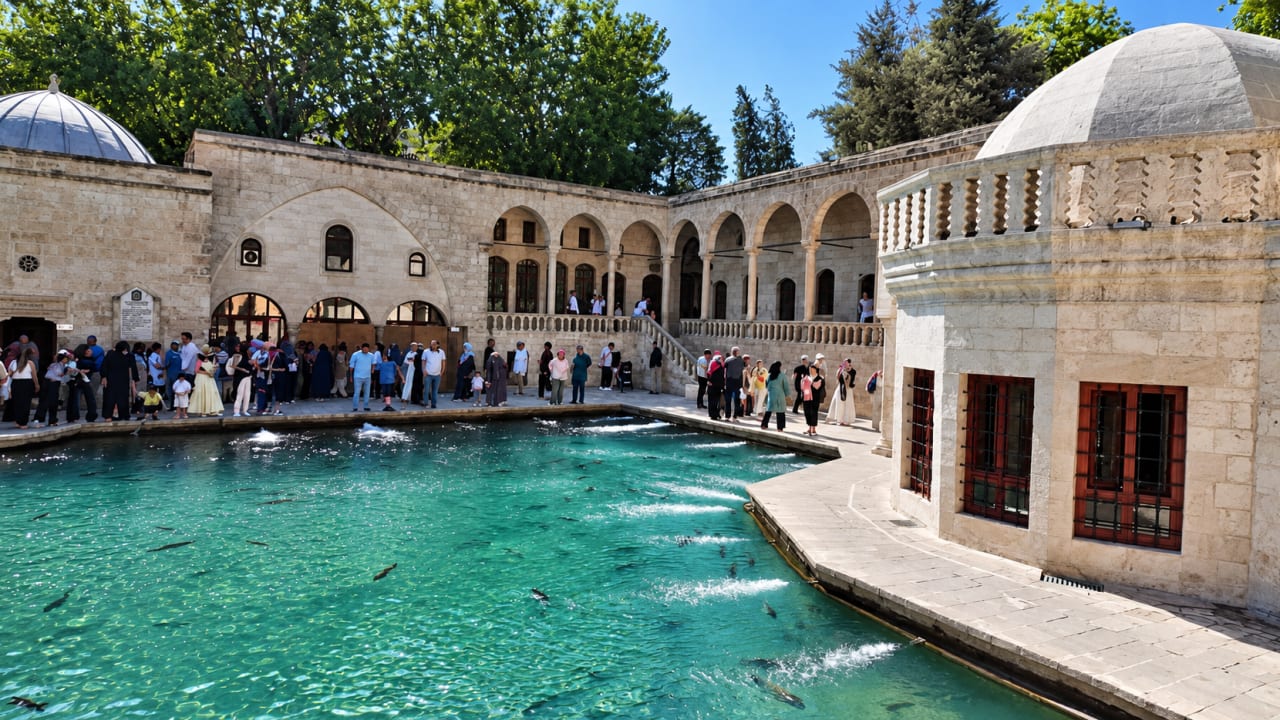
Beside the mosque lies Abraham’s Pool (Balıklıgöl), where thousands of carp circle endlessly in the still water like a living legend.
In his commentary, Rashi briefly cites the Midrash Rabbah, noting that Abraham’s father, Terah, was a dealer in idolatrous statues. One day, while still a child, Abraham smashed his father’s idols. Furious, Terah lodged a complaint against his own son with King Nimrod.
The midrash expands on this, describing a fierce theological debate between the young boy and the tyrant king. “If fire is divinity,” Abraham asks, “perhaps water is stronger? And if water, perhaps the clouds that carry it?”
The argument continues until the king loses his patience and orders Abraham cast into a fiery furnace. The midrash notes that Abraham was miraculously saved, but leaves the details mysterious.
Local tradition fills in the blanks with a happy ending: the moment Abraham hit the furnace, the fire miraculously turned into cool water, and the burning coals became fish. This is how Abraham’s Pool was created, and why the carp inside are considered sacred. Fishing here is strictly forbidden, and don’t even think of utilizing it for your gefilte fish.
Today, visitors purchase small packets of food from local vendors for a few lira to feed the fish. Watching hundreds of carp glinting in the sun while children point excitedly, it is fascinating to see the direct line connecting an ancient rabbinic midrash to a modern Turkish pool where the fish swim as if they are part of the story itself.
Şanlıurfa has another world-class attraction: the Urfa Man statue (Balıklıgöl Statue). Discovered during excavations near the pool, this limestone carving dates back roughly 13,000 years to the Pre-Pottery Neolithic period. Displayed in the city’s archaeological museum, it is widely considered the oldest known life-sized, naturalistic sculpture of a human being. (Apparently, the young Abram missed this one!).
Old travelers’ books occasionally mention a “House of Job” in Urfa. Job begins: “There was a man in the land of Uz, whose name was Job.” Because biblical Uz is frequently associated with Mesopotamia, local traditions placed his story here.
While finding the exact “house” remains elusive, the city’s historic Saladin Ayyubi Mosque stands on a site deeply tied to these ancient legends. In Urfa, it is often impossible to know where stone ends, and story begins.

Urfa’s lost Jews
For 2,500 years, a vibrant Jewish community thrived in Urfa. Five hundred years ago, a thousand Jews lived here – likely the descendants of exiles from Judah who arrived after the destruction of the First Temple.
In the Urfali synagogues, they prayed in Hebrew inflected with a distinct local accent. Their liturgical melodies absorbed the sounds of the streets around them, blending traditional prayers with Turkish musical structures and intricate maqam patterns. During Saturday morning prayers, they sang “Nishmat Kol Hai” to traditional Turkish tunes.
They lived in a Jewish quarter characterized by white stone houses squeezed along narrow lanes, where families could converse across rooftops and children easily jumped from house to house.
The Great Synagogue stood opposite what is now the historic Hayrullah Mosque. By the 19th century, the community was prominent enough to establish a yeshiva under the spiritual guidance of Hakham Abdallah Somekh, the revered rosh yeshiva of Baghdad.
By the end of the 19th century, the situation had changed. The Ottoman authorities began massacring the local Armenian population. While the violence was not explicitly directed at the Jewish community, the terrifying atmosphere prompted many of Urfa’s Jews to flee.
They went toward the Land of Israel, retracing the exact route taken by Abraham millennia earlier. Many families stopped in Aleppo, Syria, stayed for generations, and produced some of Aleppo’s most renowned rabbinic scholars. But the majority eventually completed the journey to Jerusalem and Tiberias, establishing tight-knit communities to preserve their unique Urfali traditions.
In doing so, a historical circle closed: the very city from which Abraham once departed to seek the Promised Land would, thousands of years later, send forth its own Jewish children to that exact same destination.
Today, you can still find physical traces of this community in Israel. In Jerusalem, the Urfalim Synagogue stands at 19 Bezalel Street. Until recently, the congregation still prayed from custom siddurim that followed the unique Urfa rite, though they have since transitioned to the standard Edot HaMizrach liturgy.
Another historic Urfali synagogue still stands in Rishon Lezion, founded at the turn of the 20th century by proud Urfali pioneers who built their new lives working in Baron Rothschild’s historic vineyards.
This may be one of the most moving aspects of tracing a vanished community: discovering that it hasn’t truly vanished. It’s simply changed address.
The journey continues
When we leave Urfa, it’s hard to shake the feeling that the story hasn’t really ended. The stones remain. The fish continue their circles. But the story travels with you. Am Israel Chai.
Anyone who has ever left home knows that feeling. Whether moving to another city or making aliyah, departure is always an act of faith. You know what you’re leaving. You don’t truly know what you’ll find.
I have visited many Jewish heritage sites around the world, yet few have left such a profound impression on me as the cave where tradition says Abraham, our forefather, was born. In my view, its significance as a Jewish tourist site surpasses even that of the Arch of Titus in Rome.
In Urfa, the ancient command “lech lecha” (go forth) sounds less like a biblical verse and more like a personal invitation to journey.
The author is the creator of the JewishTraveler blog.