Police tighten security measures in West Bank amid increased terror activity
After rise in "grassroots terrorism," police works with IDF and Border Police to increase presence in Judea and Samaria.
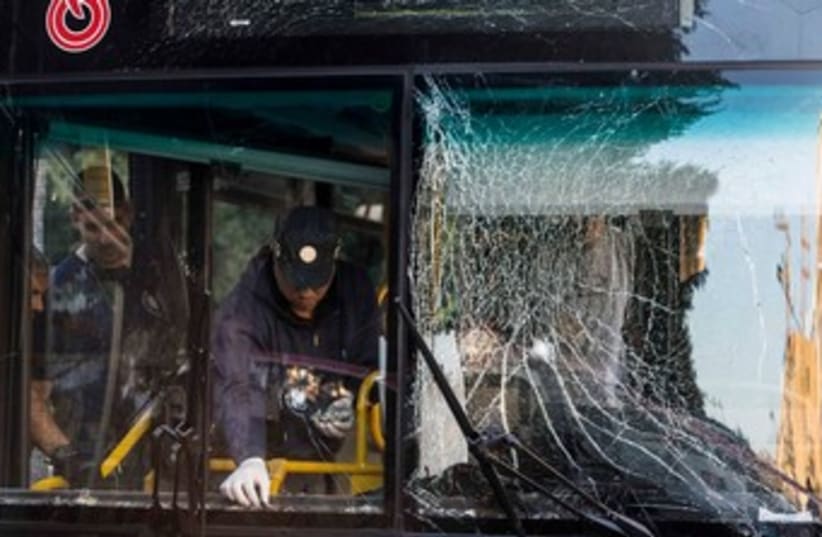
By DANIEL K. EISENBUDBat Yam bus bombing 370(photo credit: REUTERS/Nir Elias)
Following a spate of terrorist activity this week, police said Thursday that security measures have been heightened to prevent future attacks and ensure the safety of citizens.“We have carried out extensive security assessments throughout the week and police have stepped up patrols in Palestinian areas in Judea and Samaria,” said Police spokesman Micky Rosenfeld.“We are continuing to work in close coordination with the IDF and Border Police,” he added.Rosenfeld confirmed that bomb disposal experts had also been stationed in the South to respond to possible rocket fire from the Gaza Strip.On Wednesday, Insp.-Gen. Yohanan Danino said security forces had noticed a disturbing rise in “grassroots terrorism,” which had been predicted once peace talks between Israel and the Palestinian Authority resumed. Danino made the remarks during a visit at Shaare Zedek Medical Center in Jerusalem, where Rami Ravid, a traffic officer, was convalescing after being stabbed by a Palestinian in the West Bank three days ago.The 41-year-old father of two from Adam was stabbed in the back by a Palestinian terrorist Monday night next to the West Bank Highway 60 junction, just outside of Jerusalem and Ramallah.Ravid arrived at the hospital in serious condition with a 15-centimeter blade still lodged in his back. Although the knife was successfully removed during surgery, a hospital spokeswoman said the wound resulted in the loss of a kidney.“It was a major injury because the knife penetrated his back, stomach and kidney, but he is much better now and will probably be removed from the intensive care unit to a regular department tomorrow,” she said. “He’ll be okay and able to function on one kidney.”In the meantime, she said, Ravid is awake and speaking with friends and family. “He’s much, much better, thank God.”Monday’s assault came approximately 24 hours after Border Police thwarted a separate knife-wielding terrorist attack at the Ma’aleh Adumim checkpoint Sunday evening, and a bomb was detonated on an empty bus in the Tel Aviv suburb of Bat Yam earlier that afternoon.No one was wounded in either incident.Rosenfeld said that while all three incidents are considered terrorist attacks, they are presently believed to be unrelated, pending further investigation.He added that the public is being asked to remain acutely aware of their surroundings at all times.“It is very important that people remain aware of activity around them in all public places and to notify police of any suspicious activities,” he said.Rosenfeld added that police are also actively preparing for Sunday’s release of 26 Palestinian terrorists, but did not comment on measures being taken.
if(catID != 151){
var cont = `Take Israel home with the new Jerusalem Post Store