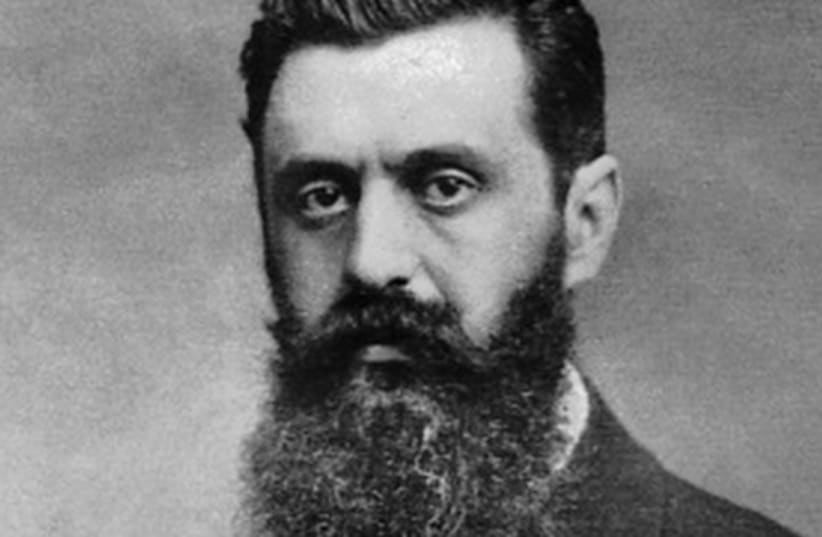
This Week In History: Herzl, rabbis clash on Zionism
In 1897, Herzl defended Zionism in ongoing battle with rabbis attempting to stop the Zionist Congress.
By TAMARA ZIEVEHerzl(photo credit: Cortesy)
On July 16, 1897, a struggle between the father of political Zionism Theodor Herzl and a group of anti-Zionist rabbis gathered momentum as Herzl published his article "Protest Rabbiner" (Protest Rabbis) in his German newspaper Die Welt. For several months Herzl had been planning the first Zionist Congress, which was originally slated to be held in Munich in August that year. However, Herzl faced a wave of opposition by European rabbis, in a battle that continued through and after the creation of the state of Israel and that is still raging today.On June 11, a group of Orthodox and liberal rabbis laid out their objections to Zionism in a letter published in German publication Allgemeine Zeitung des Juentums (General Newspaper of Judaism). The Executive Committee of the Union of Rabbis Germany, responsible for writing the letter, included Dr. Sigmund Maybaum of Berlin, Dr. Marcus Horovitz of Frankfurt, Dr. Jacob Guttmann of Barcelos, Dr. Aviezri Auerbach of Hlberstat and Dr. Werner of Munich. The "protest rabbis," a term coined by Herzl, formulated the letter in an attempt to stop the fruition of the Zionist Congress. The committee began by railing against the founding of Die Welt, which Herzl established in Vienna that year in order to create an outlet for his Zionist ideas. The rabbis branded it Zionist "propaganda" and a "calamity… that must be resisted," particularly deploring the fact that it was written in German rather than Hebrew and could thus reach a wider audience.The rabbis stated that "the Jews comprise a separate community solely with respect to religion," and emphasized that German Jewry harbored patriotism toward the country in which they lived. They argued in favor of assimilation and opined that the quest for a Zionist state impeded this goal.They argued that the intention to found a Jewish state contradicted the "messianic promises of Judaism." While they did think that eventually a Jewish state would be created in Palestine, they believed this must only be achieved with the coming of the Messiah.The rabbis also maintained that Judaism obligated its followers to devotedly serve their native land. They hastened to add here, however, that philanthropic support of agricultural settlers in Palestine was acceptable because it was not connected to the establishment of a Jewish national state."Religion and Patriotism alike impose upon us the duty of begging all who have the welfare of Judaism at heart, to hold aloof from the before-mentioned Zionist Movement, and to abstain from attending the Congress," the rabbis appealed.Herzl responded forcefully and directly to their letter in an article published in Die Welt. Countering their messianic argument, he said that a great learned rabbi had in fact said that the Talmud supported Zionist aspirations. He did not identify this rabbi and did not delve further into the issue, "preferring not to enter a theological debate." Tackling the issue of nationality, Herzl asserted that no one belongs to their homeland, but rather their homeland belongs to them and people must show their love for their nation through sacrifice rather than empty platitudes. The issue of nationality was a central point of friction between Herzl and the rabbis, as the former placed great emphasis on the Jews as a nation, while the latter did all they could to distance themselves from this notion.Herzl mocked the rabbis for cajoling philanthropists, who were funding "peasants" to work the land. He said that those same peasants needed the protection of a secure, internationally proclaimed state with which its neighbors wouldn't dare to go to war. He continued that Zionism would rehabilitate the Jewish nation suffering anti-Semitism throughout the world.The rabbis were supported in their opposition to the Zionist Congress by the Munich Jewish community, many of whom feared losing the benefits they had obtained with the emancipation and believed the congress may fuel anti-Semitic propaganda. Due to the determined protesting of these groups, Herzl decided to change the venue of the First Zionist Congress to Basel, Switzerland, where it was held a month after Herzl penned his response to the rabbis, on August 29-August 31 1897.A half-century later in 1948, long after Herzl passed away, Israel was declared the state of the Jewish people. But the battle of anti-Zionist Jews was far from dead and haredim living in Israel continue to this day to clash with other sectors of society. The spectrum is wide; some ultra-Orthodox Jews have both accepted and integrated into the State of Israel, while others refuse to recognize its existence. There are currently three haredi parties in the Knesset, but their participation in politics is a bone of contention in Israeli society. The sway which haredim hold in the government helps them to maintain conditions which allow them to live as an isolated sector of society: they have a high rate of unemployment and many live off government stipends, they have a different education system and curriculum to the rest of the country, and the vast majority dodge army service. This last point is currently a burning political issue in the quest for a replacement to the Tal Law, which allows ultra-Orthodox men to indefinitely defer army service. Just as the haredim in 1897 cited the Talmud in order to refute the creation of a Jewish state, they now maintain that their Torah studies comprise their service to the country, exempting them from army service, as well as purporting that the Torah forbids the establishment of a state and army until the Messiah arrives.
Related Tagstheodor herzl
if(catID != 151){
var cont = `Take Israel home with the new Jerusalem Post Store