Indefinite postponement of service among ultra-Orthodox going up, State Comptroller’s report says.
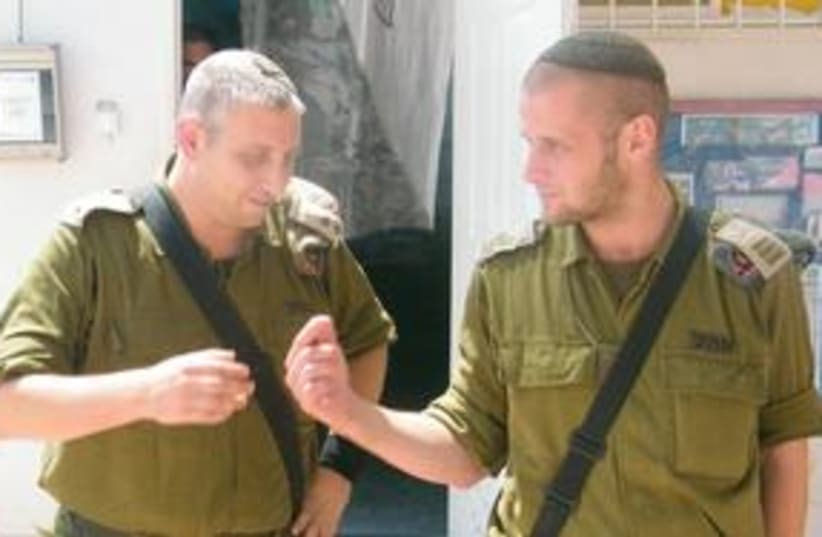
By JEREMY SHARONHaredi Soldiers 311(photo credit: YAAKOV KATZ)
An encouraging increase in the numbers of ultra-Orthodox recruits enlisting in the army has taken place in recent years in a trend that needs nurturing, the annual State Comptroller’s Report revealed on Tuesday.Despite this upward momentum, the report noted an even greater rise in the numbers of haredim deferring their military service for full-time, government-supported yeshiva study.The report comes against the background of the bitter political struggle to replace the “Tal Law,” which since 2002 has enshrined in law the option for mainly ultra- Orthodox men to indefinitely postpone military service if they are studying full time in yeshiva, while also providing certain incentives to increase haredi enlistment.The law was struck down as illegal by the High Court of Justice in February this year and will officially expire on August 1.In the review conducted between September 2010 and August 2011 of the IDF’s efforts to enlist more ultra- Orthodox soldiers into its ranks, published as part of its annual report, the State Comptroller’s Office focused on a government decision of January 2011 entitled “The advancement of military and civilian service in the ultra- Orthodox sector,” which set a target of 2,400 haredi soldiers to be enlisted in 2015.According to the report’s findings, a discernible and “important” increase has been registered in the number of haredim enlisting in recent years, exceeding the intermediary government target of 1,200 recruits in 2011 and an increase over this figure of 300 haredi recruits every year thereafter.The report cited figures showing that in 2010, approximately 1,000 haredi men eligible for military service enlisted in the IDF, representing 13 percent of possible recruits from the ultra-Orthodox sector. In 2011, 1,280 haredim, representing 16% of the potential draft from the haredi sector, enlisted into the military, meaning that if current trends continue, the IDF would reach the 2015 target of 2,400 new haredi recruits.Shas MK Nissim Ze’ev, who was a vocal proponent of preserving the Tal Law before it was struck down, welcomed both sets of the reports findings, and said that both increased haredi participation in the army and increased Torah study were important for the Jewish state.“These findings show that more and more haredim are participating in the security of the state and are taking up this yoke,” Ze’ev told The Jerusalem Post. “But equally, I welcome the increase in Torah study because this is essential for the state’s Jewish character and the Zionist project.”Ze’ev, who has argued that coercive measures taken to force haredim into the army will have a detrimental effect on ultra-Orthodox enlistment, also pointed to the fact that money for the different programs established by the Tal Law to encourage haredi enlistment was only allocated in 2007, when just 290 ultra- Orthodox men were drafted into the IDF.“You can’t expect a rise from basically 0% enlistment to 100% in such a small amount of time,” the MK reasoned.But Shahar Ilan, director of religious freedom lobbying group Hiddush, poured cold water on such sentiments and argued that the rate of increase in haredim indefinitely postponing their military service through the “Torato Omunato” (Torah is his Trade) framework is far outstripping the rate of increase in haredi military enlistment.“The state comptroller here has exposed the sad truth on the enlistment of the ultra- Orthodox in the IDF,” Ilan told the Post. “Although there are some important achievements, the rate of increase in draft evasion [through full-time yeshiva study] is much bigger.”“The conclusion is obvious: It is not possible to continue with this such a slow rate of improvement, because the demographic increase in the haredi population is growing much faster than its enlistment rate.”Ilan added that in order to speed up ultra-Orthodox enlistment, a quota should be set for military exemptions for full-time yeshiva students, while everyone else would be drafted for either military or civilian service.A spokeswoman for the draft reform lobbying group the Forum for Equality in the Share of the Military Burden, said in response to the report’s findings that “despite efforts of politicians to spin the increase in haredi enlistment” as a significant achievement, the figures showed that unless a law is passed mandating obligatory national service for all, Israeli society will collapse under societal, economic and security pressures.In its report, the State Comptroller’s Office credited the two dedicated army tracks for ultra-Orthodox soldiers – Shahar Kahol, which directs haredi recruit to hi-tech roles, and the Netzah Yehuda combat battalion – for having helped achieve the rise in haredi enlistment, which it said represented “an important trend that needs to be encouraged and nurtured.”However, the report also drew attention to a parallel trend of an increase in the numbers and overall rate of those eligible for army service in the haredi community deferring their military service by remaining in full time yeshiva study under the Torato Omunato framework, which was legally enshrined by the Tal Law.Between 2003, when the Tal Law came into effect, and 2010, the number of men eligible for military service who deferred their enlistment into the IDF rose by 60 percent, from 39,000 in 2003 to 63,000 in 2010.The report also pointed out that in 2005, 36% of Jewish men eligible for military service who were not drafted into the IDF were those in the Torato Omunato framework.Five years later, that number had risen significantly, so that by 2010, 52% of Jewish males eligible for military service who were not drafted into the IDF were ultra-Orthodox who deferred their service through the Torato Omunato status.A government decision in 2011, changing the procedures for drafting those who had deferred their service, meant that the number of men considered to be deferring military service under Torato Omunato was reduced by 10,000. Therefore, as of 2011, there were 54,000 men who were in full time yeshiva study under the Torato Omunato framework.Of the total number of haredi men eligible for IDF service in 2010 and 2011 respectively, 13% enlisted in 2010 and 16% enlisted in 2011.The percentage of all Jewish men enlisting into the IDF in 2010 was 75%.In addition to IDF service, 1,089 haredi men, representing 13% of those eligible for military service in 2011, served in national or civilian service, alongside 1,282 haredim who enlisted in the IDF, bringing the total percentage of haredim doing some form of military and national service to approximately 28% of the possible total.
if(catID != 151){
var cont = `Take Israel home with the new Jerusalem Post Store