Israel’s thwarting of the genocide plotted against its people is now presented as premeditated Israeli-instigated ethnic cleansing of Arabs
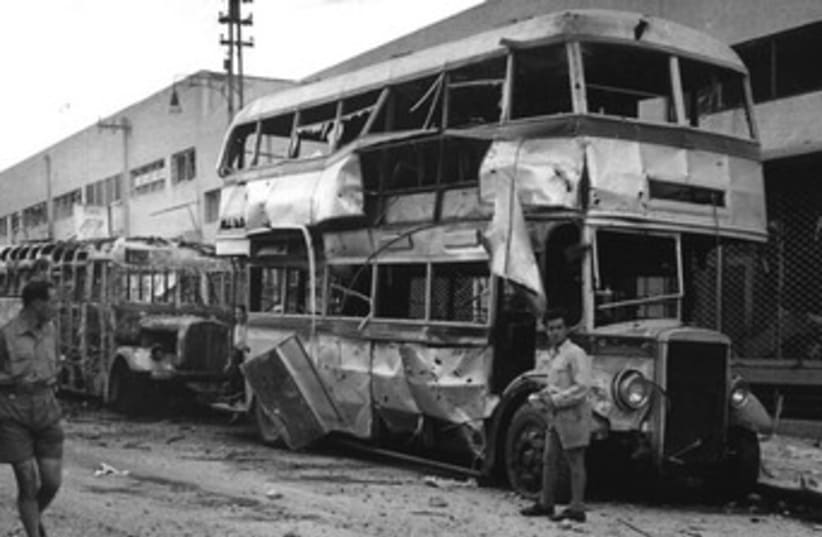
By SARAH HONIGTA Double-decker bus bombed by Egyptians_370(photo credit: The Jerusalem Post archives)
‘It is with great joy that I hereby close the Mandatory Police record book,” wrote an anonymous duty officer at Tel Aviv’s central precinct precisely as David Ben-Gurion recited the renascent Jewish state’s Declaration of Independence.Just below that spontaneous hand-inscribed historic annotation, appears the first criminal entry ever in sovereign Israel’s annals. It documents the capture of a thief. He stole a book, perchance pointing to preferences peculiar to the People of the Book.Several hours later, the first ship docked in the new state. It began its journey furtively five days earlier in Marseilles when Israel was still under British rule. Its 300 young passengers were outfitted with fake IDs, forged at the Hagana “laboratory” in France.But the Teti would claim special distinction – it became simultaneously the last “illegal” aliya boat and the first legal one. The counterfeit visas proved superfluous. The vessel proudly hoisted the Israeli flag as the new day dawned. Because it was the Sabbath, the newcomers were issued their new country’s entry permits only at sundown.With such seemingly ordinary bureaucratic yet emotionally charged tasks, the Jewish state adeptly began the business of self-determination. In time that would be presented to world opinion as inherently sinful. By its very brazen determination to be born, it would be asserted, Israel had displaced the Palestinians, condemning them to miserable refugee subsistence.According to the Arab narrative, Jewish independence, in and of itself, constitutes aggressive belligerence. Incredibly, this perception sank sinister roots. It takes stronger hold abroad now than it did 64 years ago. We may speculate why. We may point to two millennia of merciless anti-Jewish hate-mongering on religious and other mundanely lucrative grounds. But whatever the motive, our legitimacy, alone among the nations, is undermined assiduously.Expediently forgotten is the fact that never, not for a single solitary day, were Israelis allowed to savor the elation of their newfound freedom. Behind the aforementioned two matter-of-fact exemplars of sovereignty, a frightening reality festered malevolently.Israel’s birth was legally ordained via the UN Partition Resolution of November 29, 1947. Two states – Jewish and Arab – were to be established between the Jordan River and the Mediterranean. Jews cheered the patchy territorial crazy-quilt they were accorded, existentially untenable though it was, and proceeded to meet all UN prerequisites for independence. The Arabs vehemently rejected the offer of a Palestinian state and, in vituperative defiance of the UN, set out to destroy the embryonic Jewish state rather than construct one of their own.On Israel’s first day, Arab League secretary-general Abdul-Rahman Azzam Pasha, articulated Arab priorities. Sending forth seven Arab armies to slay the newborn “Zionist entity,” he declared: “This will be a war of extermination and a momentous massacre which will be spoken of like the Mongolian massacres and the Crusades.” The Arab agenda and intentions were unmistakable. New Israel’s citizens harbored no misconceptions.The Arabs had already violently opposed the Jewish community which existed in this country pre-WWII and which was ripe for statehood before the Holocaust. The “Great Arab Revolt” of 1936- 39 – fomented by the stillrevered Haj Amin al-Husseini and financed by Nazi Germany – merely delayed Jewish independence. The Arabs denied asylum here to desperate Jewish escapees from Hitler’s hell. Thereby they doomed these refugees to death. The blood of numerous Holocaust victims indelibly stains Arab hands.But that’s not all. Husseini, in the role of pan-Arab prime minister, spent the war years in Berlin, where he hobnobbed with Hitler, Himmler, Eichmann, et al. He broadcast Nazi propaganda, recruited Muslims to the SS and actively foiled the rescue of any Jews, even children, during the Holocaust.The Arabs of this country were avidly pro-Nazi, saluted each other with Heil Hitler, flaunted the swastika, hoarded arms, harbored German spies and planned to heartily welcome Rommel’s invading Afrika Korps.The war that the entire Arab world launched against newborn Israel, three years post- Holocaust, was explicitly geared to complete Hitler’s unfinished mission. Not only was there no attempt to camouflage this genocidal goal, but it was broadcast boastfully for all to hear and be intimidated. Clearly Israeli independence was fraught with the most extreme and tangible danger.Hence no fanfare could conceivably accompany the official inauguration of the state, and with good reason. Independence was to be proclaimed at 4:00 p.m. on the 5th of the Hebrew month of Iyar, which in 1948 fell on May 14. The venue – Tel Aviv Museum’s tiny auditorium on 16 Rothschild Boulevard, in what previously was the home of the city’s first mayor, Meir Dizengoff – was no one’s top choice. Jerusalem was besieged, while Tel Aviv’s Habima Theater was ruled out precisely because it was bigger and could accommodate more participants.Even a marginally larger affair was reckoned undesirable for fear that publicity about when and where the Jewish state’s birth is slated to be announced would invite Egyptian air strikes. It was, therefore, thought advisable to keep everything hush-hush, make do with fewer honorary guests and cram them all into a minuscule hall (although the secrecy was quickly breached anyhow, in keeping with local proclivities).The invitation (including a request to keep it confidential) was mimeographed and sent unsigned. The declaration itself was placed for safekeeping in a bank’s basement vault, lest it be destroyed by enemy bombardments. These indeed came, just hours afterward, at daybreak (of May 15, 1948).As Israel’s masses danced in the streets on the night that followed the declaration of independence, Abdullah I, King of Transjordan (this brainchild of British imperialism now parades under the moniker of Jordan) positioned himself dramatically at the center of Allenby Bridge over the Jordan River. At the stroke of midnight, he pulled his ornate gilded pistol from its holster, held it up in the air and fired to signal the start of the Arab invasion. Its aim was to ethnically cleanse the land –or as it was then phrased non-too-diplomatically, to “throw the Jews into the sea.”Israel’s thwarting of the genocide plotted against its people is now presented as a premeditated Israeli-instigated ethnic cleansing of Arabs. The capacity of the human mind to tolerate falsification cannot apparently be underestimated.The battle plans called on the Jordanian-led Arab Legion, the Iraqis, Syrians and Lebanese to converge on the Jezreel Valley and from there move in a concerted offensive on Haifa. The Egyptians were assigned to take Tel Aviv from the south, with Yemeni and Saudi participation. But hubris caused deviations. Abdullah coveted Jerusalem and the Syrians focused on the Jordan Valley.Still, the Arab generals who drew up the blueprints for neonatal Israel’s annihilation figured it would take two weeks to complete the job, deviations notwithstanding. They had compelling reason for optimism.The infant state, assaulted ferociously from every direction and furiously fighting for its very life, possessed no resources or military hardware. Its population of 600,000 also comprised the old, the infirm and the very young – all hardly combat-worthy.But these noncombatants nevertheless became the enemy’s primary targets. For three days, from May 15, Tel Aviv was mercilessly bombed by the Egyptian Air Force. Spitfires swooped down on the very section of Tel Aviv, where the Teti was moored. The first aerial pounding lasted three days. Its worst came on May 18 when the central bus terminal was bombarded, killing 41 civilians in only that one incident, wounding hundreds of others, inflicting severe damage in the heart of town and even hitting Tel Aviv’s beloved double-decker bus.The Egyptian planes were back two days later. They would hound Tel Aviv well into late July. Fifty Tel Avivians were killed between July 13 and 16. Hadassah Hospital was among the targets, as were queues of shoppers – housewives and children. Even the Red Cross complained about “indiscriminate bombing of non-military targets.”Hot on the heels of independence, the makeshift Israel Air Force challenged Egyptian pilots for supremacy of the skies. This, despite the fact that the IAF was assembled from an improvised mishmash of light civilian aircraft requisitioned from or contributed by their owners and precariously adapted for military purposes.A curious assortment of outmoded and surplus WWII planes – as well as prewar antiques – were additionally acquired, mostly from Czechoslovakia. Israel’s air fleet was more than anything powered by ingenuity and sheer pluck –like the rest of the IDF.Because its ragtag army stood its ground, despite the worst of odds, Israel is today accused of the crime of surviving and is portrayed as a menacing ogre for having dared to come into the world rather than surrender.But it wasn’t without a terrifying price. Besides the hundreds of Tel Aviv’s casualties, the entire country bled profusely. The Old City of Jerusalem fell to Abdullah’s legionnaires on May 29 (the 1967 Israeli reversal of the Jordanian conquest is now dubbed “occupation”). The attempts to open the bottleneck blockade on the road to Jerusalem at Latrun loomed as young Israel’s most painful failure of the War of Independence.The British had turned their hilltop Taggart Fort at that crucial junction to the Arabs who used it to besiege Jerusalem with an eye to emptying West Jerusalem too of its Jews.When the War of Independence was finally over a year-and- a-half later, Israel mourned 6,000 dead, a full one-percent of the fledgling state’s population. But perhaps the most tragic sacrifice – alas, hardly atypical for that era – was epitomized by the Teti’s passengers. Many of them gave their lives for their country just one week after arriving on that fateful first day of independence.The next morning they made their way to the encampment at Tel Aviv’s Kiryat Meir (at the end of today’s Zeitlin Street) where they enlisted in the IDF. Most – fresh off the boat, with Holocaust horrors still fresh in their minds – ended up in the Alexandroni Brigade and Division 7, which were dispatched to Latrun. The battlefield training they received consisted of a few instructions, generally incoherent to them, on the way to the front line.www.sarahhonig.com
Related TagsWar of Independence
if(catID != 151){
var cont = `Take Israel home with the new Jerusalem Post Store