Bennett’s Bayit Yehudi party has only gained from this saga. The true loser is the public.
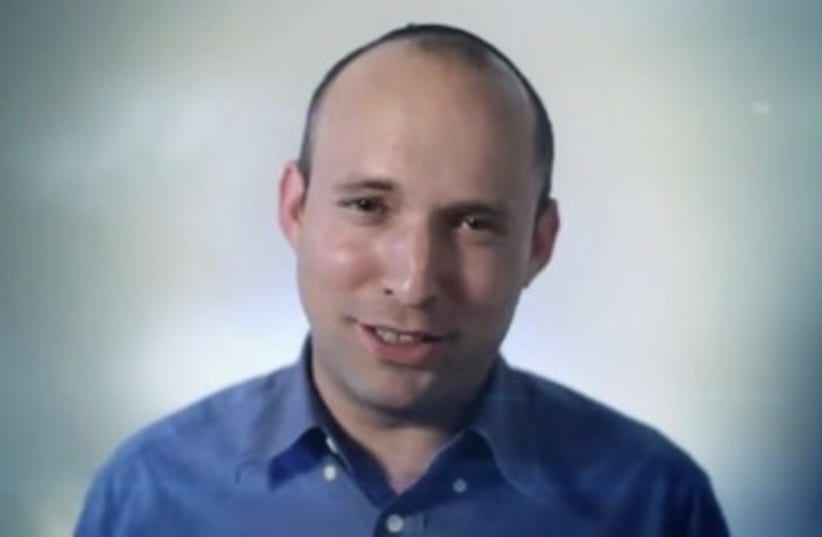
By YISRAEL MEDAD, ELI POLLAKBayit Hayehudi's Naftali Bennett 390(photo credit: YouTube Screenshot)
If we were political campaign advisers, and not columnists commenting on the media’s behavior, we might have warned Naftali Bennett to beware of Nissim Mishal and his interview program, Mishal Hot, on Channel 2.We would have warned him that Mishal is far from being a fair and even-handed interviewer. Back in June 2000, Danna Winkler, writing in The Seventh Eye, was critical of Mishal, noting that he turned the studio “into a battlefield where there is but one winner, the non-neutral moderator and also the judge.” In addition, she quoted Ma’ariv’s media critic Meir Schnitzer as warning of Mihal’s tendency “to create fictitious provocations.”Ynet’s critic, Ra’anan Shaked, wrote in July 2005 of his revulsion after watching Mishal’s treatment, together with his editor, the late Yisrael Segal, of the infamous “Pulsa D’Nura” curse ceremony. “What is left of their journalistic prestige just dripped away,” he wrote.Mishal’s reputation as a sensationalist rather than a professional has for years been problematic even among his fellow media buddies.Thursday’s program with Bennett caused Ma’ariv’s current media critic Elkanah Schor to observe that “Mishal has a more fundamental personality problem. Mishal suffers from distress. When you do not have the argumentative abilities of London and Kirschenbaum, lack the depth of Ilana Dayan, the courage of Raviv Drucker and the warmth of Amnon Levy, you’re in distress and you shout.”In the show with Bennett, as may be ascertained from the video of the interview, Mishal was as usual brash, aggressive and provocative, incessantly interrupting Bennett.Bennett could have simply announced that if he was going to be denied the common courtesy of responding to questions in a manner which would permit the viewers an opportunity to actually hear him, he would not be a party to the circus atmosphere Mishal created in the studio.We would have suggested that, if asked about the topic of soldiers refusing to obey orders, he should reply that it is his intention to join the next government so as to make sure that no further evacuations will take place, and then not to talk about refusing commands but about refusing to continue the discussion.We would also have brought to his attention the fact that actually, this whole issue was already dealt with in 1995, in this statement: “I say that a soldier must obey orders. And if a soldier feels that the command given him is against his conscience, he personally, and I emphasize – in person – should appear before his commander, tell him so and be prepared to bear the consequences.... If he feels he was given a command that is against his conscience, then he personally – it is not a matter of rebellion – ... appears before his commander, explains it to him and will be prepared to bear the consequences.”Those were the words of Ariel Sharon, who not only served as a general, a member of the IDF’s high command, but as minister of defense and also prime minister. Bennett, in his press conference the following day, where he attempted to answer the outcry raised by his political opponents, and especially Prime Minister Binyamin Netanyahu, could have noted that in September 2004, a certain Prof. Benzion Netanyahu, the prime minister’s late father, had signed a petition calling for refusal to participate in the disengagement efforts.We are now a few days after the Thursday night interview that has generated so much media hype. Was the media’s coverage of the interview and the ensuing brouhaha professional and ethical? Meirav Michaeli, a prominent left-wing Labor candidate, also called for refusal to enlist. The contrast between the frenzy of media fury when dealing with Bennett and the apologetic and even sometimes favorable attitude toward Michaeli is striking.She was essentially given a free pass, by virtue of the media’s silence, a silence which has become deafening, proving once again that our media does not understand what fairness means. The media’s silence on Michaeli’s attitude is irresponsible, and in contrast to the accepted notion that the press is a staple of democracy, actually harms it.Politicians in the past have been outspoken in favor of refusal to serve when they believe that their personal ideological interests are threatened. One striking example is Yossi Sarid, who later became a minister of education. Another minister of education, Shulamit Aloni, spoke glowingly decades ago of the “big soul” of those who refuse to serve. Yet the media did very little to put Bennett’s stand in perspective.To be fair, not all political correspondents joined in the anti-Bennett fray. Some noted, even if pro forma, that other parties and politicians were being ignored by the Likud in its attack on Bennett’s “refusal to serve” interview.Geula Even on Channel 1 on Sunday evening showed a clip of Deputy Minister Ya’acov Litzman announcing this past week that if the government pursued its policy to force haredi (ultra-Orthodox) men to enlist into the IDF, he would call upon them to refuse to cooperate. Dana Weiss of Channel 2 was objective enough to point out that Bennett, for all intents and purposes, had retreated from his position while managing to exploit the media focus to his advantage.On Channel 2, Amit Segal enumerated the candidates now running in the elections to the Knesset in other parties who have called for a refusal to serve but were somehow “missed” by the rest of the media. He mentioned Likud Beytenu’s Uzi Landau, Tzipi Hotovely and Moshe Feiglin, noting that only Yair Lapid’s Yesh Atid and the Pirate party were free of members supporting refusal.Why is it, though, that the Bennett story became so prominent, with so many zeroing in on the Bennett statement? Given the media’s anti-Netanyahu bias, is it not odd that they would lend him support in his election campaign? Is it the issue of refusal that bothers them, or the fact that the Bayit Yehudi party, in alliance with the National Union, is simply more of an anathema to the left-leaning media elites? Are they defending the law, the army and social solidarity or are they promoting their own political agenda? It is a given that election campaigns are robust, noisy and even rambunctious. It is the height of the celebration of democracy.Information overflow and hype are to be expected. The media’s central role, acting as the agent for the exchange of political messages, is essential and cannot be understated.However, if the media decides through collusion, participation or prevention to deceive voters by acting unethically, unprofessionally or even illegally then it is serving no one but itself.As of the writing of this article, it would seem, at least according to the polls, that in fact Bennett’s Bayit Yehudi party has only gained from this saga. But the true loser is the public. The media has again largely shown that it cannot be trusted to give everyone a fair shake. Democracy urgently needs a vehicle which would ensure that during the election campaign period, the media does not use its power unfairly.The authors are, respectively, vice chairman and chairman of Israel’s Media Watch (www.imw.org.il).
if(catID != 151){
var cont = `Take Israel home with the new Jerusalem Post Store