Karmit is one of a series of communities which are being planned for the Negev over the next decade.
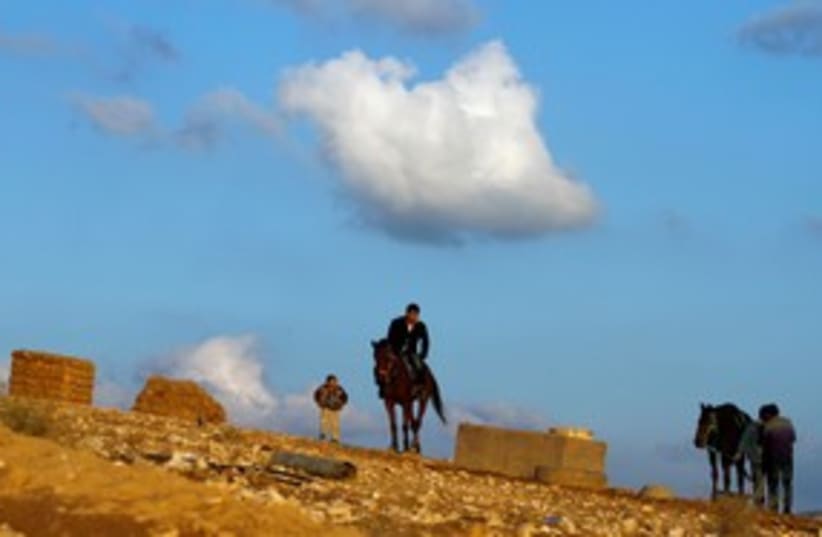
By DAVID NEWMANA Beduin man rides a horse in al-Arakib 311 (R)(photo credit: REUTERS/Amir Cohen)
Passing the Shoket Junction as one drives north from Beersheba towards Meitar and the West Bank, an isolated building stands out to the left. Surrounded by empty fields and scattered Beduin residences, the building is noteworthy for the fact that it doesn’t seem to belong to anything. Near the building is a parking area for large tractors and earth-moving machines, which are preparing the infrastructure for the construction of the new community of Karmit. In its first stages it is planned to house 500 families in detached residences. But the construction of the first house has not yet started, nor has the registration process for families interested in purchasing a land plot and building their house.A large sign at the entrance to the dirt road leading to the site shows that the new building, complete with doors, windows and tiled floors, is – or will be – the community synagogue, in what is planned to be a mixed (normal) religious – secular community. A donor from North America put up the money some years ago, so they went ahead and constructed the building in its entirety, despite the fact that the first families will probably not be here for another three to four years at the earliest, by which time it is difficult to know what state the unused building will be in. For now, its nearest neighbors are scattered Beduin houses and shacks, which dot the landscape between the two large Beduin communities of Lakiya and Horah.Karmit is one of a series of communities which are being planned for the Negev over the next decade. A renewed emphasis to bring residents to this region is under way. As the center of the country becomes ever more densely populated and expensive, land prices in the South and the opportunity to build relatively large detached houses becomes a more attractive proposition, especially for younger couples trying to get their first entry into the housing market. The completion of the improvements to the rail line from Tel Aviv to Beersheba, enabling the journey to be completed in 50 minutes, along with the extension of the Trans-Israel highway from its present point at Maahaz, further south to Lehavim and eventually to the Shoket junction, will make the region more accessible, cutting the journey time for commuters to Tel Aviv to manageable proportions – and there are many who already make this trek on a daily basis.The planned transfer of the army bases and their personnel from the center of the country to the Negev is expected to impact the development of the region. Already, all of the region’s existing towns are competing for the expected population inflow, offering housing opportunities, an improved school and cultural infrastructure, in an attempt to attract what is perceived as being a potentially high quality population to their locations.But even though the government is committed to evacuating the valuable real estate of the army bases in the center of the country, there is no definite guarantee that this will bring the population in its wake, given the fact that the improved transportation links work in both directions, and ostensibly many of the senior army personnel could well decide to travel on a daily basis to Beersheba, or simply stay on the new army bases during the week and return to their homes for weekends. Much will depend on the real opportunities – education, cultural and employment – offered to their families who are not keen to relocate to the South.It is relatively easy to construct roads and houses in both existing and new communities. It is much more difficult to create real job opportunities, which will enable people to sink long-term roots in the Negev. This is as true for the spouses of army personnel as it is for the thousands of highly qualified university graduates who finish their studies every year at Ben-Gurion University of the Negev and then immediately leave the region for greener pastures in the center of the country. At yesterday’s graduation ceremony for BGU Humanities and Social Sciences students, almost the entire 2,000-plus degree recipients traveled to Beersheba for the occasion, having moved away from the city as soon as their studies had been completed a year ago.In the past, some businesses relocated to the South because of generous government subsidies towards their relocation costs, tax reductions and cheap land prices, but as soon as the period of benefits finished, they invariably moved back to the center of the country. The Omer Industrial region, next to Beersheba, offers some opportunities, while the university is in the process of setting up a hi-tech area adjacent to the university campus, but it remains to be seen whether any major companies will move there.In the past, the university created its own academic community, in Beersheba and in the suburban middle class communities of Omer, Meitar and Lehavim. The university still offers standing loans and participation in housing rental costs for a period of three years to all those new faculty who relocate to the Negev, but increasingly the academic faculty are choosing to remain in the Tel Aviv region and commute to the university, while carrying out much of their research on non-teaching days in the libraries of Tel Aviv or Jerusalem, rather than Beersheba. The university no longer insists on residence in the region as a precondition for tenure, given the fact that no workplace can dictate to its workers where they should live, as long as they fulfill the requirements of their jobs. Nor are they prepared to lose out on the recruitment of top scholars and scientists who have no interest in relocating to the South, for fear of losing them to other universities.Settling the country’s peripheral regions has never been easy. Both the Negev and the Galilee have benefitted from generous government investment ever since the establishment of the state, but the Israeli population has demonstrated its preference for the more expensive, more crowded center of the country because of the better culture, education and employment opportunities offered. It is just possible that if the army really does move South on the scale that is being promised, that this will bring a new era of development and prosperity to the region, if only because of the long-term spinoffs of the additional services which will be required for their spouses and children – but this has to take place within the civilian sector and benefit the entire population of the region, including the Beduin and the Jewish development towns, rather than be limited to exclusive gated communities of army personnel and their immediate families. Otherwise, once they finish their military service, they will simply pack up and return to the center of the country.For the time being, the newly completed synagogue building in Karmit remains lonely and unused. It is to be hoped that it will still be in usable condition by the time the first residents of Karmit move into their new homes in three to four years’ time. The grass of the Negev may not be as green as that of other regions, but then neither do the crowded conditions of the metropolitan region necessarily offer the best social or environmental conditions for starting a new life and bringing up a young family. The writer is dean of the faculty of Humanities and Social Sciences at Ben-Gurion University, the views expressed are his alone.
if(catID != 151){
var cont = `Take Israel home with the new Jerusalem Post Store