It says a lot about Obama, that eight months after the first rebellion broke in Tunisia, his sole Middle East policy involves attacking Israel.
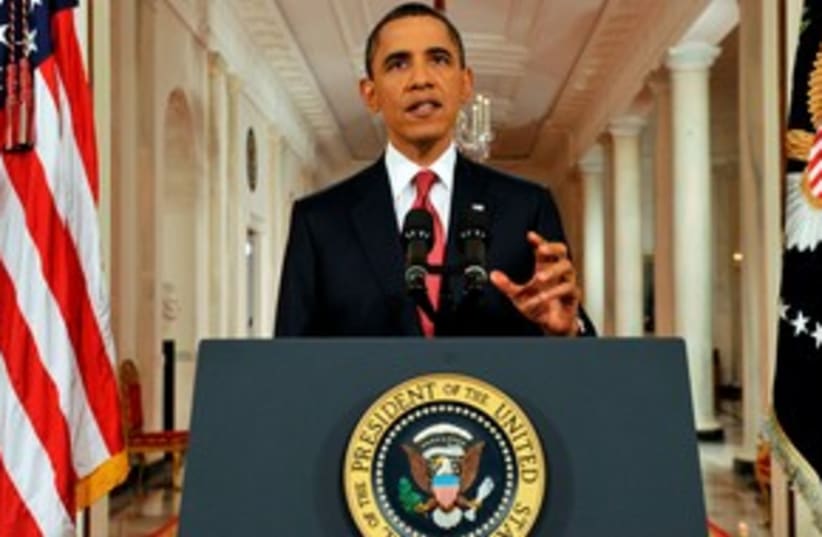
By CAROLINE B. GLICKObama White House speech 311(photo credit: REUTERS/Jim Watson/Pool)
Prime Minister Binyamin Netanyahu has explained repeatedly over the years that Israel has no Palestinian partner to negotiate with. So news reports this week that Netanyahu agreed that the 1949 armistice lines, (commonly misrepresented as the 1967 borders), will be mentioned in terms of reference for future negotiations with the Palestinian Authority seemed to come out of nowhere.Israel has no one to negotiate with because the Palestinians reject Israel’s right to exist. This much was made clear yet again last month when senior PA “negotiator” Nabil Sha’ath said in an interview with Arabic News Broadcast, “The story of ‘two states for two peoples’ means that there will be a Jewish people over there and a Palestinian people here. We will never accept this.”Given the Palestinians’ position, it is obvious that Netanyahu is right. There is absolutely no chance whatsoever that Israel and the PA will reach any peace deal in the foreseeable future.Add to this the fact that the Hamas terror group controls Gaza and will likely win any new Palestinian elections just as it won the last elections, and the entire exercise in finding the right formula for restarting negotiations is exposed as a complete farce.So why is Israel engaging in these discussions? The only logical answer is to placate US President Barack Obama.For the past several months, most observers have been operating under the assumption that Obama will use the US’s veto at the Security Council to defeat the Palestinians’ bid next month to receive UN membership as independent Palestine. But the fact of the matter is that no senior administration official has stated unequivocally, on record, that the US will veto a Security Council resolution recommending UN membership for Palestine.Given congressional and public support for Israel, it is likely that at the end of the day, Obama will veto such a resolution. But the fact that the president has abstained to date from stating openly that he will veto it makes clear that Obama expects Israel to “earn” a US veto by bowing to his demands.These demands include abandoning Israel’s position that it must retain defensible borders in any peace deal with the Palestinians. Since defensible borders require Israel to retain control over the Jordan Valley and the Samarian hills, there is no way to accept the 1949 armistice lines as a basis for negotiations without surrendering defensible borders.Say what you will about Obama’s policy, at least it’s a policy. Obama uses US power and leverage against Israel to force Israel to bow to his will.What makes Obama’s Israel policy notable is not simply that it involves betraying the US’s most steadfast ally in the Middle East. After all, since taking office Obama has made a habit of betraying US allies.Obama’s Israel policy is notable because it is a policy. Obama has a clear, consistent goal of cutting Israel down to size. Since assuming office, Obama has taken concrete steps to achieve this aim.And those steps have achieved results. Obama forced Netanyahu to make Palestinian statehood an Israeli policy goal. He coerced Netanyahu into temporarily abrogating Jewish property rights in Jerusalem, Judea and Samaria. And now he is forcing Netanyahu to pretend the 1949 armistice lines are something Israel can accept.Obama has not adopted a similarly clear, consistent policy towards any other nation in the region. In Egypt, Syria, Iran, Turkey, Libya and beyond, Obama has opted for attitude over policy.He has postured, preened, protested and pronounced on all the issues of the day.But he has not made policy. And as a consequence, for better or for worse, he has transformed the US from a regional leader into a regional follower while empowering actors whose aims are not consonant with US interests.SYRIA IS case and point. President Bashar Assad is the Iranian mullahs’ lapdog. He is also a major sponsor of terrorism. In the decade since he succeeded his father, Assad Jr. has trained terrorists who have killed US forces in Iraq. He has provided a safe haven for al-Qaida terrorists. He has strengthened Syrian ties to Hezbollah. He has hosted Hamas, Islamic Jihad and other Palestinian terror factions. He has proliferated nuclear weapons. He reputedly ordered the assassination of former Lebanese prime minister Rafik Hariri.Since March, Assad has been waging war against his fellow Syrians. By the end of this week, with his invasion of Hama, the civilian death toll will certainly top 2,000.And how has Obama responded? He upgraded his protestations of displeasure with Assad from “unacceptable” to “appalling.” In the face of Assad’s invasion of Hama, rather than construct a policy for overthrowing this murderous US enemy, the Obama administration has constructed excuses for doing nothing. Administration officials, including Obama’s ambassador to Damascus, Robert Ford, are claiming that the US has little leverage over Assad.But this is ridiculous. Many in Congress and beyond are demanding that Obama withdraw Ford from Damascus. Some are calling for sanctions against Syria’s energy sector. These steps may or may not be effective. Openly supporting, financing and arming Assad’s political opponents would certainly be effective.Many claim that the most powerful group opposing Assad is the Muslim Brotherhood.And there is probably some truth to that. At a minimum, the Brotherhood’s strength has been tremendously augmented in recent months by Turkey.Some have applauded the fact that Turkey has filled the leadership vacuum left by the Obama administration. They argue that Turkish Prime Minister Recip Erdogan can be trusted to ensure that Syria doesn’t descend into a civil war.What these observers fail to recognize is that Erdogan’s interests in a post-Assad Syria have little in common with US interests. Erdogan will seek to ensure the continued disenfranchisement of Syria’s Kurdish minority. And he will work towards the Islamification of Syria through the Muslim Brotherhood.Today there is a coalition of Syrian opposition figures that include all ethnic groups in the country.Their representatives have been banging the doors of the corridors of power in Washington and beyond. Yet the same Western leaders who were so eager to recognize the Libyan opposition despite the presence of al-Qaida terrorists in the opposition tent have refused to publicly embrace Syrian regime opponents that seek a democratic, federal Syria that will live at peace with Israel and embrace liberal policies.This week, US Secretary of State Hillary Clinton held a private meeting with these brave democrats.Why didn’t she hold a public meeting? Why hasn’t Obama welcomed them to the White House? By refusing to embrace liberal, multi-ethnic regime opponents, the administration is all but ensuring the success of the Turkish bid to install the Muslim Brotherhood in power if Assad is overthrown.But then, embracing pro-Western Syrians would involve taking a stand and, in so doing, adopting a policy. And that is something the posturing president will not do. Obama is much happier pretending that empty statements from the UN Security Council amount to US “victories.” If he aims any lower his head will hit the floor.OBAMA’S PREFERENCE for posture over policy is nothing new. It has been his standard operating procedure throughout the region. When the Iranian people rose up against their regime in June 2009 in the Green Revolution, Obama stood on the sidelines. As is his habit, he acted as though the job of the US president is to opine rather than to lead. Then he sniffed that it wasn’t nice at all that the regime was mowing down pro-democracy protesters in the streets of Tehran and beyond.And ever since, Obama has remained on the sidelines as the mullahs took over Lebanon, build operational bases in Latin America, sprint to the nuclear finishing line, and consolidate their power in Iraq and Afghanistan.On Wednesday, the show trial began for longtime US ally former Egyptian president Hosni Mubarak and his sons. During last winter’s popular uprising in Egypt, Obama’s foes attacked him for refusing to abandon Mubarak immediately.The reasons for maintaining US support for Mubarak were obvious: Mubarak had been the foundation of the US alliance structure with the Sunni Arab world for three decades. He had kept the peace with Israel. And his likely successor was the Muslim Brotherhood. But Obama didn’t respond to his critics with a defense of a coherent policy. Because his early refusal to betray Mubarak was not a policy. It was an attitude of cool detachment.When Obama saw that it was becoming politically costly to maintain his attitude of detachment, he replaced it with a new one of righteous rage. And so he withdrew US support for Mubarak without ever thinking through the consequences of his actions. And now it isn’t just Mubarak and his sons being humiliated in a cage. It is their legacy of alliance with America.Recognizing that Obama refuses to adopt or implement any policies on his own, Congress has tried to fill the gap. The House Foreign Affairs Committee recently passed a budget that would make US aid to Egypt, Lebanon, Yemen and the PA contingent on certification that no terrorist or extremist organization holds governmental power in these areas. Clinton issued a rapid rebuke of the House’s budget and insisted it was unacceptable.And this makes sense. Making US assistance to foreign countries contingent on assurances that the money won’t fund US enemies would be a policy. And Obama doesn’t make policy – except when it comes attacking to Israel.
In an interview with The New York Times on Thursday, Muammar Gaddafi’s son Saif al-Islam Gaddafi said he and his father are negotiating a deal that would combine their forces with Islamist forces and reestablish order in the country.To a degree, the US’s inability to overthrow Gaddafi – even by supporting an opposition coalition that includes al-Qaida – is the clearest proof that Obama has substituted attitude for policy everywhere except Israel.Acting under a UN Security Council resolution and armed with a self-righteous doctrine of “Responsibility to Protect,” Obama went to war against Gaddafi five months ago. But once the hard reality of war invaded his happy visions of Lone Rangers riding in on white stallions, Obama lost interest in Libya. He kept US forces in the battle, but gave them no clear goals to achieve.And so no goals have been achieved.Meanwhile, Gaddafi’s son feels free to meet the New York Times and mock America just by continuing to breathe in and out before the cameras as he sports a new Islamic beard and worry beads.If nothing else, the waves of chaos, war and revolution sweeping through Arab lands make clear that the Arab conflict with Israel is but a sideshow in the Arab experience of tyranny, fanaticism, hope and betrayal. So it says a lot about Obama, that eight months after the first rebellion broke in Tunisia, his sole Middle East policy involves attacking Israel.caroline@carolineglick.com
if(catID != 151){
var cont = `Take Israel home with the new Jerusalem Post Store