What the world fails to grasp is that the key to peace lies not in removing Jews from their homes, but rather in uprooting delusions of possible victory from the hearts of Palestinians.
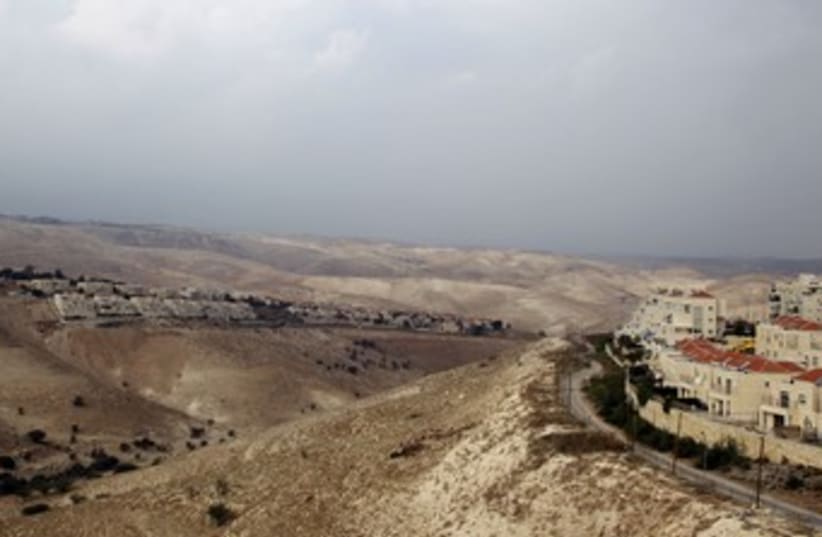
By MICHAEL FREUNDMaale Adumim 370(photo credit: REUTERS/Ammar Awad)
Even though Israel’s new coalition government has yet to be formed, international pressure is already starting to mount on the Jewish state to make concessions to the Palestinians.At a press conference last week with US Vice President Joe Biden, French President Francois Hollande went out of his way to stress that Europe will take steps to get Israel and the Palestinians back to the negotiating table.“Now that the elections in Israel are behind us,” Hollande told reporters, “we shall make sure that both the United States and Europe can support the revival of negotiations that can lead to a two-state solution.”Meanwhile, both US President Barack Obama and newly-appointed Secretary of State John Kerry are each reportedly planning to visit the region next month in what will surely be more than just courtesy calls. Obama and Kerry will undoubtedly be expecting Israel to make various “gestures” to the Palestinians as a sign of “good faith” in order to get the talks going again.And so, Israel will soon find itself confronting a renewed wave of insistence that it prove its commitment to peace by giving in to various Palestinian demands.What the international community, and even our allies, have clearly lost sight of is the very nature of the struggle in which Israel finds itself, one that pits us against a foe that is bent on our destruction.Despite 20 years of Israeli concessions since the 1993 Oslo accords, the Palestinians have utterly refused to forsake violence and intimidation, nor have they shown a willingness to make even minimal compromises in order to forge a final agreement.Put simply, this is not a battle over borders, but a clash of civilizations. It is an epic collision between good and evil, truth and falsehood, right and wrong.Indeed, this week provides a stark and painful reminder of just what type of foe Israel is up against.This coming Friday night marks the second anniversary on the Hebrew calendar of one of the most brutal Palestinian terror attacks in the region’s history. It was on the 6th of Adar two years ago that Amjad Awad and Hakim Awad, from the village of Awarta, stormed the nearby Jewish community of Itamar and proceeded to slaughter five members of the Fogel family in their home on the Sabbath.With chilling cruelty, the two perpetrators went from room to room, mercilessly slashing the throats of Ruth and Udi Fogel and three of their children: Yoav (11), Elad (4) and three-month-old Hadas.Subsequently, after their capture, the two terrorists expressed no remorse for their actions, saying that had they known that two other children had been sleeping in the Fogel home at the time, they would have murdered them as well.Many Palestinians reacted with sheer joy to news of the massacre, handing out sweets in the streets of Rafah to passersby as though their team had just won the World Cup. And a poll taken shortly afterwards found that a whopping 32 percent of Palestinians said they supported this despicable act of murder.The slaughter in Itamar, like the myriad bus bombings, rocket attacks and kidnapping of soldiers throughout the years, should serve as obvious reminders of the degeneracy of our foes. It says a lot about Palestinian society, and especially its leadership, that it countenanced such behavior and continues to laud the perpetrators of such terror as heroes.Clearly, these are not people with whom a lasting agreement can be forged, however much we or the international community might wish to believe otherwise.It is therefore time to drop the delusion that has underpinned the peace process all these years and admit the obvious: the Palestinians do not truly wish to live in peace with Israel. They have had ample opportunity to do so, but have rejected every offer, even the most generous, with nary a bit of compunction or regret.So when European or American leaders now push yet again for a two-state solution and denounce Jewish communities in Judea and Samaria as “illegitimate,” they are merely adding fuel to the fire.After all, if Jewish settlers are repeatedly labeled as “occupiers,” doesn’t that simply provide justification for those who wish to attack them?What the world fails to grasp is that the key to peace lies not in removing Jews from their homes, but rather in uprooting delusions of possible victory from the hearts of Palestinians. As long as they continue to think that the Jewish presence in the Middle East is temporary and that time and international backing is on their side, our foes will press forward with their aggressive intentions, employing violence and terror to achieve their goals.This type of malevolence cannot be negotiated with, nor can reason prevail over it. Confronted by such enmity, Israel does not dare to empower it still further by yielding to its demands. The evil we face must be opposed, not appeased.If only the world would at last open its eyes and see.
if(catID != 151){
var cont = `Take Israel home with the new Jerusalem Post Store