Deri was punished for crimes committed 20 years ago. Does this warrant his exclusion from public affairs for the rest of his life?
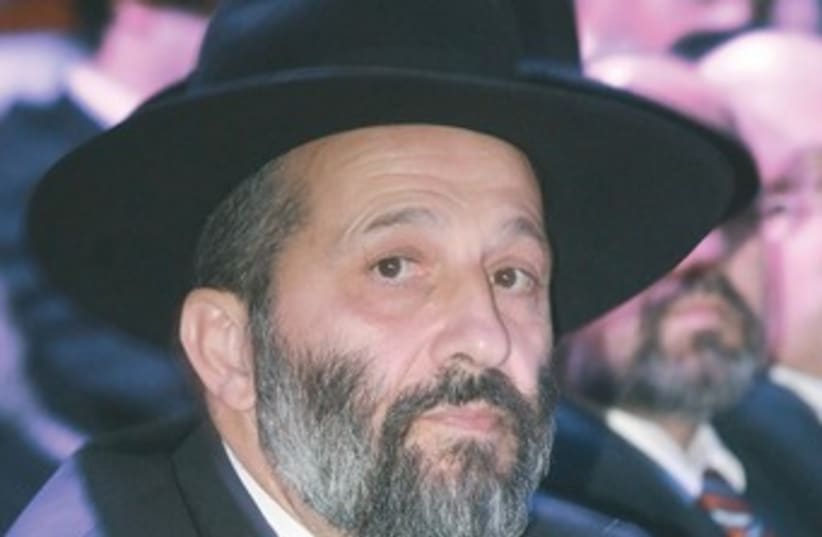
By YOSSI LEVYArye Deri 370(photo credit: Marc Israel Sellem/The Jerusalem Post)
Columnist Amotz Asa-El is troubled by Arye Deri’s return to public life, perceiving it as something dangerous.Why? Maybe because Deri, a thoughtful, intelligent man possessing wide experience and blessed with many talents, is a moderate who might serve as a bridge between Right and Left, moderate and extremist, religious and secular – a clear strategic threat to the country.Deri was punished for crimes committed 20 years ago. Does this warrant his exclusion from public affairs for the rest of his life? Asa-El might think so, but the court thought otherwise. Following lengthy deliberations and having weighed the various aspects of the case, the court ruled that after a set number of years had elapsed, he could again run for public office.There is no such thing as conditional democracy; you either accept it, with all its rules and regulations, even when it isn’t convenient to do so, or you reject it. Following the court’s ruling, it is the Israeli public alone which has the right to decide whether and in what capacity Deri is worthy to serve it again.Indeed, it appears this is precisely what Asa-El is afraid of. In a remarkable display of arrogance, he seeks to protect the Israeli public from itself by doing its thinking for it.It is also unclear why Asa-El found it necessary to bring up Deri’s Moroccan heritage – or, for that matter, Avigdor Liberman’s Russian heritage.From the Moroccans to the Russians, every wave of aliya has experienced discrimination, following in the footsteps of the Jews from Arab countries who, arriving in the 1950s shortly after the creation of the state, were diverted to the periphery of the country.Burying his head in the sand, Asa-El refuses to acknowledge the root of this phenomenon.Can he really argue that in the race of life, a child from Netivot or Karmiel and a child from north Tel Aviv or Herzliya start off on even footing? Even if the child from Netivot has a similar economic and educational background to his Herzliyan compatriot, everyone knows that he’s got a much longer road ahead of him.During the 13 years Deri was absent from public life, one might reasonably have expected Asa-El, and those like him, to have made some progress toward eliminating such disparities. But, lo and behold, they have only gotten worse.It’s no coincidence that Asa-El ignores Deri’s statements to the media, such as “poverty has no color and doesn’t wear a kippa” or that all the have-nots in the country deserve a “social safety net,” that this country is too small to suffer disparities so large.As a final note, Asa-El’s article was originally published in English in The Jerusalem Post Magazine 11 months ago. It has now been re-published in French, and it wouldn’t be surprising if, a few months down the road, he publishes a Chinese version.After all, that’s just the way creative people like him are.The writer is a strategic adviser to Arye Deri.Amotz Asa-El responds:Arye Deri’s moderation and abilities as a bridge-builder have sadly lost relevance since his conviction.As for the conviction, it is refreshing to see Mr. Deri’s adviser admit that his boss was “punished for crimes committed 20 years ago,” because Deri himself has never confessed his felonies. That undermines the very legal system that is the foundation of the democracy that Mr. Levy claims to hail.As for the court’s ruling, it was not that Deri should or should not be restored to the public sphere, because the court – rather than pass moral judgment – only interprets the law, which indeed allows Deri to run now. The moral judgment is left for us voters, and it was the voter whom I prodded in my column to vote for anyone other than a convicted felon.Concerning Deri’s geographic origin, it is he, not I, who makes it an issue, indeed an ideal, so much so that “Sephardi” is part of his ticket’s name, and Shas’s faction does not sport even one token Ashkenazi.Finally, Levy’s lamentation of the social state of the “periphery” would be more convincing had Shas’s schools equipped their students with the English, math, biology, history and the rest of the secular tools that are prerequisites for making it in today’s world.To best understand this, Levy and Deri should look to Israelis like Delek Chairman Yitzhak Tshuva, FIBI Holdings’ owner Tzadik Bino, insurance magnate Shlomo Eliyahu, supermarket entrepreneur Rami Levy, linguist Prof. Moshe Bar-Asher, historian David Ohana, economist Shlomo Maoz, actor Moshe Ivgi or novelist Amnon Shamush, to mention but a few of the countless self-made products of the Middle Eastern immigrations who made it big here thanks to the opportunities that veteran Israel offered them.Not one of these backs Shas, or sends his children to its schools. Why?
if(catID != 151){
var cont = `Take Israel home with the new Jerusalem Post Store