Berlin is no longer Jerusalem’s most dependable ally inside the EU, and Germans have grown increasingly disenchanted with Israeli policies.
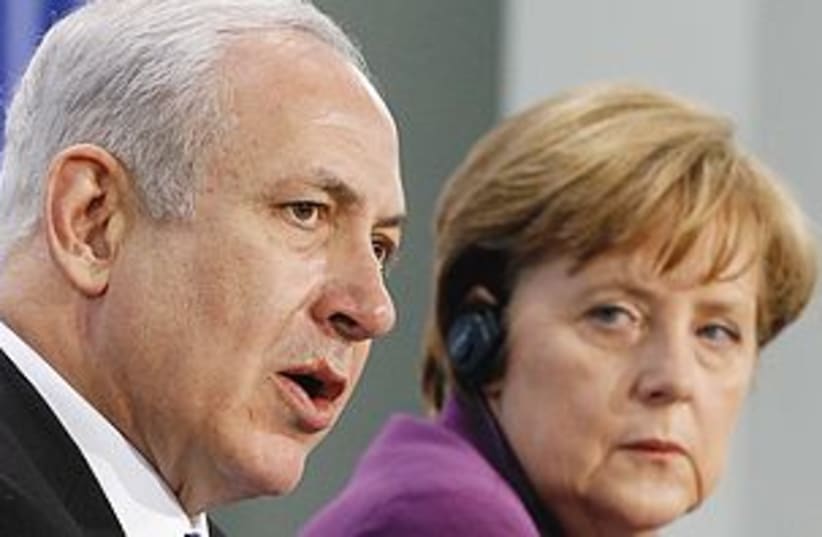
By ELLIOT JAGERNetanyahu Merkel 311(photo credit: REUTERS)
At a joint press conference in Berlin on April 7, Prime Minister Binyamin Netanyahu thanked German Chancellor Angela Merkel for the atmosphere of mutual trust and friendship in which their just-concluded talks had taken place. Germany, he averred, was “a great friend” of Israel.Yet any sober assessment of the Germany- Israel relationship would come to a different conclusion. Berlin is, in fact, no longer Jerusalem’s most dependable ally inside the European Union, and Germans have grown increasingly – sometimes, it seems, unreasonably – disenchanted with Israeli policies.As a German friend working in Israel recently told me: “We just don’t understand Israelis anymore.” That is quite evidently the case, at least to judge by the results of recent surveys registering the unshakeable German trust in a twostate solution and, by implication, in the good faith of Mahmoud Abbas.Indeed, Germany is Europe’s biggest financial backer of the Palestinian Authority. And since, for Germans, a solution to the Palestinian issue is practically a prerequisite for regional stability, they blame Israel, and definitely not the Palestinians, for the current diplomatic stalemate. Outrageously, 47.7 percent of Germans believe “Israel is conducting a war of extermination against the Palestinians.”In particular, Germans view Israel’s failure to capitulate completely on the issue of settlements as all but justifying Abbas’s intransigence. In February, Germany supported an Arabsponsored resolution in the UN Security Council demanding that Israel cease all “settlement activities in the occupied Palestinian territory,” including in metropolitan Jerusalem, and terming “illegal” any Jewish presence whatsoever anywhere over the Green Line. When Netanyahu telephoned Merkel to protest the German vote, she turned the tables by complaining that he had not followed through on a promised new peace overture.The fissures extend to just about every facet of Israeli behavior. In the Mavi Marmara affair, for example, the Bundestag unanimously blamed Israel and not Turkey for the violent Islamist radicals on board that ship. Then there is the matter of the current upheavals in the Arab world. Sitting next to Merkel at the press conference, Netanyahu said Israel wanted to see its neighbors move toward democracy.But, he added, “we can’t be sure” the transformations under way are indeed a harbinger of the positive change Europe experienced in 1989 or, rather, the sort of change that in 1979 left Iran a mullah-run autocracy. It is with this uncertainty in mind, he explained, that “we have to fashion our policies.”This attitude appears to infuriate many Germans. On the events in Egypt prior to the ouster of Mubarak, my German friend said Israelis ought to be cheering the protesters and trying to form positive relationships with this new generation of potential democratic leaders.Many of his countrymen seem to agree, viewing Israel’s caution, and its “obsession” with the Islamist menace, as cynical and counterproductive.To give Merkel her due, she did assure Netanyahu that Berlin would not agree to any unilateral recognition by the UN of a Palestinian state – a commitment that takes on added significance in light of Germany’s recent assumption of a two-year term on the Security Council. Even so, however, there are persistent reports that Germany, together with France and Britain, has been egging on the Quartet (the US, the UN, the EU and Russia – the foursome involved in mediating the “peace process” – toward imposing a solution on Israel. And this points to a difference between Merkel herself and others in Germany, including some within her own inner circle.On a visit to Israel in 2008, Merkel told the Knesset that Germany would “never abandon Israel,” and would “remain a loyal partner and friend.” At the April 7 press conference with Netanyahu, she also stated forthrightly that Iran’s nuclear program is “a greater threat now than ever before,” and that everything must be done to prevent the Islamic Republic from acquiring nuclear weapons. No less significantly, and alone among European leaders, she always makes a point of referring to Israel as “the Jewish state.” Politically, however, none of this wins her points at home. Sixtyfive years after the Holocaust, notions of Germany’s historic responsibility toward the Jewish people are mostly balanced by a combination of realpolitik and Euro-Left political culture.That, indeed, may be the context in which to understand Berlin’s four-billion annual trade with the same Iranian regime about whose intentions Merkel has warned in no uncertain terms.True, doing business with Iran is not illegal anywhere in the EU so long as it does not directly aid the mullahs’ quest for nuclear weapons.To Washington, the Hamburg-based European-Iranian Trade Bank is in fact a financial conduit for Iran’s nuclear proliferation. But Berlin professes to be unconvinced. Besides, Germans are big believers in engagement, and are prone to rationalize their behavior by arguing that punitive sanctions would mostly hurt innocent Iranians while paving the way for China and Russia to exploit the business vacuum created by Europe’s departure.Despite a sense of disillusionment that is increasingly mutual, it would be reckless to minimize Israel’s need for good relations with Germany – one of its most important trading partners and its largest in Europe. On the security front, moreover, Berlin has financed half the costs of three custom-designed, Dolphin-class submarines for the Israeli navy; two more are on order, and negotiations continue over the financial terms for a sixth.The subs are crucial to Israel’s strategic deterrence against Iran.The upshot? For now, and under this chancellor, the structure of the Germany- Israel partnership remains fairly solid even if, plainly, both the façade and some of the underpinnings show signs of crumbling.The writer is a former Jerusalem Post editorial page editor, and is now contributing editor to Jewish Ideas Daily (www.jewishideasdaily.com), where this article was first published and is reprinted with permission.
if(catID != 151){
var cont = `Take Israel home with the new Jerusalem Post Store