Anybody who doubts that Iran might use nuclear weapons if it means its own population could suffer as a result is ignoring the power of the martyrdom mentality.
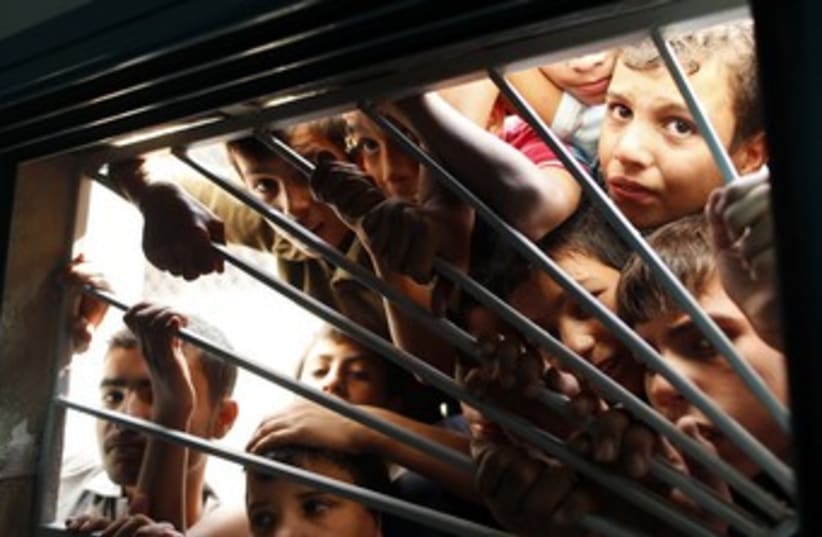
By LIAT COLLINSPalestinian boys look through morgue window 370(photo credit: Reuters/Mohammed Salem)
I pity future historians. I pity the truth. And I’m beginning to pity all of us. Never has so much information been available in wartime; never has it been so hard to sort out the information from the disinformation and outright lies. And, since I’m the sort of person who still prints out photos and sticks them in an album, I wonder how much of this virtual material, even the facts, will survive in the long term and how easy it will be to put it in context.Gone are the letters written to and from the front that provided almost a hint of romance to the historical record. An SMS with the words “Don’t worry” doesn’t do much even to calm the fears of the mother/wife/sibling or friend waiting on the home front, also under attack, and certainly doesn’t supply many clues for the researcher of the future.And then there is what’s known as the social media. I, too, have kept up with friends and family via Facebook during the past week or so of Operation Pillar of Defense (which I much prefer to think of by its Hebrew name, Pillar of Cloud).As a result, I have also been inundated by pictures purporting to be of innocent Palestinian victims of Israel’s latest campaign to stop the rocket attacks on its citizens. I have also been bombarded with the refutations. Some of the images have been so obviously stolen or staged that they had me humming the post-Six Day War song: “My daughter: Are you laughing or crying?” CNN’s Anderson Cooper, for example, apologized for screening footage of an ostensibly wounded Palestinian man who made a remarkable recovery as soon as he thought the cameras were no longer rolling. Elsewhere, footage that was supposed to show the Gaza coastline had the distinctive colors and style of an Agam painting – the exact same painting that decorates Tel Aviv’s Dan Hotel, to be precise. This was just another sign that truth was a casualty in the Hamas propaganda war; it was also an indication of what could have been had the Palestinians in Gaza decided to develop their tourism potential rather than terror, as I have noted before.Other photos supposedly coming out of Gaza were more shocking, not only for the amount of blood they showed, or for their audacity, but for what they symbolized. As The Jerusalem Post’s Lahav Harkov, among others, has pointed out, Izzadin Kassam tweeted a photo of a father weeping over the bloody body of his child, as doctors looked on. It didn’t take long for Twitter followers to point out that the photo was taken at the Dar al-Shifa Hospital in Aleppo, Syria, and originally came from a slideshow on the Guardian website. The lie might have been quickly exposed but the image itself has been immortalized in screencaps posted on Facebook and Twitter, another child victim to be used in the war against Israel.I couldn’t help but think of Muhammad al-Dura, probably the best-known Palestinian child martyr. The whole world remembers his story, how he was killed by gunfire at the start of the second intifada in September 2000. What most of the world doesn’t know (or certainly doesn’t remember) is that an IDF investigation found he could only have been shot by Palestinian fire, and a Paris appeals court backed the claim by Philippe Karsenty that France 2 had broadcast a staged report on the death of the 12- year-old.A particularly poignant picture posted by pro-Palestinian activists this week showed a baby, dazed and bloodied, being held in the hands of a rescue worker. Not a victim of an Israeli atrocity in Gaza, or even a recycled victim from the huge reserve of those affected by the civil war in Syria, the tiny child was wounded when a missile from Gaza hit a home in the Israeli town of Kiryat Malachi, resulting in the deaths of three people on November 15.Incidentally, “concerned readers” can stop sending me emails informing me that the Palestinian missiles are primitive and not loaded with warheads.Frankly, I don’t believe you (or the Palestinian missile launchers, more to the point).I am not immune to pictures of child victims. Friends, colleagues and readers around the world have called on me this week, as in Operation Cast Lead in 2008, to remember that the children in Gaza are suffering, too. They’re right. Israeli children (Arabs as well as Jews) are the victims of Hamas and the children in Gaza are no less so.And this is what makes the situation so depressing. The fact is Hamas and its supporters are looking for blood – and it doesn’t care whether it’s the blood of me and my countrymen or whether it’s the blood of its own martyrs. And if it doesn’t have enough blood to rally around, it will import some from Syria or even the Zionist state (perhaps the nearest it comes to admitting that we also bleed if you blow us up).I used to wonder how to say “chutzpah” in Arabic; now I think they need to come up with a word of their own – one that goes beyond Leo Rosten’s classic definition of a man who has killed his parents and then pleads for mercy in court on the grounds that he is an orphan.Terrorists like to spread terror – hence not only the missile fire but also the attacks like the Tel Aviv bus bombing on November 21. Anything is legitimate. As a Palestinian Media Watch report pointed out, on November 18 the Hamas-run Al-Aksa TV broadcast a message “From the Al- Qassam Brigades to the Zionist soldiers: The Al-Qassam Brigades love death more than you love life.”The death threats don’t scare me – they are an obvious means of psychological warfare: What scares me is the message behind the boasting; that our enemies really might love death more than the average traumatized Tel Avivian likes life in the cosmopolitan “city that never sleeps.”It should be pointed out – again and again, if necessary – that every single one of the thousands of missiles fired by the Palestinians on Israel for the past 12 years was by definition illegal. Every mortar and missile was launched indiscriminately at civilian populations, starting in the South and spreading further and further to the center of the country until Tel Aviv was targeted and even Jerusalem.That the Holy City could be an address for Palestinian missiles is telling in itself. It reveals a very different story from the Muslim narrative.And yes, I do feel sorry for the Palestinian whose olive groves were hit close to Bethlehem and Gush Etzion when a missile failed to make it to the Israeli capital. He, too, is a victim.I’m not scared of missiles and I’m not scared of terror attacks. I am scared, however, of the cult of martyrdom. In Arab and Muslim countries around the globe, children are being raised to revere death and blood. This should frighten not only Israelis, but the whole civilized world. Anybody who doubts that Iran might use nuclear weapons if it means its own population could suffer as a result is ignoring the power of the martyrdom mentality.Even as a cease-fire was announced, and the missiles continued to fall on the South, I – like most Israelis – realized that the war is not over. In the oft-quoted words of Golda Meir: “Peace will come when the Arabs will love their children more than they hate us.”That’s why the fake images of martyred children make my blood boil. It’s the only thing that stops it freezing in my veins.The writer is editor of The International Jerusalem Post.liat@jpost.com
if(catID != 151){
var cont = `Take Israel home with the new Jerusalem Post Store