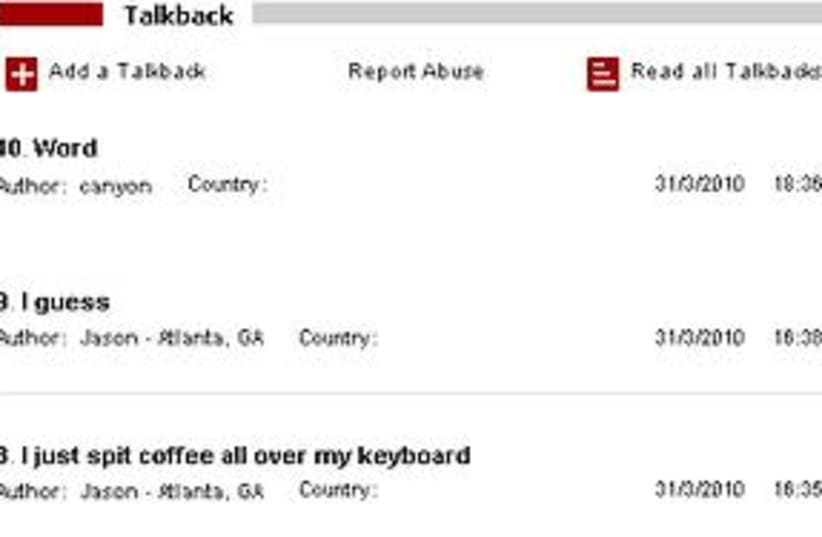
Talkbacks are a product of the age before newspapers knew what to do about the Internet.
By HIRSH GOODMANtalkbacks 311(photo credit: Screenshot)
There used to be “readers’ letters.” Now we have “talkbacks.” Readers’ letters are edited for content; the people writing them identify themselves and are accountable for what they say.In talkbacks, the writers are often anonymous, have few limits on what they write and can almost never be held accountable, no matter how terrible the slander they spew.Unlike readers’ letters, which land up neatly folded in the bird cage the next morning, talkbacks linger on forever in the electro-sphere, constantly coming back to haunt you, no matter how preposterous, ridiculous or slanderous, never to be eradicated no matter how hard one may try.Talkbacks are a product of the age before newspapers knew what to do about the Internet. The thinking was that one of the ways to create reader loyalty was to use the new medium to create a dialogue with readers and allow them to share their thoughts on subjects of relevance.What has been created, in fact, is a monstrous beast that allows people who call themselves “Toughjew” and “Spongwoggler” to respond with their crazy views to whatever one writes and, through the newspaper’s site, reach tens of thousands of people under the de facto legitimacy of the masthead that carries them.Thus, for example, the following comments posted on this newspaper’s site, living in perpetuity on the Internet, in response to a piece I wrote on the Lt.-Col. Shalom Eisner case last week, supporting his dismissal: “What uniform did Hirsch Goodman wear?” “How dare this moron attempt to lecture a true soldier like Col Eisner on how he should have conducted himself?” “On that day the JP became a credible newspaper. They miss him as much as I miss my piles which were surgically removed.” “sick, twisted biased opinion. Why are you still alive?” “You are guilty of all the aggression, vitriole, insults and pathetic drivel.” “Look in the mirror. Time to barf.”These are some of the more intelligent. But the point is that before talkbacks came along, at least there was some semblance of sanity to the responses to what is written in the paper and the paper seemed to exercise at least some modicum of control over what goes out in its name.An inviolate charter of journalism is respect for the power of the profession and the need to tread very carefully when dealing with someone’s name or reputation. Once tarred, no matter how many times cleansed, the stigma remains forever.Talkbacks that go out on newspapers’ websites make a mockery of that. They often make yellow journalism look pristine in comparison. So destructive have these become that Wikipedia now has an entry for the phenomenon called “flaming,” defined as “hostile and insulting interaction between internet users and the use of profanity.” Flaming has, in turn, given birth to “flamers,” who, we are told, “are specifically motivated to incite flaming,” while “trolls,” the lowest species on the flaming ladder, are defined as “less professional flamers.” All this is well and good and I have no problems with either new media or new phenomena, but when these, even by affiliation, go out in the name of branded titles we have a problem.Another casualty of all this is the seriousness of the subjects under debate. The chief of staff of the Israeli army decides to kick Eisner out of the ranks; I support the decision and, by implication, get called a Nazi and a sick, biased, pathetic, twisted moron by people who can’t even spell my name correctly.I WRITE this because two sirens have sounded over our country in recent days, one in memory of the Holocaust; the other in honor of the soldiers and victims of terror who have fallen so Israel can live.What has allowed this country to overcome, survive and thrive has been a basic decency in the way we overcome our differences and remain within normative parameters of discussion that make even heated debate palatable.These should not be thrown by the wayside just because technology allows it.Newspapers and responsible publications must find ways of extinguishing the flamers and stopping the trolls from showing their ugly faces. While it is true that no one is forced to read these diatribes, it makes a lot more sense not to provide them with a platform in the first place.This is not a call for censorship, nor am I saying it because I take issue with those who take issue with me. It is a call for responsibility and accountability and for the established media to apply the same criterion to the posts they publish in their electronic versions as they apply to good old readers’ letters in print. Otherwise we all risk being dragged down into the gutter.Israel’s democracy is the only key to its future. Tolerance and unity, without stymying diversity, are at the heart of democracy. It is when people start screaming “Nazi” at one another and calling them morons for agreeing with the chief of staff of the Israel Defense Forces that we should stop and think what type of flames we want to light this Independence Day.The writer is a senior research associate at the Institute for Strategic Studies at Tel Aviv University and an author. His most recent book The Anatomy of Israel’s Survival, won the 2011 National Jewish Book Award in the history category.
if(catID != 151){
var cont = `Take Israel home with the new Jerusalem Post Store