The world is numb listening to useless addresses in an organization that has become ineffective in dealing with today’s global challenges.
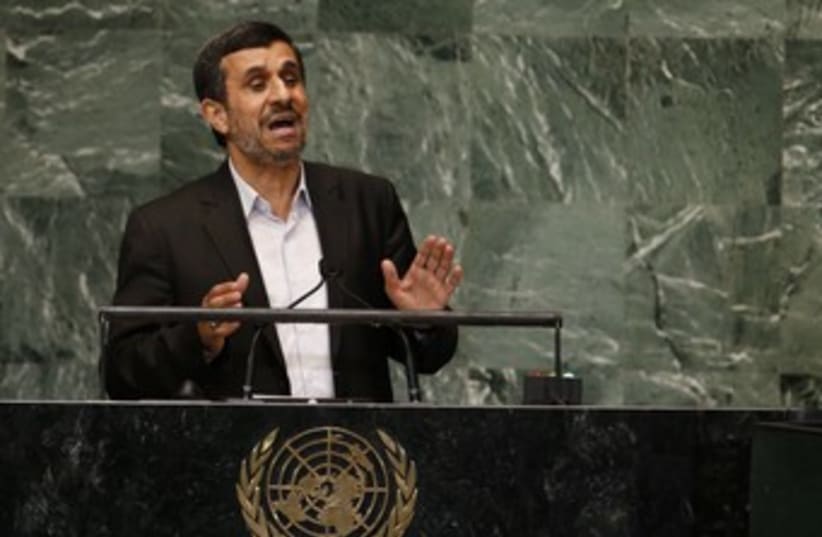
By URI SAVIRIranian President Mahmoud Ahmadinejad at UN 370 (R)(photo credit: Mike Segar / Reuters)
Watching the UN General Assembly this year made one wonder if the illustrious world organization should not be moved from the East River to Hollywood, as it is undoubtedly the “best show in town,” with almost 200 heads of state, prime ministers and foreign ministers mostly directing their bravado toward their domestic constituencies and the television cameras.The Oscar for the Best Actor would probably go to Mahmoud Ahmadinejad, as his act was closest to the somewhat ridiculous and dangerous man he is, speaking about freedom, human rights and peace without masking his Muslim fanaticism or revealing his nuclear and terroristic ambitions and Iran’s abuse of human rights and basic freedoms.The Oscar for the Best Actor in an Animated Feature would probably go to our own Binyamin Netanyahu with his simplistic live presentation – vintage Bibi.Barack Obama, the current and probably next president of the United States, was not convinced.There seem to be very few candidates for Best Actress as there are far too few female heads of state and government, not to speak of within the UN itself. Best Director would probably have to go to Ban Ki-moon, as he orchestrated the charade at the General Assembly – intelligent and polite, but yet he has done very little to reform this outdated organization.While this parade of endless speeches took place at the General Assembly, the world witnessed hundreds of innocent Syrians killed every day by the brutal Bashar regime, al-Qaida terrorism in Afghanistan and Libya, tension between China and Japan, a dangerous stalemate in the Middle East, a series of humanitarian crises all over the African continent with, for instance, thousands of Eritrean refugees tortured or killed in the Sinai Desert, human sex-trafficking, violent demonstrations in the Muslim world, and a breakdown of the Greek and Spanish economies.The world is numb listening to useless addresses in an organization that has become ineffective in dealing with today’s global challenges.The United Nations was created after World War II to replace the League of Nations as a reflection of a new post-war reality and a post-colonial world. The UN Charter puts at the forefront of the organization’s mandate peace, security and friendly relations among countries based on equality, respect of human rights and fundamental freedoms for all without distinction of race, sex, language or religion. The UN has clearly failed as conflict and wars continue and human rights are violently violated in virtually every corner of the world.This comes at a time when international collective action has become more important and urgent. Without collective multilateral efforts, there will be no solutions to most of the world’s conflicts and ailments, be they in Iran, Syria or Sudan, or in the reduction of poverty, hunger and disease so prevalent in Africa.However, while there is a desire for the leading world power – the United States under President Barack Obama – to act diplomatically through collective efforts, the UN is an inefficient vehicle. At best it represents the powers of the middle of the last century, with the predominance of the nation state and the supposed omnipotence of government.The world of 2012 is not that of 1945. The world is in many ways borderless when it comes to the movement of people, trade, money and the important interconnectivity between value- and interest- based communities, not necessarily countries. The forces of evil have also fundamentally changed – if after WWII, a country needed to be wealthy in resources, financial or natural, in today’s world the weaker and poorer parts of the chain of nations have become more dangerous. The acquisition or development of weapons of mass destruction is open to all including the poorest of states, such as North Korea and Iran, and in the near future probably to terrorist organizations such as al-Qaida. Opportunity and destruction are easier to come by – and both challenges can only be met by effective collective efforts.This is especially true at this moment in history when governments have become less relevant and governance more difficult. Economies are mostly run by the private sector, societies are moved increasingly by civil society, information is passed on by new media vehicles and security is, more than before, in the hands of individual groups.A fundamental reform of the international governing body, the UN, is therefore absolutely necessary.Such a reform, once attempted without success by Kofi Annan, should include the following elements:
The creation of a UN Parliamentary Assembly as a “lower house” parallel to the General Assembly as an “upper house.” A Parliamentary Assembly constituted by nongovernmental and youth organizations dedicated to social progress and peace building from all member countries and observers – this body to be selected by the existing and former secretary-general of the UN – an assembly for the “United People of the World” convening once a year and communicating on a special UN website.
A stronger and bigger US Secretariat that will have the authority to implement the necessary reform, including the modus operandi of the new Parliamentary Assembly, and its relationship to the General Assembly and to the specialized agencies. With the appointment of the next secretary-general, the person at the helm of the new United Nations should come with a background in the most pressing social and human rights issues, preferably a first-ever female secretary- general, such as Burma’s Aung San Suu Kyi.
Turning the Economic and Social Council of the UN (ECOSOC) into an important body parallel to the Security Council – also with 15 members of whom at least eight are from the developing world, and all 15 without veto power. This body would deal with socioeconomic development, humanitarian intervention, education, environment and human rights – all closely linked to world peace and development. The new ECOSOC should work closely with the World Bank and the International Monetary Fund. Private sector groups and foundations willing to contribute to development would be included as observers.
The establishment of two new specialized agencies – given that the central purpose of the United Nations is to promote peace, yet there are no specialized agencies which deal specifically with this:
A peace-building and security agency with a rapid intervention force, peacekeeping and peace-building forces and the mandate to initiate peace-building and reconciliation programs in post-conflict areas, thus contributing to the prevention of relapse and future conflict. This agency should be headed preferably by the main contributor to its activities, i.e. the United States.
A human rights agency charged with ongoing monitoring of human rights abuses in relation to the UN Charter, as fundamental human rights are at the basis of the principle of equality and therefore of peaceful coexistence – equality between genders, religions, cultures, races, nations and countries. The basic rights include food security, a clean environment, education, labor, respect for human dignity and self-determination, as well as the rights of children, of women, and of minorities. This agency should have a special global education and training program with respect to building a culture of human rights. The agency should work in conjunction with NGOs such as Amnesty International and youth organizations (as these rights are at the top of the agenda of young people all over the world). It should be headed by a representative of a country with an impressive experience on human rights such as South Africa or Norway.
Reform along these lines is necessary if the UN is to represent the world of the 22nd century, with the growing power of civil society institutions. Change is necessary if the UN wants to become more effective in a collaborative effort to tackle today’s complex and deep global problems, such as dealing with Syrian genocide, Iran’s nuclear ambitions, regional peace and security, poverty and economic development, abuse of human rights and international justice.As for Israel, we need to understand that the modern world will increasingly function through collective efforts, often led by the United States. We should be part of it, contribute to it, and isolate pariah states such as Iran and North Korea, rather than isolate ourselves.The writer is president of the Peres Center for Peace and served as Israel’s chief negotiator for the Oslo Accords.
Related TagsMahmoud Ahmadinejad
if(catID != 151){
var cont = `Take Israel home with the new Jerusalem Post Store