Savir's Corner: Gaza and the West Bank – Hamas and Fatah
It is high time for us in Israel to understand that military solutions to national conflicts are virtually impossible.
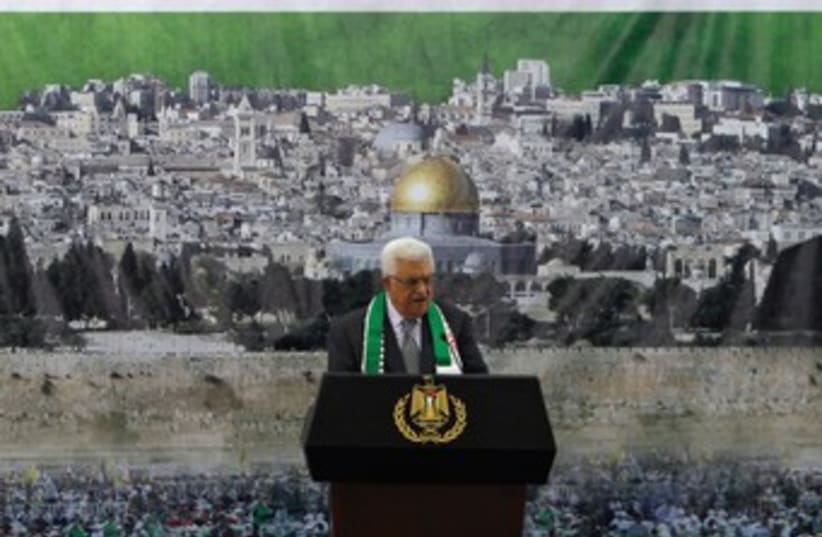
By URI SAVIRAbbas gives speech marking Yasser Arafat's death 370 (R)(photo credit: Mohamad Torokman/Reuters)
Wars between powerful and sophisticated armies and weaker militias or terror groups tend to begin in a similar way – surgical air strikes backed by excellent intelligence, creating a very short-lived sense of omnipotence of the mighty. They also tend to continue in similar ways – be it Israel in Lebanon or the United States in Afghanistan – the weaker sides are motivated and able to inflict harm on armies and civilian populations, turning the surgical attacks into a very messy war.Operation Pillar of Defense followed these patterns.Ahmed Jabari well deserved his fate, orchestrating the missile attacks on Israel’s southern population and turning Hamas into an organized terror army in the name of God. The missile attacks on southern Israel and the strengthening of Hamas, due to the stalemate in the peace process, gave our government little choice but to act against it. Yet both sides in this conflict have only tactical goals, and political ones, both lacking a strategic outlook or plan to serve their peoples’ real interests.Hamas, while a religious movement popular among the poorer and traditional parts of the Palestinian society, is a tragedy for Palestinians. It stands on ideology and practice against everything that would ensure the Palestinian peoples’ place under the sun. It is made up of fundamentalists without any respect whatsoever for human rights and democracy, not to mention gender equality.Ideologically motivated to eliminate Israel and overtaken by their hatred, Hamas committed a historical mistake by not using the 2005 Israeli total withdrawal to the 1967 lines and evacuation of all settlements from the Gaza Strip for peace and nation-building.Instead, Khaled Mashaal, Ismail Haniyeh, Ahmed Jabari and others opted for terrorizing southern Israel on an ongoing basis, convincing most Israelis to oppose a withdrawal from the West Bank, fearing a similar reaction there. They severely damaged the Palestinian cause in the West, weakening the perception of Abu Mazen (Mahmoud Abbas) as a Palestinian leader and potential peace partner; and even worse, they offered the 1.2 million Palestinians in Gaza only poverty and unemployment, turning Gaza into a quasi-Iranian enclave in the core of our region.While more Western and stable, during the same period (since the withdrawal from Gaza) Israel committed fundamental mistakes on the Palestinian issue, replacing a sound strategic policy approach with a narrow, tactical, short-term view seen through the lens of a gun barrel. The Palestinian conflict, of which Hamas is – to a large degree – a product, is not about military superiority as we see it. It is a historical struggle of two sides with legitimate claims to the same land which must be shared between them, with many political, religious, cultural and economic facets.What Israel needs is a historical compromise rather than a hysterical reaction: a two-state solution with true mutual recognition of two national movements, a reasonable peace border, security arrangements and economic cooperation. This demands, on both sides, real, courageous and unpopular decisions. The Gaza campaign draws us further away from that necessary historical and existential deal.The cease-fire will halt violence, probably for several months. The Palestinians in Gaza will be worse off than before without international support except for the Islamist Arabs, in the irresponsible hands of fanatic leadership, and enduring economic misery.Israel will perhaps enjoy a tactical achievement, some short-lived calm for the South, and the prime minister will have gained in election popularity; yet our public discourse will be limited to the military deterrence of the biggest and best army in the region, against a mediocre medium-size terror organization. Any necessary talk of historical compromise will be sidelined to the irrelevant Left, while all others dance to Bibi’s tune – something which did not escape the prime minister when he launched the operation.OUR ALL-IMPORTANT relationships with Egypt, Jordan and Turkey will be damaged as well as our regional posture, in the wake of a new Egypt-Turkey- Qatar-Hamas coalition, and yet after war there are always alternatives and new opportunities. Our eyes have to be set on the West Bank, not on Gaza. The West Bank cities have relatively developed economies, with a number of succeeding private sector companies, a stock market, a vibrant civil society, several universities, a more secular society as well as pragmatic leadership.Our strategic choice should be to strengthen the West Bank and the leading Fatah group. Instead, by defining Gaza and Hamas as the strategic threat to a powerful Israel, we are also, through this operation, strengthening Hamas in the eyes of the Palestinians and other Arabs whose leaders have become pilgrims to Gaza City.In the aftermath of the military confrontation, we have to shift focus and priorities; from Gaza to the West Bank, from Hamas to Fatah, from war to peacemaking.Abu Mazen, who is in not too splendid isolation – even in the Arab world – will turn at the end of the month to the United Nations General Assembly to ask, and receive by an enormous majority, a non-member state status based on all possible UN resolutions, even the one regarding the creation of a Jewish and Arab state, precisely 55 years after its original adoption.Not much will come out of it for the Palestinians – they will still be stateless and under occupation with settlements and roadblocks. Palestinian public opinion will initially applaud, but then will become disillusioned as the UN does not change realities in the Middle East. Therefore Abu Mazen, like us, is barking up the wrong tree. What can he do with the verbal support of about 135 states, from Micronesia to Indonesia? He must move back from the east river to the Middle East, i.e. to Israel, as it is only with us that he can forge the necessary historic compromise of a two-state solution.INDEED, IN the aftermath of the two unilateral acts – Israel in Gaza and the Palestinians in New York – we must turn to each other to truly resolve the problem.And if we need help internationally, as indeed we do, it’s not from the UN, but rather from the US.In the beginning of December, Israel and the PA should work with the administration of re-elected President Barack Obama on a roadmap for 2013 leading to real, strategic solutions for both sides.This understanding can be based on the Peres-Abu Ala agreement from Rome 2002, which became the basis of the American roadmap, and can be composed of the following elements:• Mutual recognition between the State of Israel and the (non-UN member) state of Palestine, without defining the border at this point.• An American letter to the parties stating that it encourages immediate direct negotiations between the two states, based on the Obama vision of 2011, i.e. with the border based on the pre-1967 lines with mutually agreed land swaps.• The strengthening of security and anti-terror cooperation while broadening Palestinian security authority in Area B, aiming, with permanent status, to dismantle all Palestinian militia and terror organizations.• Enhancing sound economic cooperation between the two states, also enabling a democratic institution-building process in Palestine and normalized relations between the two states and between them and the region.• A one-year (2013) direct-negotiation period based on the Obama vision on all permanent-status issues, followed by a three-year implementation period.With the sounds of cannons, fighter planes, missiles and sirens (even in Tel Aviv and Jerusalem) people tend to lean on their Pavlovian national instincts and pride. This may be good for the governments in Jerusalem and Gaza, but damaging for country and people.It is therefore high time for us in Israel to understand that military solutions to national conflicts are virtually impossible as national wills can not be defeated. The solution to our legitimate national security predicament, especially in the age of ballistic and terror warfare, is only of a political nature and through historical compromise with the political movement that represents the Palestinians – the PLO, headed by Abu Mazen.The alternative is a stronger Gaza, Hamas in the West Bank, more military operations in shorter intervals, leading us ultimately to a bi-national state. In this way, Operation Pillar of Defense, while in some ways understandable, will not in the long run be a pillar of our national security.The writer is president of the Peres Center for Peace and served as Israel’s chief negotiator for the Oslo Accords.
if(catID != 151){
var cont = `Take Israel home with the new Jerusalem Post Store