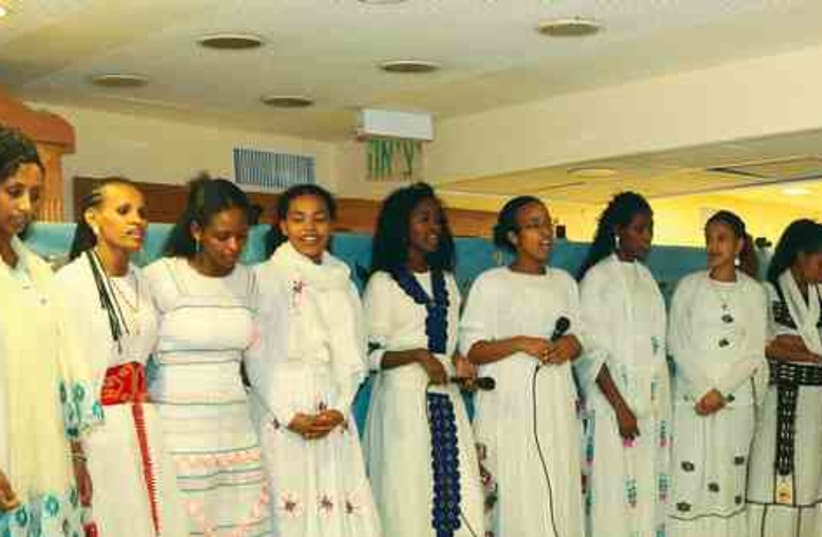
Nearly 200 women and men celebrate an Ethiopian festival for Nishmat’s Maayan Program.
By BARBARA SOFERSIGD NIGHT at Nishmat(photo credit: Courtesy)
‘What happens when you want to move a tree?” asks the stately young woman in the long white gown, reading to the audience from an oversized notebook marked “Sigd.”Let’s call her Adina – a name that works in both Hebrew and Amharic. Out of modesty and unease about media exposure, she prefers to use a pseudonym.“You can try to transplant the tree without the roots,” she says. “But if you take the trouble of digging out the roots, it will thrive in new surroundings.”This Ethiopian aphorism captures the theme of Sigd night at Nishmat, the Jeannie Schottenstein Center for Advanced Torah Study for Women in Jerusalem. Nishmat is renowned for enabling women to decode complex Jewish texts, a prerequisite for leadership in the religious community, and for the pioneering of women’s halachic advisers – yoetzot halacha – who run an authoritative hotline for women in matters of ritual purity.But tonight the tall books of Talmud are stored away.Nearly 200 women and men – students, teachers, volunteers, friends – led by Ethiopian-born students like Adina from Nishmat’s Maayan Program, are celebrating the Ethiopian festival. The usual photos of Sigd show Ethiopian patriarchs (kesim) in white robes, carrying umbrellas and staffs, praying on the hillsides of Jerusalem. Back in Ethiopia, Jews celebrated Sigd by fasting, dressing in festive white clothing and climbing to the highest nearby mountain peak where they reaffirmed their commitment to the observance of Judaism and their continued longing for Jerusalem through prayer and reading the Torah. Later, they returned to their villages for feasting and dancing. In 2008, the Knesset made Sigd an official holiday of the State of Israel.Adina has taken a rare day off from her intensive studies.She went to the ritual ceremony with her dormmates, Sabra Torah scholars and American gap-year students, and interpreted for them. And she and her 16 fellow Ethiopian-born first-year Maayan students have prepared the evening’s dramatic readings and the food.The menu includes miser wat (red lentils), dabo (bread) and stewed vegetables eaten with injera, the high-protein sour crepe that is the staple of the Ethiopian diet.Cooking is easy for them, she says. By age five, children in Ethiopia were already helping their mothers cook, draw water and craft pottery. School wasn’t an option. Adina also had a stint as a tiny shepherdess, but was relieved when her younger brother took over the family flock. The family eventually left its remote village for the pre-immigration camp in the city of Gondor, where she learned to read. Her family made aliya eight years ago and settled in Petah Tikva. She was 14, and in the following years she succeeded in graduating from high school and completing national service on time with her class. With the help of a program sponsored by Emunah, she completed her matriculation exams.THEN SHE heard about Nishmat’s Maayan Program from a recent graduate. The program provides personal tutoring and mentoring, coaching, life skills like timemanagement and Jewish studies to ambitious and gifted Ethiopian-born Jewish women. After students get into college, support continues until they graduate and join the workforce. Current students are enrolled in colleges and universities, majoring in education, nursing, social work, biotechnology and law. Adina wants to become a teacher. “I wanted the help getting into college, but what really appealed to me was to strengthen my Jewish background at the same time,” she says.The skits the students perform are mostly lighthearted – but not all of them are. One deals with the prohibition they maintained in Ethiopia not to marry anyone who was a family member for seven generations back. In Ethiopia they sought a match in a distant village, but in Israel marrying within their community and keeping the strict ruling is difficult. Learning to compromise and adapt – at least partially – to prevailing Israeli norms of Judaism is one example of the challenges they face creating a Judaism with which they are comfortable. They have been transplanted but not without roots.Many of the young women are already taking the lead in infusing their families’ homes with Judaism, says Nishmat founder and director Chana Henkin. “It’s not uncommon for students to come home on a Friday evening, make kiddush while the TV is turned on, eventually joined by one of their siblings,” she says. Unlike the Ethiopian immigrants who arrived decades ago on Operations Moses and Solomon, a large percentage of these immigrants are Falash Mura who were forcibly converted to Christianity in Ethiopia. Indeed, a number of the moms in the audience have crosses tattooed on their foreheads.The program wasn’t created to make the Ethiopian community more religious, though. Nor was it created out of hessed, a desire to act in lovingkindness for the needy. Henkin and the members of her staff speak in terms of acting out of social justice. Her eyes tear as she describes the high rates of school dropouts and poverty among Ethiopian immigrants. “I don’t want to see a black underclass developing in this society,” she says.“That offends my Torah values.”And so Nishmat founders and supporters respond by doing what they know and what they do best: empowering women who are seeking education to become leaders in their community. There are 43 sensational women in different stages of the program.An hour into the Sigd festivities, Adina and a coemcee announce that all the men and boys are invited to go upstairs to a Torah class. The rest of the evening is for women only. As the men and boys file out, the stage fills with young women. In this religious institution, women don’t sing or dance in front of men. The young women open with the soulful prayer recited on Rosh Hodesh (the first day of the new month) and holidays, where the phrase “remembrance of our ancestors” feels particularly poignant considering their background.Then the dancing begins. No tepid horas here. The students are dressed in long skirts and long sleeves, but their dance style is all esketsa, the Northern Ethiopian dance style built on impossible-to-imitate shoulder shaking and head joggling. Soon everyone is up and dancing. The music is an eclectic mix, from Israeli wedding music to Ethiopian pop, like Teddy Afro favorites.The dance floor is a mix, too. Moms dance with daughters.Teachers dance with students. American and Sabra students, their hair plaited by their roommates, are making a credible effort to loosen up their shoulders to get the shaking right. On the pulsing, joyful dance floor, Jewish educator Chana Henkin comes over to gently nudge a couple of visitors to join in. “This is Nishmat,” she says. “No wallflowers here.”The author is a Jerusalem writer who focuses on the wondrous stories of modern Israel. She serves as the Israel director of public relations for Hadassah, the Women’s Zionist Organization of America. The views in her columns are her own.
if(catID != 151){
var cont = `Take Israel home with the new Jerusalem Post Store