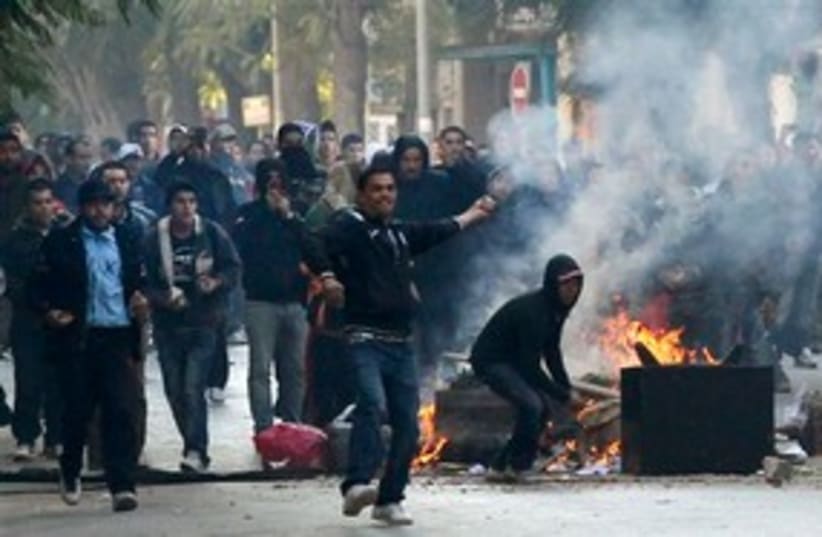
Recent events in Tunisia, Lebanon and Egypt spell a dangerous new trend in the region.
By BARRY RUBINTunisia Riots 311(photo credit: Associated Press)
There have been major developments in Tunisia, Lebanon and Egypt, each of which is of tremendous importance.In Tunisia, a popular uprising fueled by unemployment, economic suffering and long-term discontent has overthrown the dictator, but not necessarily the dictatorship. In 55 years of independence, the country has been governed by two dictators, the current one being Zine al-Abedin Ben Ali, who has been president for 23 years and was a key power in the regime even before that.Is this going to spread? Does it mark some new phase in Arab politics? Probably not. Tunisia is a very distinctive country. It has been the most Europeanized state in the Arab world, due in part to the secular-oriented policies of the regimes. There has been an Islamist movement, but the regime has kept it weak, perhaps making Tunisia the Arabic-speaking state with the lowest proportional support for Islamism among its population.There have been economic riots in other countries over the years, especially in Algeria or, for example, against reductions in bread subsidies in Egypt.Notably, there was the Beirut Spring movement against Syrian control of the country. But in Tunisia the opponents’ lack of leadership and organization is likely to mean that the same elite and the army will remain in control of the country.Statist and dictatorial policies have led to serious limits on freedom throughout the Arabic-speaking world.Economic stagnation and lagging living standards are prevalent, except in those countries that have large oil and natural gas incomes and small populations.How have regimes kept control? Through giving rewards to supporters and punishing opponents, military and police power, redirecting hostility toward other targets (America, Israel, the West) and other means. While revolutionary Islamists have promoted rebellion, Arab nationalist regimes have opposed them with a wide arsenal of tactics. And the very fear of an Islamist transformation can also be a good tool in keeping the elite together and the masses in line.That system got too far out of balance in Tunisia.There is a chance of parallel developments elsewhere, but it is not likely. At any rate, this issue will have to be watched closely.IN LEBANON, Hizbullah ministers walked out of the government, bringing it down. Why? They didn’t have to do it since they have veto power and would have prevented the government from endorsing the international tribunal investigation that would point to Syria (and perhaps Hizbullah) as the source of terrorism in Lebanon, including the killing of former prime minister Rafik Hariri.Hizbullah doesn’t just want the government just to be silent on the tribunal, but to condemn the investigation explicitly. It wants to renegotiate the coalition agreement to give itself more power. And it timed it for the moment when the prime minister was meeting with US President Barack Obama to embarrass its opponents. In Middle East talk, that timing signals: Our enemies are American puppets.Finally, it is a message to America and the world: We – Iran, Syria and Hizbullah – are in control of Lebanon now, not you. There is no question that this assertion is true, yet US and Western policy is simply not adjusting to meet this situation.IN EGYPT, an extraordinarily important fatwa has been issued by Dr. Imad Mustafa, of al-Azhar University, the world’s most important Islamic university.He began by stating the well-known doctrine of “defensive jihad,” that is Muslims must go to war against infidels who attack them. Of course, the word “attack” is often spread rather thinly to justify aggression.But now Mustafa has publicly and explicitly come up with a new concept, one that up until now was supposedly restricted to groups like al-Qaida: “Then there is another type of fighting against the non- Muslims known as offensive jihad... which is to pursue the infidels into their own land without any aggression [on their part]...“Two schools [of Islamic jurisprudence] have ruled that offensive jihad is permissible in order to secure Islam’s border, to extend God’s religion to people in cases where the governments do not allow it, such as the Pharaoh did with the children of Israel, and to remove every religion but Islam from the Arabian peninsula.”What does it mean about extending “God’s religion,” i.e., Islam? On the surface, “where the governments do not allow it” and the reference to Pharaoh seem to imply the complete prohibition of Islam.But in the current context, this means that it is permissible to wage jihad against a country if anything “necessary” to Islam according to (hard-line) clerics’ interpretations is blocked (polygamy, child marriage, special privileges at work places, building mosques anywhere, permitting the wearing of head scarves or burkas).In practice, according to this doctrine, then, any non-Muslim can be attacked anywhere. Thus, mainstream, powerful clerics are now calling for a seventhcentury- style jihad against non-Muslim lands even if the victims cannot be accused of attacking Muslimruled lands. Merely to “extend God’s religion” to others is a sufficient motive. Mustafa says that two of Islam’s main schools have always endorsed offensive jihad, but I doubt if he would have made that argument ten or 20 years ago.Of course, that doesn’t mean most Muslims will accept this new stance. But it does mean that radical groups now have mainstream support for their most extreme, aggressive behavior. Even if nobody repeats Mustafa’s statement publicly – if for no other reasons than it is bad public relations in the West – this idea will be more and more taken for granted. Presumably, Mustafa won’t be forced to retract this fatwa by his colleagues or Egypt’s government.Moreover, we probably won’t see senior clerics denouncing and rejecting the doctrine of offensive jihad.This is a development of stupendous proportions that will probably not be covered in the Western mass media. If this viewpoint continues to spread, along with the growing al-Qaida type doctrine of the Muslim Brotherhood, it could be a historical turning point that will greatly intensify revolutionary Islamist terrorism and attacks on the West.The writer is director of the Global Research in International Affairs Center and editor of Middle East Review of International Affairs Journal and Turkish Studies. He blogs at www.rubinreports.blogspot.com
if(catID != 151){
var cont = `Take Israel home with the new Jerusalem Post Store