Do radical ideological movements say things in their campaigns to gain power, including election campaigns, which disappear due to the pragmatism forced by the need to govern?
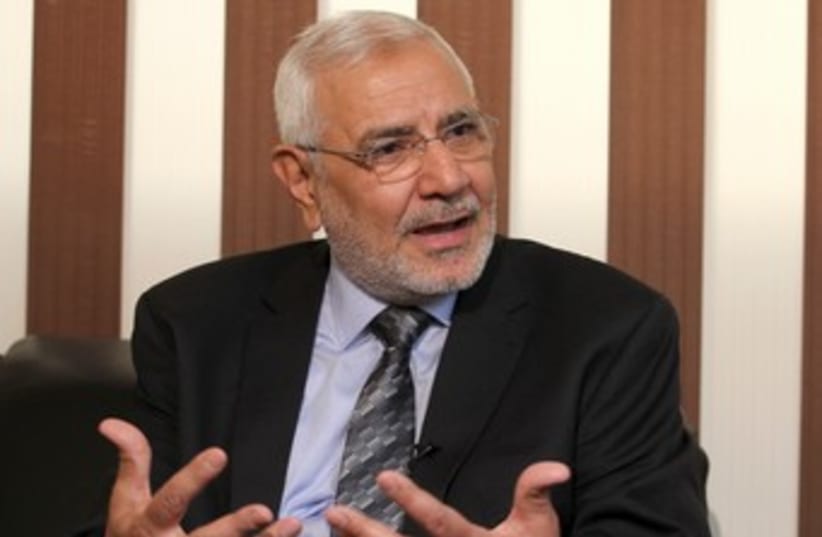
By BARRY RUBINAbdel Moneim Abol Fotouh 370(photo credit: REUTERS)
If I’ve ever seen a sentence that spells disaster in the Middle East it’s this one: “‘People say things in a campaign and then when they get elected they actually have to govern,’ [US State Department] spokeswoman Victoria Nuland said.”The specific context of this statement were remarks by the Obama administration’s favorite Egyptian presidential candidate, Abdel Moneim Aboul Fotouh, in a debate. He called Israel racist, an enemy of Egypt, and a state based on occupation (that is, which has no right to exist), then calling to alter the Egypt-Israel peace treaty.Pay no attention to the man in front of the curtain, says Nuland, he doesn’t really mean it. The problem with this, like hundreds of other statements by the currently dominant worldview in the West is that almost nobody is around in the mainstream media or academia to say: Wait a minute!In fact, I can make a very strong counter-argument that would persuade most people if they were allowed to hear it.So let us parse Nuland’s sentence, which does accurately reflect US foreign policy today, and is indeed a death or prison sentence for many people in the Middle East.Nothing is easier, of course, than finding examples of politicians who did not keep their election promises. But that’s not what we are dealing with here. No, the case here is: Do radical ideological movements say things in their campaigns to gain power, including election campaigns, which disappear due to the pragmatism forced by the need to govern?Examples, please?I’ve heard this argument before, most notably in 1978- 1979, when the Islamist revolution came to Iran. The Islamists have won every election since and have not been moderated by the need to govern. On the contrary, they have used their extremism to continue to govern.“The depiction of Khomeini as fanatical, reactionary and the bearer of crude prejudices seems certainly and happily false.... To suppose that Ayatollah Khomeini is dissembling seems almost beyond belief... Having created a new model of popular revolution based, for the most part, on nonviolent tactics, Iran may yet provide us with a desperately-needed model of humane governance for a third-world country.”It is only poetic injustice that Richard Falk, a man who totally misjudged the Iranian radical threat, has now been made by the UN the judge of Israel, which is facing that same threat.The same kind of thing was said throughout the 1990s. Yasser Arafat will be moderated by having to pave roads and collect the garbage. Power is inevitably moderating and ideology is meaningless.This is not true, and history shows it isn’t true.Were the Communists moderated by being in power? Well not in the USSR (maybe a bit after 70 years). And not in China (well, yes, more than a bit, after only about a half-century). We’re still waiting for Cuba and North Korea, both between five and six decades old. Add in such examples as the Taliban in Afghanistan, the Ba’ath Party in Syria or Iraq, and Hamas in the Gaza Strip.It is important to understand why this isn’t true. There are some dangerously false assumptions in Nuland’s simple sentence.She is assuming that radical movements are saying things to please voters in the same way that American politicians do. But American politicians are overwhelmingly unideological. Deep down, few of them think that ideas matter. But what if they sincerely and passionately believed that every plank on their platform was ordered by the supreme being and that this was in fact the only reason their political party existed?Suppose their rivals were willing and able to destroy their careers or even kill them if they showed they were totally phony in their devotion?Suppose a large portion of the masses took all of this seriously and meant to hold them to their promises? And suppose they truly believed themselves that instituting Shari’a law – perhaps at most with a slightly more liberal interpretation here and a few exceptions there – was the only way to govern?In other words, there are lots of reasons for radicals to remain radicals in government. And, after all, that is what usually happens.But that’s not all, by a long shot. What happens when those who actually have to govern fail to make things better and to satisfy the masses’ aspirations? Then they really need those things said in the campaign: the demagoguery, scapegoating, and impossible demands.At this point, these kinds of things aren’t just forgotten promises, they are magical solutions that are vital for governance! Instead of falling or facing serious internal conflict due to failure, the regime puts itself at the head of the masses marching against evil foreign enemies onto whom it puts the blame for these failures.Let’s suppose that Egypt elects a “moderate Islamist” as president. Will he call out the army to suppress his Salafist voters when they burn down a church, assassinate a secularist, or help Hamas attack Israel and set off a war? Does the fact that this person would not have a single reliable vote in parliament affect things at all?What do these wishful-thinking observers believe must happen to throw their views into question? Presumably Egyptian presidential candidates would have to come onto the stage drooling, wearing horns and a tail, and screaming, “Kill! Kill!”For example, from The New York Times, February 16, 1979, an op-ed by Richard Falk: “Meanwhile, back in Egypt, Aboul Fotouh is not the worst person who might be elected president and he probably would restrain to a small degree the speed of transformation to a radical Islamist regime.” But in an interview with an Egyptian station, Abul Fotouh has just said that he is against “terrorism” but Osama bin Laden was not a terrorist, that the United States only called him one in order to “hit Muslim interests,” and that the killing of bin Ladin was an “act of state terrorism.” In other words, he’s saying September 11 wasn’t an act of terrorism but that Obama’s policy is anti-Muslim and terrorist.The writer’s book, Israel: An Introduction, has just been published by Yale University Press. He is director of global research in the International Affairs (GLORIA) Center and a featured columnist at PJM and editor of The Middle East Review of International Affairs (MERIA) journal.
if(catID != 151){
var cont = `Take Israel home with the new Jerusalem Post Store