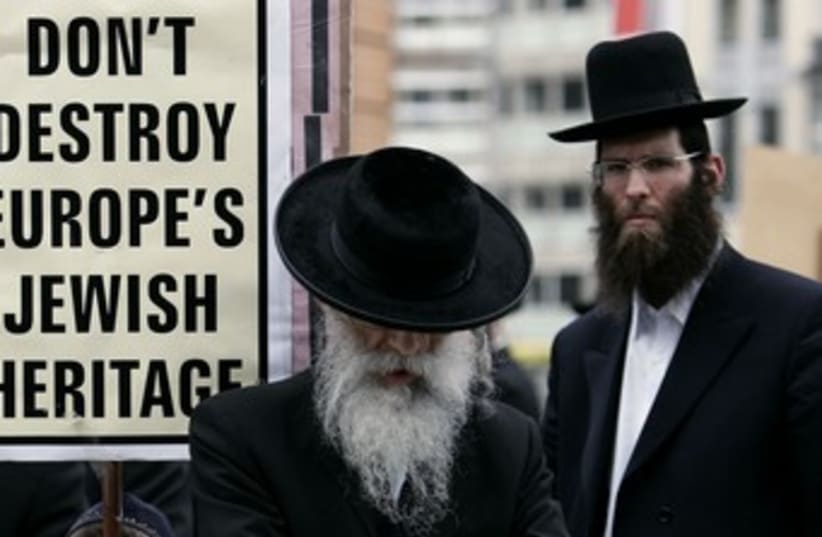
Guest columnist, Efraim Zuroff speaks about the uniquely extensive role played by Lithuanians in the mass murder of Jews.
By EFRAIM ZUROFFUpdated: AUGUST 20, 2017 19:32Lithuanian Jews(photo credit: Reuters)
After reading Lithuanian Prime Minister Andrius Kubilius’s answers to Michael Freund’s pointed and probing questions regarding Lithuanian-Jewish relations and the policies of the current Lithuanian government on a wide range of Holocaust related issues last week, it is not hard to understand why political leaders are often compared to used car salesmen. Both portray their mediocre merchandise in glowing terms with the aim of closing as many sales as possible.Thus Kubilius would have the readers of The Jerusalem Post believe that his country is honestly and successfully confronting its bloody past and that there are no serious problems between Jews and Lithuanians that a healthy dose of education and understanding cannot solve. If only that were the case.On the contrary, the descriptions offered by Kubilius in the interview are full of distortions and misrepresentations of the current situation, and if we add a pronounced tendency to evade giving any clear and unequivocal answers to difficult questions, we emerge with a “laundered” version of the reality that makes Lithuania appear to be a haven of flourishing contemporary Jewish life nurtured by a legendary past, with only a few unpleasant episodes continuing to cast shadows on the glorious present.For example, on the subject of local anti- Semitism, Kubilius claims that the government has always “very strongly and without any hesitation condemned all those acts of vandalism” – a patently false statement which does not reflect the reality in Lithuania of the past several years, during which the number of Jewish cemeteries, Holocaust memorials and even synagogues vandalized has risen at an alarming rate, with virtually no response from the government and nary a perpetrator caught and convicted.If we add the relatively recent (since 2008) phenomenon of neo-Nazi marches in Vilnius and Kaunas on Lithuanian independence days (two different dates are celebrated), which more and more people are attending each year, and which have never been condemned by the Kubilius government, it is obvious that there is no correlation between the ostensible current Lithuanian reality described by the prime minister and the discouraging situation faced on a daily basis by Lithuanian Jews.Kubilius’s tendency to whitewash serious problems in Lithuanian-Jewish relations is nowhere more blatant than in his comments relating to the two most serious issues affecting relations between Jews and Lithuanians, both in Lithuania and throughout the Diaspora.I am referring to the uniquely extensive role played by Lithuanians in the mass murder of Jews, both in Lithuania as well as outside its borders (in Poland end especially in Belarus), as well as to Lithuania’s recent efforts to promote the canard of equivalency between the Shoah and Communist crimes.As far as the former is concerned, one issue is the country’s failure to sufficiently acknowledge the highly critical role played by local Nazi collaborators in the annihilation of Lithuanian Jewry and to sufficiently incorporate that painful dimension of local Holocaust history in the school curriculum.Another is Lithuania’s total failure to punish any of the many local Nazi war criminals who should and could have been brought to justice in the country following the renewal of independence, and whose successful prosecution would not only have provided an excellent history lesson for Lithuanian society, but also would have contributed significantly to healing the wounds and promoting reconciliation.The second issue continues to be a source of constant friction between the two communities.Ever since the promulgation of the Prague Declaration of June 3, 2008, the manifesto of the double genocide movement, to the consternation of Jews the world over the Lithuanian government has actively promoted the equivalency canard and has worked very hard to encourage the adoption of resolutions in European forums which reflect a similar approach to the crimes committed by both the Nazi and Communist regimes.Thus, for example, the call to designate August 23 (the day of the signing in 1939 of the Molotov-Ribbentrop agreement) as a joint memorial day for all victims of totalitarian regimes, a date purposely chosen to imply that the Soviets bear equal guilt for the atrocities of World War II, and a step which would eventually make Holocaust memorial day redundant, clearly points to the determination to undermine the current status of the Shoah as an unprecedented and unique case of genocide.In Kubilius’s responses to Freund’s specific questions on these subjects, he repeatedly uses ambiguous phrases and euphemisms to circumvent the issues and remain true to his distorted Holocaust narrative. Regarding Lithuanian complicity in Holocaust crimes, which he admits is “painful,” Kubilius speaks of the participation of “some” Lithuanians, a neutral and in this context meaningless term which fails to reflect the historical reality and spares his countrymen an honest confrontation with their massive crimes against their Jewish fellow Lithuanian citizens during the Holocaust.In responding to the recent reinterment in Kaunas of the remains of Juozas Ambrazevicius, the prime minister of the provisional government established by Lithuanians in the wake of the German invasion, which fully supported the Nazis and actively participated in the persecution and murder of Jews, Kubilius claims that the government was not officially involved.This despite the fact that it financed the entire project, and then pontificated about the need for both sides to be open to the other side’s narrative, essentially a call for Jews to forgive the mass murder of their brethren, who were killed, according to the prime minister, by “naive, romantic people who were captured by historical circumstances and very complicated times when they were trying to achieve the independence of Lithuania.”He then added in the defense of these romantics that they later became the leaders of the anti-Nazi movement, which is basically a figment of Lithuanian fantasy and never, if it even existed, achieved any meaningful results.In response to the questions regarding the attempts to equate Communism and Nazism and the ultimate challenge of whether to categorize Lithuanians as victims or perpetrators, Kubilius resorts to the same kind of double-speak which seeks to satisfy both sides, but ultimately clearly reflects his allegiance to the double genocide theory and his obstinate refusal to admit the uniqueness of the Holocaust.Thus he begins by preaching against any attempt to compare the two tragedies, but then promptly reminds us that 14 million people were killed in “this area” during the mid-1930s to mid-1940s, and that “we, and Jewish people, of course, suffered the most terrible fate.”Adding insult to injury, Kubilius then concludes the “Jewish” part of the interview by juxtaposing the mass murder of Jews during the Holocaust with the largescale deportations of Lithuanians to Siberia.Kubilius notes with pride the success of the many Litvaks who have achieved prominence outside Lithuania, as if he can claim their achievements as part of Lithuania’s history, but as this interview clearly demonstrates, the prime minister’s understanding of history, particularly that of Lithuanian Jewry, leaves much to be desired. Dr. Efraim Zuroff is the chief Nazi-hunter of the Simon Wiesenthal Center and director of its Israel Office. His most recent book, Operation Last Chance; One Man’s Quest to Bring Nazi War Criminals to Justice (Palgrave/ Macmillan), deals extensively with Lithuania’s failure since independence to prosecute local Nazi war criminals. For more information: www.operationlastchance.org
if(catID != 151){
var cont = `Take Israel home with the new Jerusalem Post Store