Despite my warm words about Naftali Bennett, don’t get me wrong – there is no chance I will vote for him.
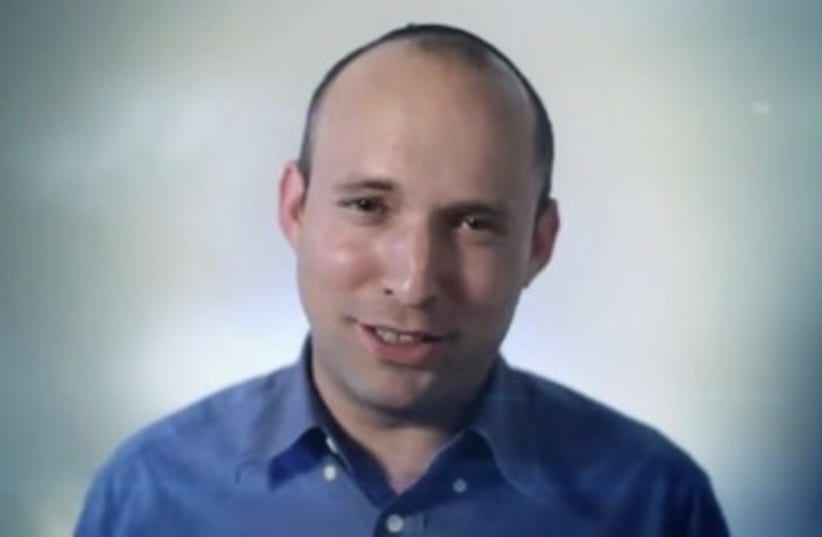
By SUSAN HATTIS ROLEFBayit Hayehudi's Naftali Bennett 390(photo credit: YouTube Screenshot)
On Thursday, December 20, the leader of the Bayit Yehudi (Jewish Home) party, Naftali Bennett, appeared on Nissim Mishal’s television interview program Mishal Cham on Channel 2.If anyone wishes to view the totally chaotic interviewing and debating culture of Israeli politicians, Mishal’s program is a perfect place to do so. For example, Yair Lapid and Aryeh Deri, who appeared on the show the week after Bennett’s performance, spent most of the time speaking simultaneously – not at the top of their voices, but nevertheless in a manner that made it impossible to hear exactly what each was trying to say.In the case of Bennett he was the sole interviewee, and the cacophony resulted from Mishal asking questions, Bennett dodging them, and Mishal trying (usually unsuccessfully) to get him back on track.It is strange that under the circumstances Bennett actually made what appeared to be a serious faux pas, and got all tangled up in an exchange with Mishal on the issue of refusal to obey orders in the army on ideological grounds.Viewing the interview several times on the Internet, I discovered that my first impression upon watching the program when first broadcast had been correct. When Bennett was asked by Mishal what he would do if ordered to remove Jewish settlers from their homes, Bennett (a Major in the reserves) actually answered that he would appeal to his commander to be absolved from carrying out the order (in later interviews he made it clear that he objects to throwing anyone out of his home – Arabs included).It was then that Mishal pounced, saying, “So you advocate disobedience!?” In response, Bennett forthrightly explained his ideological position, saying that he would prefer going to prison to carrying out such an order.The Likud, worried by the fact that the polls have been showing consistently that Likud-Beytenu is losing voters to Bayit Yehudi, reacted by embarking on a self-righteous anti-Bennett campaign.Of course ideological disobedience of any sort in the IDF is totally unacceptable, though to the best of my knowledge the IDF tries most of the time to reach some sort of accommodation with those who are not simply draft dodgers for selfish reasons, but rather persons with honest religious or ideological reservations, be they left-wingers, right-wingers, national religious, or haredim (ultra-Orthodox).Apparently the Likud screwed up on this point, largely because many of its own supporters, and of the right-wing parties in general, sympathize with Bennett’s position. Furthermore, I suspect that most of the candidates on the Likud-Beytenu list, if confronted with the same question as Bennett was, would have reacted exactly as he did, though probably less eloquently.How would the Likud-Beytenu leadership have reacted? Most likely the way they react every time Miri Regev (a former IDF spokesperson) or Danny Danon (the chairman of the World Likud) blurt out some outrageous pearl of wisdom. Nada. It’s all elections, stupid.Though I did not particularly like Bennett’s aggressive manner of speaking during his Mishal interview, and disagree with many of his positions, I must admit that if I were forced to choose between him and Netanyahu in elections (which, thank God, I am not) I would definitely choose him.The main reason is that I believe what he says, which is something I cannot say about Netanyahu.The second is that despite his extreme positions about the eventual annexation of the whole of the West Bank, and the insistence that Jordan is Palestine, he is not a xenophobe nor a racist a la Michael Ben-Ari (and by the look of it, Bennett’s list might actually manage to push the Otzma LeYisrael party below the qualifying threshold).Furthermore, Bennett appears to be truly sympathetic to the demands for social justice – including justice for Israel’s Arab citizens, and genuine in his wish to build bridges between the religious and the secular.My main problem with Bennett is that regarding political issues I am convinced that if he were prime minister he would lead Israel straight into a brick wall, while in Netanyahu’s case, since I do not really know how he thinks and what he believes, I can continue to delude myself that if pressed to the wall he will end up doing the right thing.Finally, in case someone feels that only Netanyahu, with his fluent English, can face the world in a language it understands, I recommend viewing a CNN broadcast from November 16, 2012, (during Israel’s Operation Pillar of Defense in Gaza) in which Bennett confronted one Ed (Mohamed Mahbub) Hussein – a senior fellow in the New York-based Council on Foreign Affairs.In Israel the confrontation was presented as between Bennett and a “Palestinian representative.”In fact, Ed Hussein was born in Britain to a Bangladeshi Muslim family, and the positions he expresses are liberal and Western rather than radical and Muslim.Be that as it may, Bennett’s appearance was exemplary – in fluent English, with the right balance between facts and emotions, and what is most important, without breaking into Hussein’s words, preferring to bite his lip and await his turn to speak, which just goes to show that unlike most Israeli politicians he is capable of holding a civilized debate.Despite my warm words about Naftali Bennett, don’t get me wrong – there is no chance I will vote for him.The writer is a former Knesset employee.
if(catID != 151){
var cont = `Take Israel home with the new Jerusalem Post Store